

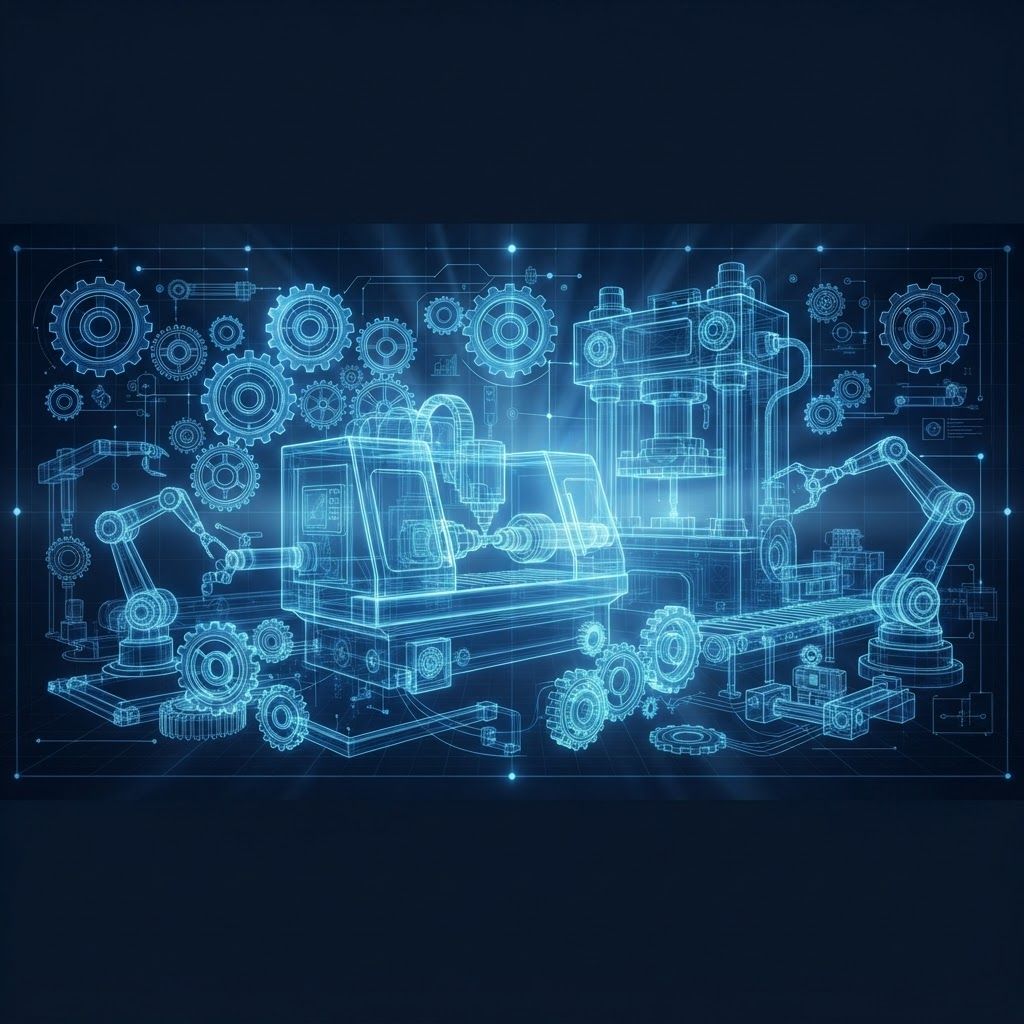
A City Built on Engineering
Gloucester's industrial identity was forged in heavy engineering. Railway carriage and wagon works, aircraft production, agricultural implement manufacture, and marine engineering on the docks all shaped the city's skills base across the nineteenth and twentieth centuries. While the specific industries have changed, the underlying capability in machining, fabrication, assembly, and mechanical design has endured and evolved.
Today the county supports machinery manufacturers producing everything from ultra-precise metrology instruments to agricultural equipment, packaging lines, process plant, and bespoke automation systems. What unites them is a focus on engineered solutions rather than commodity products.
Categories of Machinery Production
Several distinct segments operate in the region. Precision instruments and metrology equipment represent the highest value tier, demanding sub-micron accuracy and extensive research investment. Process and packaging machinery serves food production, pharmaceuticals, and consumer goods manufacturers.
Agricultural and land-based machinery reflects the rural economy surrounding the city, covering cultivation equipment, handling systems, and livestock infrastructure. Materials handling, including conveyors, lifting equipment, and warehouse automation, has grown with the logistics sector along the motorway corridor.
Bespoke special purpose machinery is perhaps the most characteristic local offering. These are one-off or small batch machines designed to perform a specific production task for a particular customer, combining mechanical design, electrical control, pneumatics or hydraulics, and software.
Leading Machinery Manufacturers Serving Gloucester
Renishaw is the outstanding name in the region, producing measurement probes, encoders, calibration systems, and metal additive manufacturing machines from its Gloucestershire facilities. Its combination of research intensity, precision manufacturing, and global reach makes it a genuine world leader.
Spirax Sarco, headquartered in Cheltenham, is a global leader in steam system engineering, producing valves, control systems, heat exchangers, and thermal energy equipment used in process industries worldwide.
Hydro Industries and Bowman Engineering style specialists serve water treatment and heat transfer applications. Mecmesin and similar instrument makers supply force and torque testing machinery used in quality laboratories.
Bosch Rexroth and Festo maintain United Kingdom operations supplying hydraulic, pneumatic, and automation components that regional machine builders integrate into their systems. Schneider Electric and Siemens provide the control platforms underpinning most modern machinery.
Hozelock, Dawson Group, and other regional manufacturers contribute to the wider mechanical products ecosystem. Locally, Gloucester's substantial base of subcontract machinists, fabricators, and toolmakers supplies components and assemblies to machine builders across the South West and Midlands.
Gloucestershire Engineering Training supports the sector by developing the apprentice workforce that machinery manufacturers depend upon, an often overlooked but genuinely critical institution.
Design and Engineering Capability
Modern machinery development is heavily digital. Three-dimensional computer aided design, finite element analysis for structural and thermal performance, kinematic simulation, and virtual commissioning of control software all shorten development cycles and reduce risk before metal is cut.
Digital twins, where a virtual model mirrors the physical machine, allow performance optimisation and predictive maintenance. For Gloucester manufacturers, offering these capabilities differentiates them from lower-cost competitors who supply hardware alone.
Automation and Robotics Integration
Demand for automation continues to rise, driven by labour availability, quality consistency, and cost pressure. Machine builders in the region increasingly integrate industrial robots, collaborative robots, vision systems, and automated inspection into their equipment.
Food and beverage production, a significant Gloucestershire sector, has been a particular growth area, with hygienic design requirements and rapid changeover capability shaping machinery specification. Warehouse and distribution automation has similarly expanded with the logistics presence along the M5.
Compliance and Safety Standards
Machinery supplied in the United Kingdom must meet the Supply of Machinery Safety Regulations, requiring risk assessment, appropriate guarding and safety systems, technical documentation, and conformity marking. Functional safety standards govern control systems performing safety functions.
Reputable manufacturers maintain rigorous documentation including risk assessments, safety integrity calculations, operation and maintenance manuals, and declarations of conformity. Buyers should verify this documentation exists and is complete, as responsibility for safe equipment extends to the user.
Aftercare and Lifecycle Support
Machinery is a long-term investment, frequently operating for decades. Service capability, spare parts availability, and upgrade paths matter as much as initial specification. Many Gloucester manufacturers derive substantial revenue from service contracts, remote diagnostics, refurbishment, and control system retrofits that extend the life of existing plant.
Remote monitoring has transformed this. Connected machines transmit performance and condition data, enabling predictive maintenance that prevents unplanned downtime, which is usually far more costly than the maintenance itself.
Energy Efficiency and Sustainability
Machinery buyers increasingly evaluate lifetime energy consumption alongside purchase price. Efficient motors, variable speed drives, regenerative systems, compressed air optimisation, and heat recovery all reduce operating cost and carbon footprint. Manufacturers able to quantify these benefits win specification advantages.
Selecting a Machinery Partner
Buyers should assess relevant sector experience, in-house design and control engineering capability, quality certification, references from comparable installations, and the strength of the aftersales organisation. Factory acceptance testing before delivery is standard practice and should be built into contracts.
Gloucester's machinery manufacturers offer a combination of engineering depth, responsiveness, and proximity that provides real practical advantages over distant suppliers, particularly when commissioning support and ongoing service are considered.
Want your brand featured in front of decision-makers? Publish a guest post or get a link insertion in our guides through AAMAX's guest post and link insertion service.
Helpful Links
 SponsoredAAMAX — Full-Service Digital Agency
Write for Us
Share your expertise with our readers. We welcome guest contributions from industry specialists.
Pitch your idea

