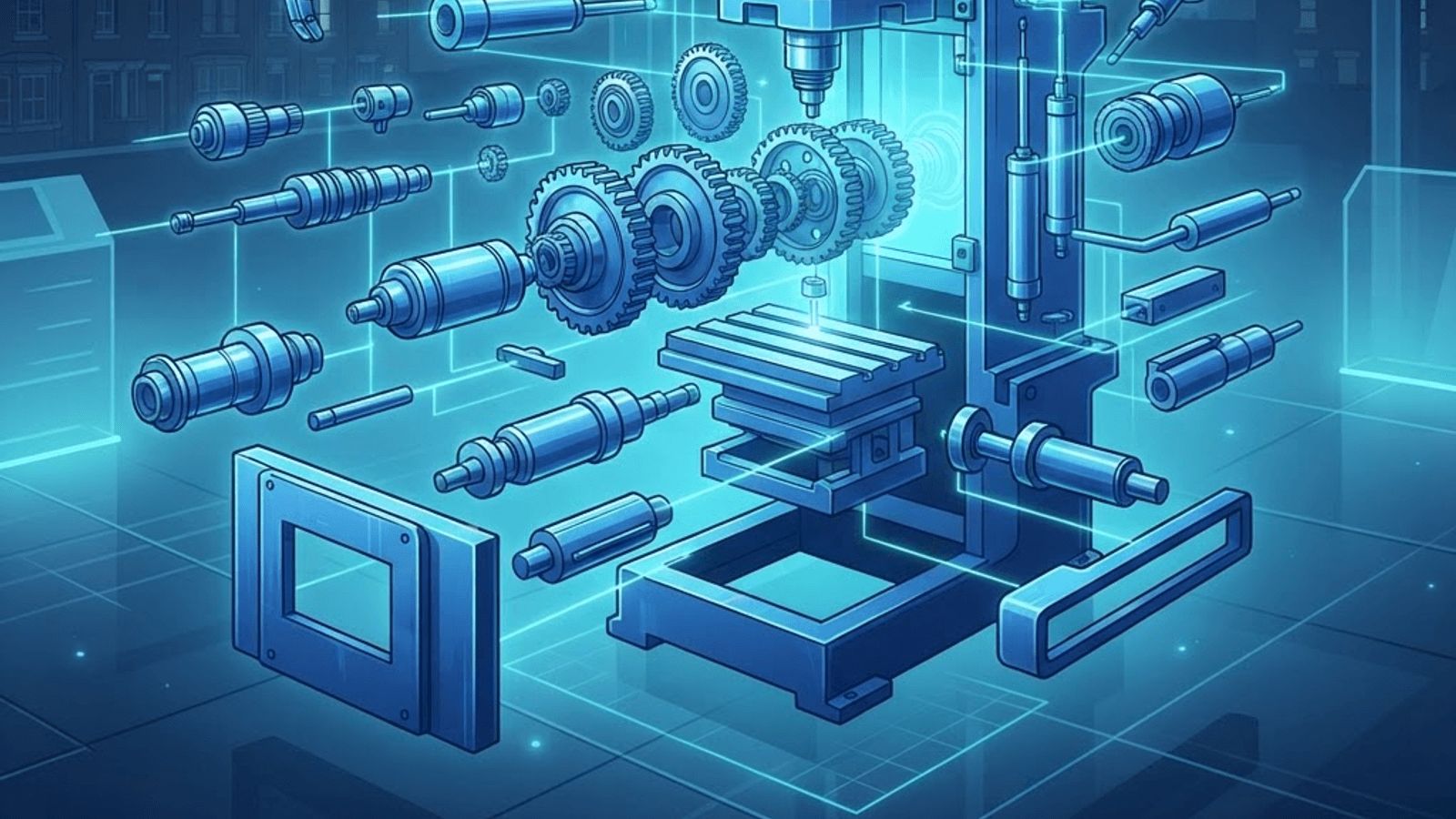
A Borough Built on Engineering
Machinery manufacturing in Gedling traces its roots to the industrial demands of the Nottinghamshire coalfield and the lace and textile trades that once dominated the county. Mining machinery, conveyor systems, winding gear and textile equipment all required local engineering support, and the workshops that grew up to provide it left behind something valuable: a skills base in heavy fabrication, machining, hydraulics and mechanical design that has proved remarkably adaptable.
Today those same competencies are applied to automated production lines, food processing equipment, packaging machinery, materials handling systems and bespoke special-purpose machines. The customers have changed but the underlying craft has not, and Gedling remains a place where a company with a difficult mechanical problem can find someone able to solve it.
What Machinery Manufacturers in Gedling Produce
The borough's machinery output splits broadly into four categories. Special purpose machinery covers one-off or small-batch machines designed around a specific customer process, common in food, pharmaceutical and automotive applications. Materials handling includes conveyors, elevators, palletisers and bulk handling equipment. Process equipment covers mixers, dryers, filtration systems and tanks. Finally, sub-contract machine building involves manufacturing to a customer's own design, where the client owns the intellectual property and the local firm provides the workshop capability.
Increasingly, all four categories involve significant control and software content. A modern machine is as much a programmable system as a mechanical assembly, and the better local manufacturers now employ controls engineers alongside fitters and welders.
The Top 10 Machinery Manufacturers Serving Gedling
1. Gedling Special Purpose Machinery
Designs and builds bespoke automated machines for customers who cannot buy an off-the-shelf solution. Their process runs from concept study and mechanical design through fabrication, assembly, controls integration and factory acceptance testing.
2. Colwick Conveyor Systems
A materials handling specialist producing belt, roller, chain and modular conveyor systems for warehousing, food production and recycling. Modular design allows systems to be reconfigured as customer operations change.
3. Netherfield Heavy Fabrication
Handles large-scale structural fabrication, machine frames, hoppers, chutes and tanks. Coded welding, in-house rolling and plate profiling allow heavy assemblies to be produced without sub-contracting the critical stages.
4. Arnold Process Equipment
Manufactures stainless steel process plant including mixing vessels, hoppers and filtration units for food, beverage and chemical customers. Hygienic design and surface finish quality are central to their offering.
5. Carlton Hydraulics and Pneumatics
Builds hydraulic power packs, cylinders and pneumatic control systems, and provides retrofit and refurbishment services for ageing machinery. Their workshop combines new build with a strong repair and service business.
6. Mapperley Automation Engineering
Focuses on robotic cells, pick-and-place systems and vision-guided automation, integrating industrial robots into customer production lines with bespoke tooling and guarding.
7. Burton Joyce Toolmaking
A precision toolroom producing press tools, jigs, fixtures and moulds, and supporting other machinery manufacturers with high-accuracy machined components and fixtures.
8. Lambley Packaging Machinery
Supplies filling, capping, labelling and case packing equipment, often configured into complete end-of-line systems for food and household product manufacturers.
9. Ravenshead Machine Services
Specialises in machine relocation, overhaul, refurbishment and control system retrofits, extending the working life of capital equipment rather than replacing it.
10. Gedling Agricultural Machinery
Manufactures and modifies equipment for the farms surrounding the borough, including trailers, feeders, handling attachments and bespoke implements suited to local conditions.
Key Trends in Machinery Manufacturing
Automation demand is the dominant trend. Persistent labour shortages in warehousing, food production and logistics have made automation a necessity rather than a luxury, and machinery builders report strong interest from customers who previously considered manual operation adequate.
Digitalisation follows closely behind. Machines are increasingly expected to report their own condition, with sensors monitoring vibration, temperature and cycle counts feeding predictive maintenance systems. This changes what a machinery manufacturer must deliver: not only reliable mechanics, but data architecture and remote diagnostics.
Energy efficiency has risen sharply up the specification list as industrial electricity costs have climbed. Regenerative drives, right-sized motors, improved insulation on heated processes and reduced compressed air consumption all now feature routinely in tender documents.
Finally, sustainability and circularity are changing lifecycle thinking. Refurbishment, control retrofits and design for disassembly are growing areas, and several Gedling firms have built solid businesses on extending equipment life rather than replacing it.
Safety, Compliance and Documentation
Machinery supplied in the UK must meet the Supply of Machinery (Safety) Regulations, which require risk assessment, appropriate guarding and interlocking, a technical file and a declaration of conformity with UKCA marking. For exported machines, equivalent CE marking and the EU Machinery Regulation apply.
Buyers should confirm that a prospective supplier genuinely understands these obligations. Ask to see a sample technical file, a risk assessment and an operations and maintenance manual from a previous project. Poor documentation is a common and expensive problem that only becomes visible after installation, often during an insurance inspection or a safety audit.
How to Select a Machinery Manufacturer
Define the problem, not the solution. The most successful bespoke machinery projects begin with a clear statement of throughput, product variants, available floorspace, utilities and the failure modes that matter most, leaving the supplier's engineers free to propose the best mechanical approach.
Evaluate design capability separately from build capability. Some firms excel at fabrication but outsource design; others design brilliantly and sub-contract manufacture. Neither is wrong, but you should know which you are buying.
Insist on a factory acceptance test with your own product before the machine leaves the supplier's works. Problems are dramatically cheaper to fix in the builder's workshop than on your production floor.
Finally, weigh aftercare heavily. Spare parts availability, response times, remote support and the depth of the service team determine the true cost of ownership far more than the purchase price.
The Outlook
With UK manufacturers under continuing pressure to raise productivity, Gedling's machinery builders occupy a genuinely strategic position. Their combination of heavy engineering capability, controls expertise and geographic proximity to Midlands industry makes them natural partners for businesses investing in automation, and the sector's outlook in the borough looks solid.
Want your brand featured in front of decision-makers? Publish a guest post or get a link insertion in our guides through AAMAX's guest post and link insertion service.
Helpful Links
 SponsoredAAMAX — Full-Service Digital Agency
Write for Us
Share your expertise with our readers. We welcome guest contributions from industry specialists.
Pitch your idea