

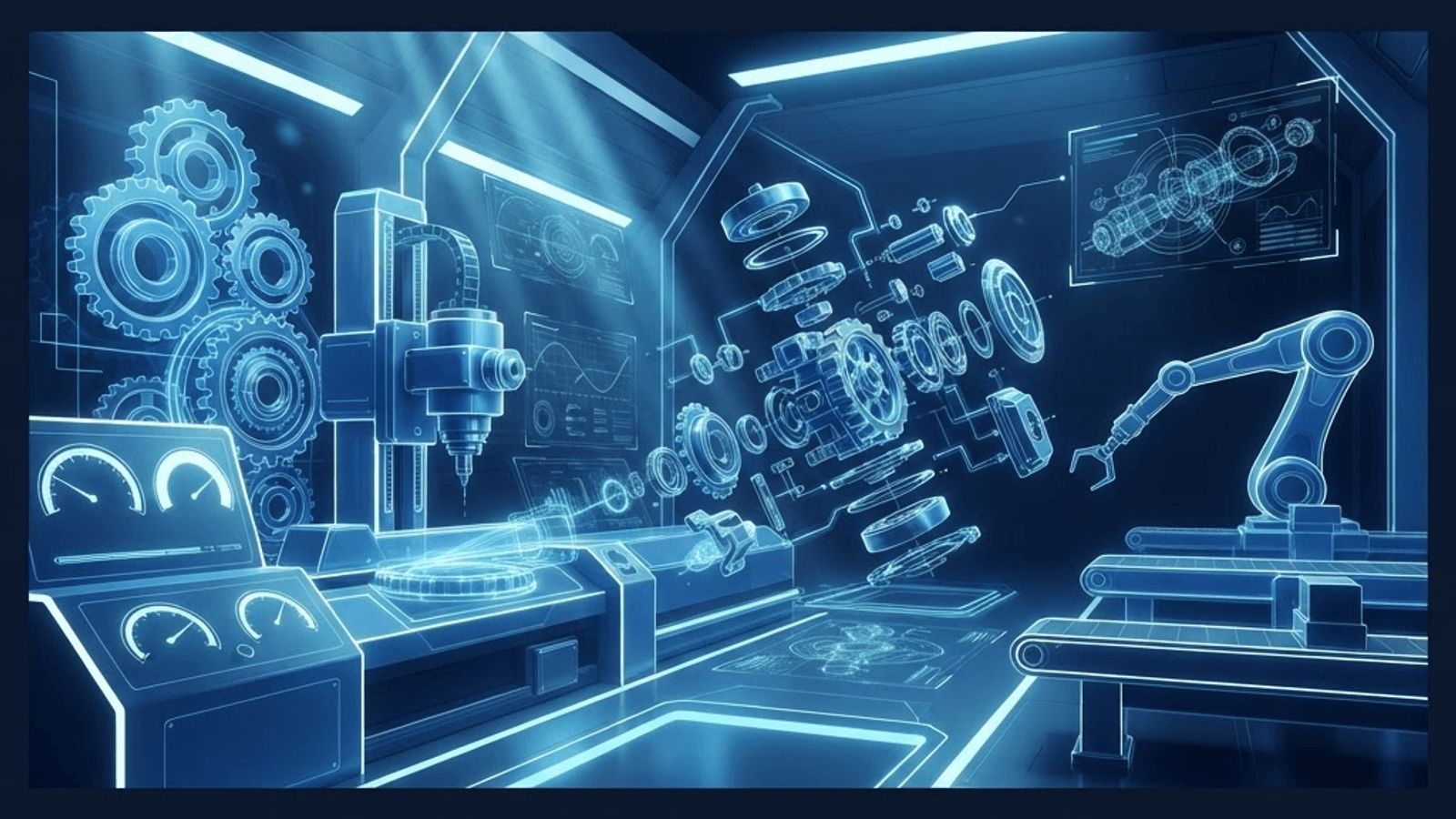
Engineering Roots and Modern Machinery Manufacture
Dundee's textile dominance required machines, and the city developed a formidable engineering sector to supply them. Firms in Dundee designed and built jute preparing, spinning, and weaving machinery that was exported globally, alongside marine engines, boilers, and shipbuilding equipment. The mills eventually closed, but engineering knowledge is unusually persistent, transferring between generations of apprentices and between apparently unrelated industries.
Today machinery manufacture in Dundee and the surrounding Tayside area concentrates on bespoke and small-batch equipment rather than standard product lines. Typical work includes process machinery for food and drink production, materials handling and conveying systems, agricultural equipment, industrial automation cells, hydraulic systems, and specialist test rigs. The common thread is engineered-to-order work where customer specification drives the design.
What Drives Demand Locally
Several regional sectors generate machinery requirements. Food and drink processing across Angus, Perthshire, and Fife needs handling, washing, grading, filling, and packaging equipment. Agriculture, particularly soft fruit and arable production, requires planting, harvesting, and grading machinery. Energy and offshore work needs lifting equipment, skids, and test rigs. Life sciences and electronics require cleanroom-compatible handling and precision assembly equipment. This diversity keeps local engineering firms flexible.
The Top 10 Machinery Manufacturers and Engineering Organisations in Dundee City
1. Bespoke Process Machinery Builders in Tayside
The strongest category in the region comprises engineering companies that design and build made-to-order process machinery. They take a customer problem, produce a mechanical and electrical design, fabricate in-house, integrate controls, and commission on site. Their differentiators are design capability, CE and UKCA conformity assessment competence, and willingness to take responsibility for machine performance.
2. Materials Handling and Conveyor System Manufacturers
Conveyor and handling specialists build belt, roller, screw, and pneumatic conveying systems for food, recycling, agriculture, and manufacturing clients. Their value lies in understanding product behaviour, since bulk solids, delicate produce, and packaged goods all require entirely different handling approaches.
3. Industrial Automation Integrators and Robotics Specialists
Automation integrators design robotic cells, vision inspection systems, PLC control architectures, and SCADA supervision. As labour availability tightens across Scottish manufacturing, these businesses have become central to productivity improvement, and their skill is often in the safety design and guarding as much as the robot itself.
4. Precision Machining and CNC Engineering Companies
Machine shops with CNC turning, milling, and grinding capability supply components to machinery builders, energy contractors, and OEMs. Key differentiators include achievable tolerances, material breadth from stainless and duplex to aluminium and engineering plastics, inspection equipment such as CMMs, and turnaround on urgent breakdown work.
5. Hydraulic and Pneumatic Systems Manufacturers
Hydraulic specialists design and build power packs, cylinders, hose assemblies, and control manifolds for industrial, marine, and mobile equipment. Their proximity matters because hydraulic failures stop production, and local firms provide same-day hose manufacture and cylinder repair alongside new system builds.
6. Structural Steel and Heavy Fabrication Firms
Heavy fabricators produce frames, platforms, hoppers, tanks, chutes, and access structures that form the physical skeleton of most machinery installations. Coded welders, weld procedure qualification, and shot blasting and painting facilities separate serious fabricators from general welding shops.
7. Agricultural Machinery Manufacturers and Modifiers
Serving Angus and Perthshire, agricultural engineering businesses manufacture and adapt equipment for soft fruit, potato, and arable production, including grading lines, trailers, sprayers, and handling equipment. Much of this is genuinely innovative, driven by growers seeking labour reduction and crop quality improvement.
8. Michelin Scotland Innovation Parc Advanced Manufacturing Tenants
MSIP provides large industrial units suited to machinery builders and advanced manufacturing companies, with engineering support and skills training on site. Its focus on decarbonisation attracts businesses building equipment for recycling, battery processing, and clean energy applications.
9. University of Dundee and Abertay Engineering Research Facilities
Both universities offer testing, simulation, and materials analysis capability that machinery manufacturers can access, along with collaborative research funding routes. Finite element analysis, geotechnical testing, and computational modelling support let smaller firms validate designs without owning specialist software or rigs.
10. Dundee and Angus College Engineering Apprenticeships
Machinery manufacture depends absolutely on skilled fitters, machinists, welders, and control engineers. The college delivers the mechanical, fabrication, and electrical apprenticeships that supply this workforce, and works directly with employers to shape training content.
Machinery Sector Trends
Automation demand is rising steadily as wage costs and recruitment difficulty push manufacturers toward mechanised solutions. Energy efficiency has become a purchasing criterion, with variable speed drives, regenerative systems, and reduced compressed air use influencing specification. Digital monitoring is increasingly expected, with condition sensors and remote diagnostics built in from the outset. Compliance requirements around UKCA marking and functional safety continue to raise the technical bar for machine builders.
Choosing a Machinery Manufacturer
Ask for a written functional specification before any order, as ambiguity here causes most project disputes. Confirm who takes responsibility for conformity assessment and technical file compilation. Review reference installations in comparable applications, not just general capability claims. Establish spare parts availability and response times for breakdowns, because whole-life cost is dominated by downtime rather than purchase price.
Conclusion
Dundee retains real machinery engineering capability, concentrated in bespoke process equipment, handling systems, automation, precision machining, hydraulics, and heavy fabrication. Supported by an innovation campus, university research facilities, and strong apprenticeship provision, the city remains a practical place to have industrial equipment designed and built.
Want your brand featured in front of decision-makers? Publish a guest post or get a link insertion in our guides through AAMAX's guest post and link insertion service.
Helpful Links
 SponsoredAAMAX — Full-Service Digital Agency
Write for Us
Share your expertise with our readers. We welcome guest contributions from industry specialists.
Pitch your idea

