

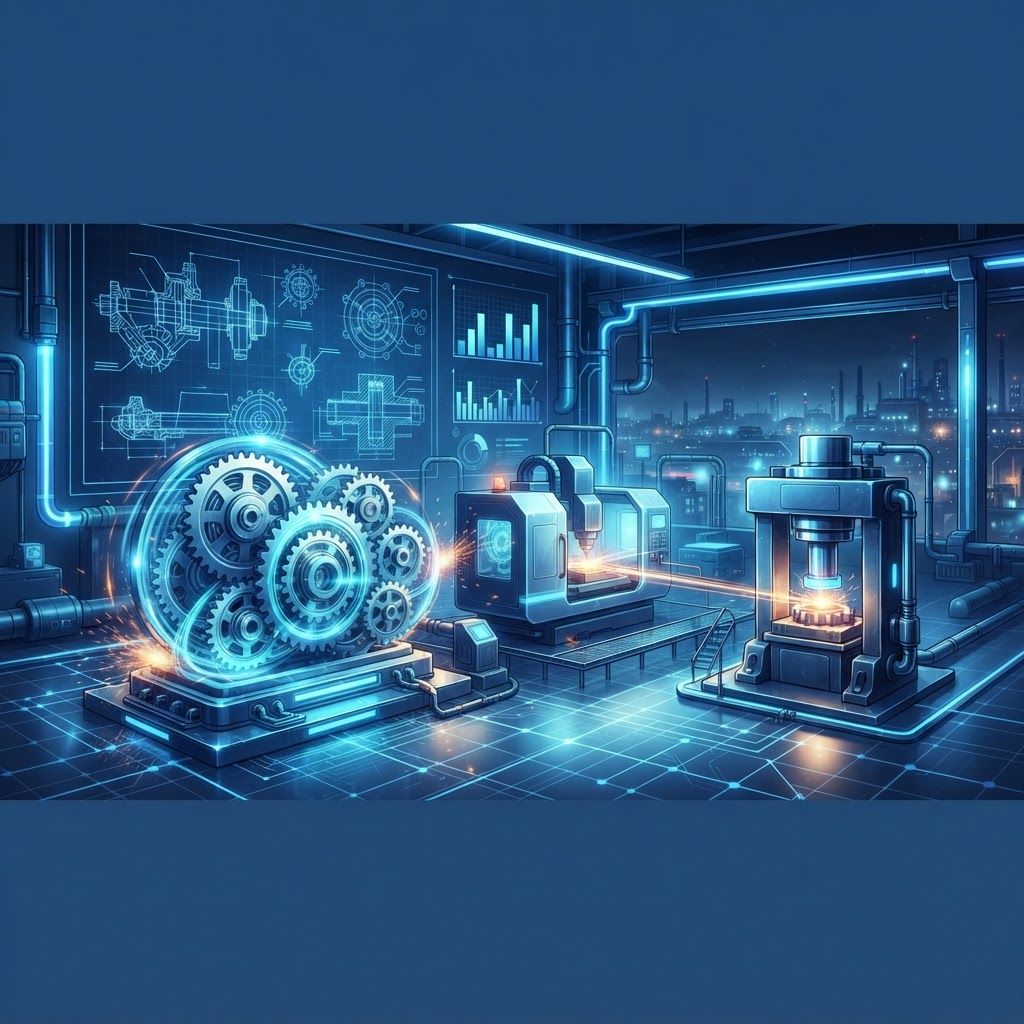
The Engineering Backbone of Dartford
Machinery manufacturing rarely attracts headlines, yet it underpins almost every other industry. Food producers, packaging houses, pharmaceutical plants, recycling operators and construction firms all depend on purpose-built equipment, and much of that equipment in the South East is designed and assembled within a few miles of Dartford.
The town's machinery builders tend to occupy the specialist end of the market. Rather than competing with mass-produced imported plant, they focus on custom automation, bespoke handling systems and process equipment tailored to a customer's exact throughput, footprint and hygiene requirements. That model rewards engineering depth and close customer relationships, both of which Dartford's industrial community has in abundance.
Ten Machinery Manufacturers Setting the Standard
1. Darent Industrial Systems designs and builds turnkey automation cells, integrating robotics, vision inspection and conveying into complete production solutions. The company's strength lies in its ability to take responsibility for an entire process step, handling mechanical design, control software, installation and operator training under one contract.
2. Crayford Machine Tools manufactures and rebuilds precision machine tools, including specialist grinding and boring equipment. Machine rebuilding is a valuable service for manufacturers whose capital equipment remains mechanically sound but electrically obsolete, and the firm's retrofitting of modern controls to proven machine bases delivers new-machine capability at substantially lower cost.
3. Thameside Process Equipment serves food, beverage and pharmaceutical customers with hygienic mixing vessels, transfer systems and clean-in-place installations. Stainless fabrication to hygienic standards demands careful weld preparation, surface finishing and drainage design, disciplines this business has refined over many projects.
4. Bluewater Packaging Machinery builds filling, capping, labelling and end-of-line packaging equipment. With brands launching products in ever more varied formats, the ability to produce changeover-friendly machines that handle multiple pack sizes has become a decisive advantage.
5. Stone House Materials Handling specialises in conveyors, elevators, palletisers and bulk handling systems. The company engineers for the realities of industrial life, prioritising accessible maintenance points, generous bearing specifications and guarding that operators will actually keep in place.
6. Joyce Green Hydraulics designs hydraulic power packs, presses and actuation systems. Hydraulics remains unmatched where high force in a compact envelope is required, and the firm pairs traditional expertise with modern proportional control and energy-efficient variable-speed pumps.
7. Temple Hill Automation focuses on control systems, retrofitting programmable controllers, drives and supervisory software to existing plant. Many manufacturers hold perfectly serviceable machines starved of data, and this business unlocks performance monitoring and predictive maintenance without wholesale replacement.
8. Princes Road Engineering Works produces heavy fabricated machinery for recycling, aggregates and waste processing. Equipment in these sectors endures punishing duty cycles, so wear-resistant liners, robust bearing arrangements and straightforward field repair define good design.
9. Acacia Special Purpose Machines builds one-off machines for tasks no catalogue product addresses, from test rigs to assembly jigs and inspection stations. Its consultative approach, beginning with observation of the customer's current manual process, consistently produces practical rather than over-engineered solutions.
10. Hesketh Precision Machinery manufactures high-accuracy positioning systems and laboratory equipment where micron-level repeatability matters. Thermal stability, vibration isolation and careful material selection distinguish this class of work from general engineering.
Trends Driving Machinery Demand
Labour availability is the single strongest driver of automation investment across the South East. Persistent recruitment difficulty in production roles has pushed manufacturers to automate tasks that were previously considered uneconomic to mechanise, and machinery builders have responded with smaller, more affordable modular cells.
Data connectivity is the second theme. Customers now expect machines to report output, downtime, cycle time and fault history to plant systems. Retrofitting sensors and gateways to older equipment has become a significant revenue stream for Dartford's machinery firms.
Energy efficiency follows closely. With industrial energy costs a serious line item, buyers scrutinise motor efficiency, compressed air consumption, regenerative braking on drives and heat recovery. A machine that costs slightly more to buy but noticeably less to run now wins tenders.
Collaborative robotics deserves mention as well. Robots designed to work safely alongside people have lowered the barrier to automation for smaller manufacturers, and local integrators have built practical expertise in risk assessment and safe deployment.
Selecting a Machinery Manufacturer
The most important question is who owns the outcome. Buying components and integrating them yourself can be cheaper but transfers risk; a single supplier accepting responsibility for performance against an agreed specification usually delivers better value overall.
Examine how a builder approaches the specification stage. Strong machinery manufacturers ask uncomfortable questions early about product variation, upstream feed consistency, cleaning regimes and operator skill levels, because unrealistic assumptions at that stage cause most commissioning failures.
Consider lifetime support too. Spare parts availability, response times, remote diagnostics and documentation quality determine what a machine actually costs over a decade. Local presence matters here, and Dartford's proximity to much of the South East industrial base is a practical advantage.
The Outlook for Machinery Building in Dartford
Demand for bespoke machinery is likely to remain strong as manufacturers pursue productivity gains without expanding headcount. The builders best positioned are those blending mechanical craft with software competence, since the value in modern machinery increasingly resides in control, data and usability as much as in steel and bearings. Dartford's established engineering culture, combined with a steady willingness to invest in new disciplines, suggests the town will continue to produce equipment that quietly keeps British industry moving.
Want your brand featured in front of decision-makers? Publish a guest post or get a link insertion in our guides through AAMAX's guest post and link insertion service.
Helpful Links
 SponsoredAAMAX — Full-Service Digital Agency
Write for Us
Share your expertise with our readers. We welcome guest contributions from industry specialists.
Pitch your idea

