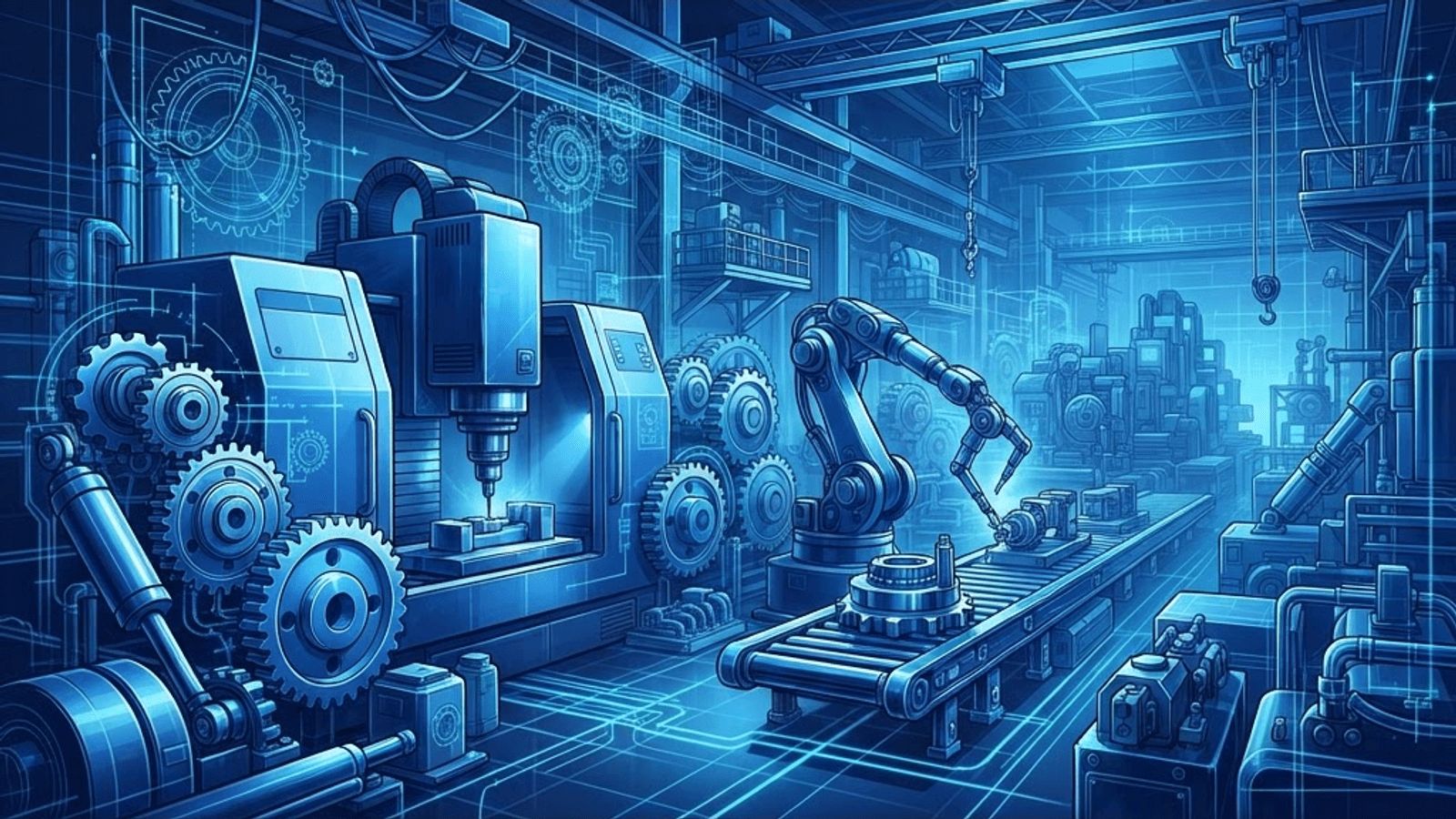
Why Machinery Manufacturing Matters in Crawley
Machinery is the industry that builds other industries. Every manufacturer, warehouse, food producer and airport operation depends on equipment designed and built by machinery specialists. In Crawley, that dependence is unusually visible. Gatwick Airport requires baggage handling systems, ground support equipment, de-icing rigs, cargo handling machinery and maintenance tooling. Manor Royal's manufacturers need machine tools, automation cells, conveyors and inspection systems. The logistics operators along the M23 corridor rely on sortation, palletising and racking systems.
The result is a machinery ecosystem combining large international equipment manufacturers, specialist system integrators, bespoke machine builders and maintenance providers. Crawley's engineering workforce, trained largely through aerospace and precision manufacturing, supplies exactly the mechanical, electrical and controls skills this sector requires.
1. Vanderlande
Vanderlande is a global leader in baggage handling and warehouse automation systems, with extensive airport installations worldwide. Baggage systems represent some of the most complex material handling machinery in existence, integrating conveyors, scanners, sortation and control software at enormous scale.
2. Daifuku
Daifuku supplies airport baggage handling, automated warehouse systems and factory automation equipment. Its systems combine mechanical handling with sophisticated warehouse control software, serving both aviation and distribution customers.
3. Renishaw
Renishaw manufactures precision metrology equipment, machine tool probing systems and additive manufacturing machines. Its measurement technology is embedded in machine tools across the aerospace and automotive supply chains that surround Crawley.
4. Yamazaki Mazak UK
Mazak manufactures advanced machine tools including multi-axis machining centres and turning machines, supported by a United Kingdom technology and service network. Precision machining capability is fundamental to the region's aerospace component suppliers.
5. DMG Mori UK
DMG Mori supplies computer numerical control machine tools, automation cells and digital manufacturing solutions. Its equipment enables lights-out machining, where automated loading allows production to continue unattended, improving utilisation for high-value machines.
6. TLD Group and Ground Support Equipment Manufacturers
Ground support equipment manufacturers produce aircraft tugs, belt loaders, ground power units, air start units and catering trucks. With Gatwick operating continuously, this equipment category represents significant local demand for both new machines and maintenance services.
7. Interroll
Interroll manufactures material handling components and modules including rollers, drives, conveyor platforms and sorters. Component suppliers of this kind form the building blocks that system integrators assemble into complete warehouse solutions.
8. Bosch Rexroth
Bosch Rexroth supplies drive and control technologies including hydraulics, electric drives, linear motion systems and factory automation. Its products appear throughout machinery built by integrators serving the South East industrial base.
9. Regional Bespoke Machine Builders
Specialist machine builders across Sussex and Surrey design and manufacture custom automation, test rigs, assembly machines and handling equipment for clients with requirements no standard machine can meet. This bespoke capability is particularly valuable for aerospace and medical manufacturers with unique processes.
10. Crawley Engineering and Maintenance Service Providers
Local engineering firms provide machinery installation, relocation, refurbishment, spare part manufacture and planned maintenance. Keeping existing machinery running reliably is often more valuable than capital replacement, and responsive local support minimises costly downtime.
Types of Machinery in Demand Locally
Categories include material handling and conveyor systems, automated storage and retrieval systems, robotic palletising and packing cells, computer numerical control machining centres and turning machines, sheet metal fabrication equipment including laser cutters and press brakes, inspection and metrology systems, test rigs and environmental chambers, packaging machinery, ground support and airside equipment, and industrial cleaning and surface treatment plant.
Automation and Industry 4.0
Automation adoption has accelerated sharply, driven by labour availability, cost pressure and quality requirements. Collaborative robots have lowered the barrier to entry, allowing smaller manufacturers to automate repetitive tasks without extensive safety caging or specialist programming teams. Vision systems have become affordable and reliable, enabling automated inspection that was previously impractical.
Connectivity is the other major shift. Modern machinery generates continuous data on utilisation, cycle times, energy consumption and component condition. Manufacturers use this for predictive maintenance, replacing fixed service intervals with condition-based intervention that reduces both unplanned downtime and unnecessary servicing. For airport equipment operating around the clock, this capability has clear operational value.
Digital twins and simulation now precede physical build on major projects. Modelling a baggage system or warehouse layout before construction identifies bottlenecks and validates throughput assumptions, reducing costly rework after commissioning.
Energy Efficiency and Sustainability
Machinery specification increasingly includes energy performance. Variable speed drives, regenerative braking on lifting equipment, efficient compressed air systems and intelligent standby modes all reduce consumption meaningfully. With commercial electricity costs high, efficiency improvements often justify equipment upgrades on financial grounds alone.
Circular approaches are also growing. Machine refurbishment, component remanufacture and controls retrofit extend asset life at a fraction of replacement cost and carbon footprint, an approach well suited to robust mechanical equipment with long service lives.
How to Choose a Machinery Supplier
Specify outcomes rather than equipment where possible, describing required throughput, accuracy, availability and footprint, and allow suppliers to propose solutions. Assess after-sales support carefully, including spare part availability, engineer response times and training provision, because machinery downtime cost usually dwarfs purchase price differences.
Review integration capability. Machinery rarely operates in isolation, and compatibility with existing control systems, enterprise software and material flows determines real-world performance. Ask for reference sites with comparable applications and, if possible, visit them in operation. Finally, evaluate total cost of ownership including energy, consumables, maintenance and expected life rather than capital cost alone.
Final Thoughts
Machinery manufacturing and support form the backbone of Crawley's industrial capability, serving aviation, logistics, precision engineering and food production. As automation, connectivity and energy efficiency reshape the sector, businesses that specify systems thoughtfully and invest in maintenance capability will extract the most value from their equipment.
Want your brand featured in front of decision-makers? Publish a guest post or get a link insertion in our guides through AAMAX's guest post and link insertion service.
Helpful Links
 SponsoredAAMAX — Full-Service Digital Agency
Write for Us
Share your expertise with our readers. We welcome guest contributions from industry specialists.
Pitch your idea