

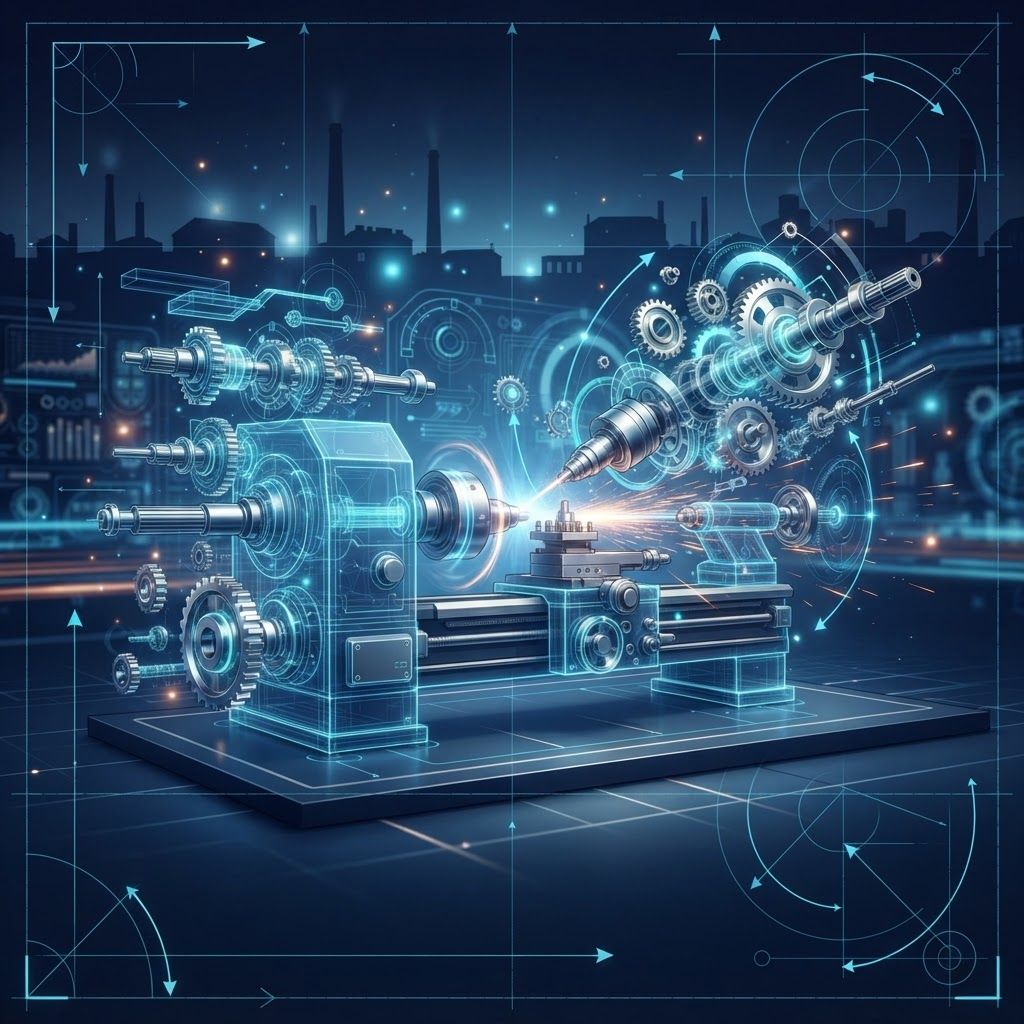
Colchester's Global Machine Tool Legacy
Among engineers worldwide, the name Colchester means one thing above all: lathes. The Colchester Lathe Company established the town's reputation for robust, accurate centre lathes that became fixtures in workshops, technical colleges and factories across the globe. Generations of machinists learned their craft on Colchester machines, and the brand remains highly regarded in the secondhand market decades after individual units were built.
That heritage is more than nostalgia. It seeded a deep pool of mechanical engineering skill in north Essex that persists in today's machinery manufacturing businesses, whether they build bespoke production equipment, automation systems, agricultural machinery or precision components for other machine builders.
What Machinery Manufacturing Involves Today
Modern machinery manufacture is a multidisciplinary undertaking. Mechanical design establishes structure, kinematics and load paths. Electrical and control engineering delivers drives, sensors, safety circuits and PLC or motion control programming. Software increasingly provides operator interfaces, data logging and remote diagnostics.
Fabrication and machining produce the physical parts, followed by assembly, commissioning and factory acceptance testing. Compliance is a significant workstream in its own right, since machinery must satisfy safety requirements covering guarding, emergency stops, risk assessment and technical documentation before it can lawfully be supplied.
Notable Machinery Manufacturers and Engineering Firms Serving Colchester
Machine tool businesses continuing the Colchester lathe tradition maintain, rebuild and support the extensive installed base of these machines. Rebuild specialists strip, regrind, refit and recommission lathes to near-original accuracy, often adding modern digital readouts or variable frequency drives. This work extends the life of exceptionally well-built machines and represents genuine engineering rather than mere refurbishment.
Bespoke special purpose machinery builders in Essex design and construct one-off production equipment for manufacturers who cannot buy what they need off the shelf. Typical projects include assembly stations, test rigs, handling systems and packaging equipment tailored to a specific product.
Industrial automation and robotics integrators serving north Essex deploy robotic cells, vision systems, conveyors and control architecture. Demand has grown steadily as manufacturers respond to labour availability pressures and quality consistency requirements.
Agricultural machinery manufacturers and modifiers around Colchester serve the substantial arable farming economy of north Essex. Work spans implement manufacture, machine modification, hydraulic systems and precision agriculture equipment fitting, alongside heavy repair and fabrication for harvest-critical machinery.
Materials handling and conveyor manufacturers in the region build systems for food production, logistics and general manufacturing. Design considerations include hygiene in food applications, throughput calculations and integration with warehouse management systems.
Hydraulic and pneumatic system specialists in Essex manufacture power packs, cylinders, manifolds and complete circuits. Hose assembly, pressure testing and on-site breakdown service are core parts of this business, since hydraulic failures halt production immediately.
Precision engineering and subcontract machining firms supplying machine builders produce the shafts, housings, plates and bespoke components that populate finished machinery. Capability typically includes CNC turning and milling, grinding, and CMM inspection with full material traceability.
Packaging machinery suppliers and integrators serving Essex food and manufacturing businesses deliver filling, capping, labelling, wrapping and end-of-line systems. Colchester's food production and distribution activity supports meaningful demand in this area.
Machinery maintenance, rebuild and relocation contractors provide the service layer that keeps plant running. Preventive maintenance contracts, breakdown response, machine moves and installation are all specialisms requiring rigging, alignment and commissioning skill.
Test rig and laboratory equipment builders connected to the University of Essex research base produce bespoke experimental apparatus. Research-driven machinery demands unusual flexibility and close collaboration between engineers and scientists.
Design, Compliance and Documentation
Anyone commissioning machinery should understand the compliance dimension. A machine supplied for use in Great Britain requires appropriate conformity marking, a declaration of conformity, a risk assessment, and a technical file supporting the safety claims. Operator manuals must cover safe use, maintenance and residual risks.
Functional safety matters too. Guarding, interlocks, light curtains and emergency stop circuits must be designed to an appropriate performance level based on assessed risk, not simply added as an afterthought. Reputable Essex machine builders treat this as integral to design and will discuss it early.
Automation, Data and Modern Manufacturing
The most significant recent change in machinery is connectivity. Machines now routinely log cycle times, fault codes, energy consumption and quality data. This enables condition-based maintenance, in which components are replaced based on measured wear rather than fixed schedules, and provides the data foundation for continuous improvement.
Colchester manufacturers investing in these capabilities report measurable gains in uptime and yield. Importantly, the value comes from actually using the data, which requires clear thinking about which measurements matter rather than simply collecting everything available.
Collaborative robotics has lowered the barrier to automation for smaller manufacturers. Cobots can be deployed for machine tending, palletising and inspection tasks without extensive fixed guarding, making automation viable at lower volumes than traditional industrial robots required.
Selecting a Machinery Manufacturer
Define the requirement carefully before approaching suppliers. A clear specification covering throughput, product variants, footprint, utilities, operator interaction and integration points prevents costly misunderstanding later.
Assess supplier capability across all disciplines your project needs. A firm with excellent fabrication but weak controls capability may subcontract critical work. Ask who performs electrical design and software, and how commissioning support is provided after installation.
Discuss spares and long-term support explicitly. Machinery lifespans measured in decades mean that component obsolescence and supplier continuity are legitimate concerns. Standardised commercially available components are generally preferable to proprietary parts.
Skills and the Future
The machinery sector around Colchester shares the national challenge of engineering skills supply. Apprenticeships in mechanical fitting, machining, electrical installation and controls remain the most effective route into the industry, and local colleges work with employers to deliver relevant training. The combination of the town's machine tool heritage and the university's engineering research provides an unusually strong foundation.
Conclusion
Colchester's connection to machinery manufacturing runs deeper than most British towns, and that legacy translates into real present-day capability. From lathe rebuilding and bespoke special purpose machines to automation integration and agricultural equipment, local businesses combine traditional mechanical craft with modern controls and data expertise. For manufacturers seeking equipment, that depth means genuine engineering partnership rather than simple procurement.
Want your brand featured in front of decision-makers? Publish a guest post or get a link insertion in our guides through AAMAX's guest post and link insertion service.
Helpful Links
 SponsoredAAMAX — Full-Service Digital Agency
Write for Us
Share your expertise with our readers. We welcome guest contributions from industry specialists.
Pitch your idea

