

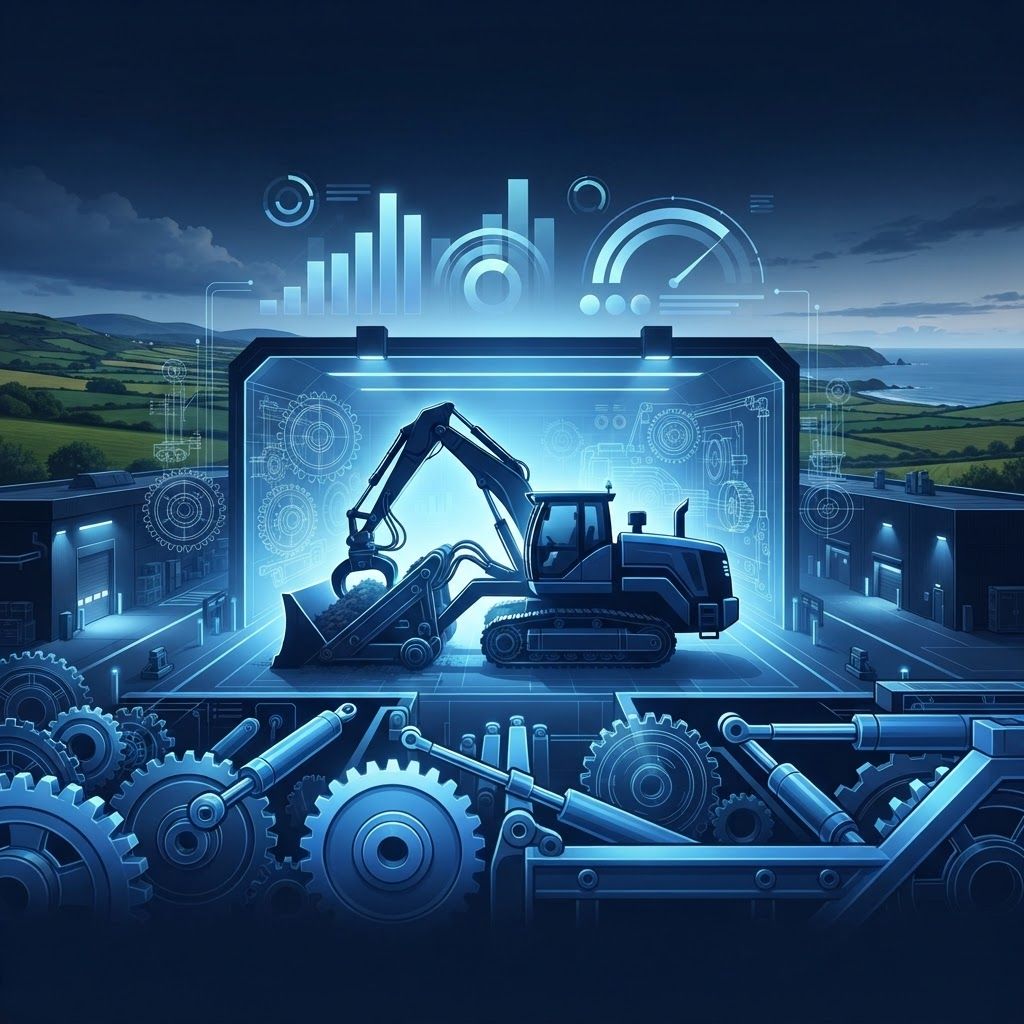
Engineering Excellence in the North of Ireland
Northern Ireland punches far above its weight in machinery manufacturing. The region is internationally recognised for materials handling and quarrying equipment, agricultural machinery and food processing systems, exporting to markets across six continents. The Causeway Coast and Glens contributes meaningfully to that reputation, hosting engineering firms whose products work in fields, quarries, factories and processing plants around the world.
The foundations of this success are straightforward. The borough has a deep tradition of practical engineering, a farming community that demands machinery capable of handling heavy, wet ground and awkward field shapes, and a workforce comfortable with fabrication, welding, hydraulics and mechanical assembly. Machines developed to cope with Northern Irish conditions tend to be over-engineered by international standards, which turns out to be an excellent selling point abroad.
The Main Categories of Machinery Made Here
Agricultural machinery is the largest strand, covering slurry handling equipment, feeder wagons, bale handling, grassland machinery and livestock handling systems. Materials handling and processing equipment for quarrying, recycling and aggregates forms a second major category, including conveyors, screens, crushers and washing plant.
Food processing machinery serves the region substantial food and drink industry with conveying, grading, washing, packing and hygiene-critical stainless steel equipment. Finally, bespoke automation and special purpose machinery covers one-off machines designed to solve a specific production problem for a specific client.
Ten Machinery Manufacturers in the Borough
1. Bann Valley Agricultural Engineering designs and manufactures grassland and livestock equipment including feeder wagons, bale handlers and slurry systems built specifically for the heavy soils and high rainfall of the region.
2. Causeway Materials Handling produces conveyors, hoppers, feeders and bulk handling systems for quarrying, recycling and industrial clients, with a reputation for heavy-duty construction and straightforward maintenance access.
3. Roe Valley Process Equipment specialises in stainless steel food processing machinery, including washing, grading and conveying systems built to hygienic design standards for the food and drink sector.
4. Glens Engineering Works undertakes bespoke machine design and build, taking on the special purpose projects that catalogue manufacturers cannot serve, from custom test rigs to unique production line solutions.
5. Coleraine Hydraulic Systems manufactures and services hydraulic power packs, cylinders and control systems, supplying both original equipment manufacturers and end users needing repair or upgrade work.
6. Ballymoney Machine Tools focuses on precision machining and the manufacture of machine components, operating CNC turning and milling capacity that supports the wider engineering supply chain across the borough.
7. Antrim Coast Quarry Plant builds and refurbishes screening and washing plant for the aggregates industry, a sector with a strong presence given the geology of the Antrim Plateau and surrounding areas.
8. Dalriada Automation Engineering integrates mechanical machinery with programmable control systems, robotics and vision inspection, helping manufacturers automate repetitive or hazardous operations.
9. Limavady Fabrication and Plant combines heavy fabrication with machinery assembly, producing structural frames, chutes, guarding and large weldments for industrial installations.
10. Basalt Precision Engineering rounds out the list with tight-tolerance machining, gear cutting and specialist component manufacture supplying machinery builders across Northern Ireland.
Why Local Machinery Design Travels Well
Machinery developed in this part of the world has a distinct character. Wet ground demands greater ground clearance, better weight distribution and more powerful drive systems. Small, irregular fields separated by hedges and stone walls require compact, manoeuvrable machines. High rainfall and coastal salt demand superior corrosion protection.
Machines built to these requirements perform exceptionally well elsewhere, and buyers in other markets recognise durability when they see it. This is a significant reason why machinery from Northern Ireland has established such strong export positions in Britain, continental Europe, North America, Australia and beyond.
Technology Transforming the Sector
Machinery manufacturing has been reshaped by digital tools. Three dimensional computer-aided design allows complete machines to be modelled, checked for interference and stress-analysed before any steel is cut. Computer numerical control machining and laser or plasma profiling deliver parts with accuracy and repeatability that manual methods cannot match.
On the machine itself, electronics and software now play a central role. Programmable logic controllers manage sequences, sensors monitor condition, and telematics allow remote diagnostics so that a fault on a machine operating hundreds of miles away can be assessed without a service visit. Several manufacturers in the borough now sell service packages built around this connectivity.
Precision agriculture is another driver. Machinery that can vary application rates automatically, record field data and integrate with farm management software adds genuine value for farmers managing input costs carefully.
Safety, Standards and Compliance
Machinery must comply with rigorous safety requirements covering guarding, emergency stops, noise, vibration and risk assessment, supported by proper technical documentation and operating instructions. For machines sold into export markets, additional regional requirements apply.
Established manufacturers treat compliance as part of good design rather than a paperwork exercise. Well-designed guarding that does not obstruct routine maintenance, for example, is far more likely to remain in place than an awkward cover that operators remove out of frustration.
Aftersales: The Real Differentiator
For any customer running machinery in a production environment, downtime is the dominant cost. A machine that breaks during silage season or mid-way through a processing run causes losses far exceeding the value of the failed component.
The manufacturers that build the strongest reputations are those with genuine aftersales capability: spare parts held in stock, field service engineers available promptly, clear technical support and a willingness to stand behind their product. Buyers evaluating suppliers should weigh this heavily, and should ask direct questions about parts availability for machines ten or fifteen years old.
Skills and Investment
The sector depends on welders, fabricators, machinists, design engineers, hydraulic specialists and controls engineers. Apprenticeships remain the primary route into these trades, and manufacturers across the borough maintain active training programmes. Retaining experienced staff is equally important, since much of the practical knowledge in machinery design is accumulated rather than taught.
Looking Forward
Machinery manufacturing in the Causeway Coast and Glens is well positioned. Global demand for food production equipment, recycling and aggregates plant, and automation solutions continues to grow. Electrification of off-highway machinery is an emerging challenge, as is the need to reduce embodied carbon in heavy steel products.
The manufacturers most likely to prosper are those that keep listening closely to the people who actually operate their machines. That habit, more than any single technology, is what built the region engineering reputation in the first place.
Want your brand featured in front of decision-makers? Publish a guest post or get a link insertion in our guides through AAMAX's guest post and link insertion service.
Helpful Links
 SponsoredAAMAX — Full-Service Digital Agency
Write for Us
Share your expertise with our readers. We welcome guest contributions from industry specialists.
Pitch your idea

