

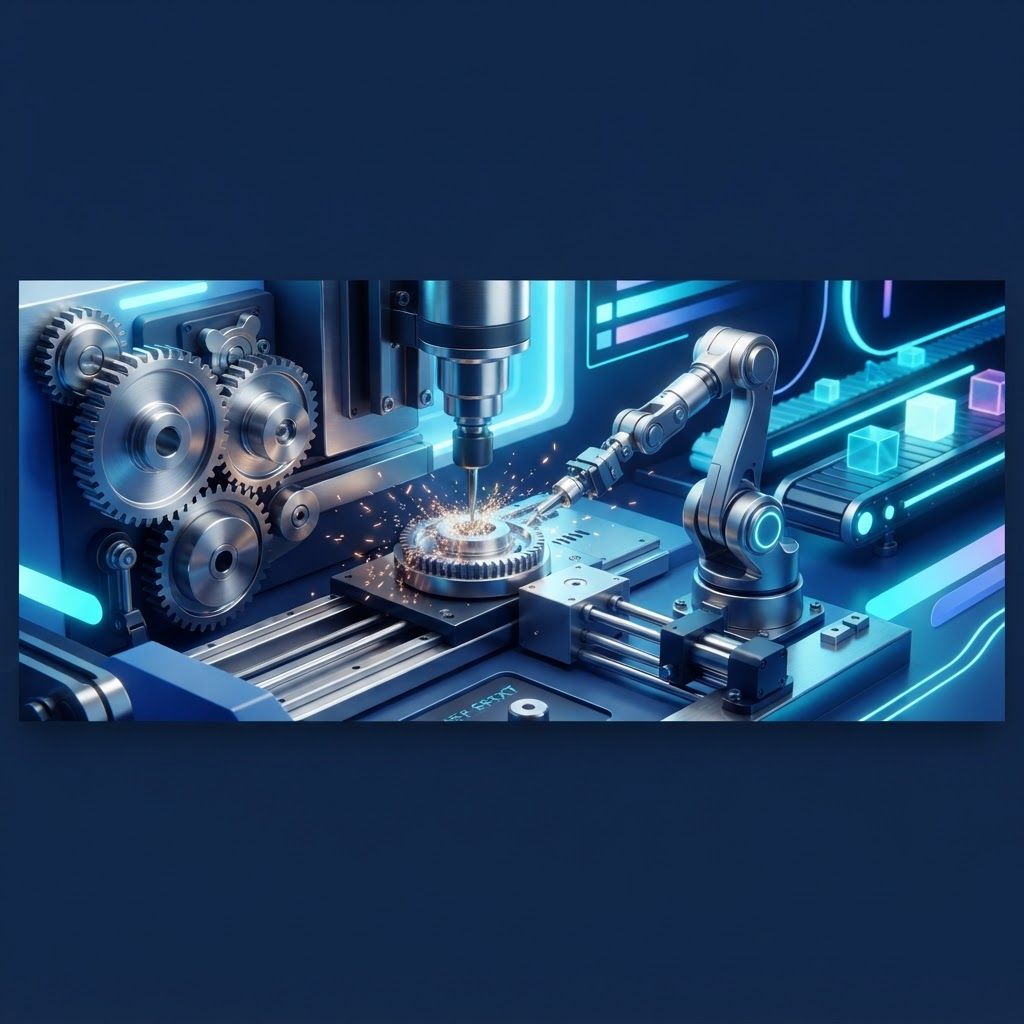
Machinery Manufacturing in Central London
Machinery manufacturing in Camden is defined by precision rather than scale. The borough's engineering firms build laboratory automation, production machinery for food and cosmetics producers, packaging equipment, robotic handling systems, machine tools and bespoke one-off machines designed to solve a specific problem. What they share is high engineering content per unit and small production quantities.
This suits an urban location. A machine builder producing a handful of custom systems each year needs skilled engineers, good client access and a well-equipped workshop rather than a large factory. Camden supplies the first two abundantly, thanks to nearby universities, research institutes and a dense concentration of manufacturing and laboratory clients across London and the South East.
How These Manufacturers Were Assessed
Selection considered mechanical and controls engineering capability, precision and quality standards, ability to design bespoke solutions from a client problem statement, safety and compliance competence, installation and commissioning support, and aftercare including spares and servicing. Manufacturers that take responsibility for a whole system rather than supplying components were rated highest.
1. Camden Precision Machinery
A bespoke machine builder designing and manufacturing custom production equipment: assembly stations, handling systems, test rigs and specialist tooling. Camden Precision Machinery works from a client's process problem through concept, design, build, commissioning and operator training in a single engagement.
2. King's Cross Automation Systems
Specialists in industrial automation: robotic cells, conveyor integration, vision inspection systems, programmable logic controller programming and human machine interface development. King's Cross Automation Systems retrofits automation into existing production lines, which is usually more economic than replacing them.
3. Bloomsbury Laboratory Equipment
Manufacturers of scientific and laboratory machinery: sample handling automation, environmental chambers, precision motion stages, fluid handling systems and custom analytical instruments. Bloomsbury Laboratory Equipment serves the borough's research sector, where experiments frequently require equipment that does not exist commercially.
4. Euston Packaging Machinery
Producers of filling, capping, labelling, sealing and cartoning equipment for food, beverage, cosmetics and pharmaceutical producers. Euston Packaging Machinery specialises in compact machines suited to small and medium producers operating in constrained urban premises.
5. Kentish Town Machine Tools
Suppliers and builders of machining equipment: computer numerical control retrofits, spindle and drive upgrades, tooling systems and precision fixtures. Kentish Town Machine Tools also refurbishes older machine tools to modern control standards, extending asset life considerably.
6. Somers Town Food Production Equipment
Manufacturers of hygienic processing machinery: mixing and blending systems, dough handling, portioning equipment, cooling systems and washdown-rated conveyors. Somers Town Food Production Equipment builds to hygienic design standards required by food safety regimes and supports Camden's substantial artisan food sector.
7. Regent's Park Hydraulics and Pneumatics
Engineers of fluid power systems: hydraulic power units, cylinder and actuator assemblies, pneumatic control circuits, manifold design and system commissioning. Regent's Park Hydraulics and Pneumatics also provides diagnostic services for systems suffering intermittent faults, which are notoriously difficult to trace.
8. Holborn Robotics Integration
Integrators deploying industrial and collaborative robots for pick and place, palletising, machine tending, welding and inspection tasks. Holborn Robotics Integration conducts risk assessment and safety system design, which is essential where robots and people share a workspace.
9. Primrose Hill Custom Fabrication
A fabrication workshop producing machine frames, guarding, enclosures, stainless steel assemblies and precision welded structures. Primrose Hill Custom Fabrication supports other machine builders as well as end users, offering the metalwork capability that many design-led engineering firms lack in-house.
10. Camden Machinery Maintenance and Retrofit
Providers of servicing, breakdown response, preventive maintenance programmes, control system upgrades and obsolescence management. Camden Machinery Maintenance and Retrofit addresses the reality that most industrial machinery in London is old and that upgrading controls is often far cheaper than replacement.
What Bespoke Machinery Delivers
Custom machinery is justified when standard equipment cannot perform the process, when a specific bottleneck limits output, when manual handling creates quality inconsistency or injury risk, or when a product's form makes generic handling impossible. In those situations a purpose-built machine can transform capacity and consistency simultaneously.
The critical requirement is a well-defined process specification. Machine builders can only automate a process that is understood, so the discovery phase in which cycle times, tolerances, product variation and failure modes are documented is not overhead but the foundation of the project. Machines that disappoint almost always trace back to incomplete specification rather than poor engineering.
Trends in Machinery Manufacturing
Collaborative robotics has lowered the entry cost of automation considerably, making it viable for small producers who could never justify a caged industrial cell. Sensor-rich machines now generate operational data continuously, enabling condition monitoring and predictive maintenance that reduce unplanned downtime.
Modularity has become a design principle rather than a preference, allowing machines to be reconfigured as products change instead of being replaced. Digital twins and simulation are used to validate machine behaviour before metal is cut, reducing commissioning surprises. Energy efficiency has also risen in importance, with servo drives, regenerative braking and optimised pneumatics reducing running costs that were previously ignored.
Commissioning a Machine Successfully
Start by documenting the problem rather than proposing a solution. Provide product samples including the awkward variants, since real production variation is what breaks machines. Agree acceptance criteria in writing, covering throughput, reject rate, changeover time and uptime, and specify how these will be measured on site rather than in the builder's workshop.
Plan for the whole lifecycle. Ask about spares availability, control system support and the expected obsolescence horizon of key components. Ensure documentation includes electrical schematics, mechanical drawings and control software with commented source, since undocumented machines become unsupportable. Finally, budget properly for operator training and for a settling-in period, because even a well-built machine needs adjustment against live production.
Final Thoughts
Camden's machinery manufacturers deliver precision engineering, automation and bespoke equipment for clients whose processes cannot be served by catalogue machines. For food producers, laboratories, manufacturers and workshop operators, the borough offers design, build, integration and maintenance capability that solves specific problems rather than selling standard products.
Want your brand featured in front of decision-makers? Publish a guest post or get a link insertion in our guides through AAMAX's guest post and link insertion service.
Helpful Links
 SponsoredAAMAX — Full-Service Digital Agency
Write for Us
Share your expertise with our readers. We welcome guest contributions from industry specialists.
Pitch your idea

