

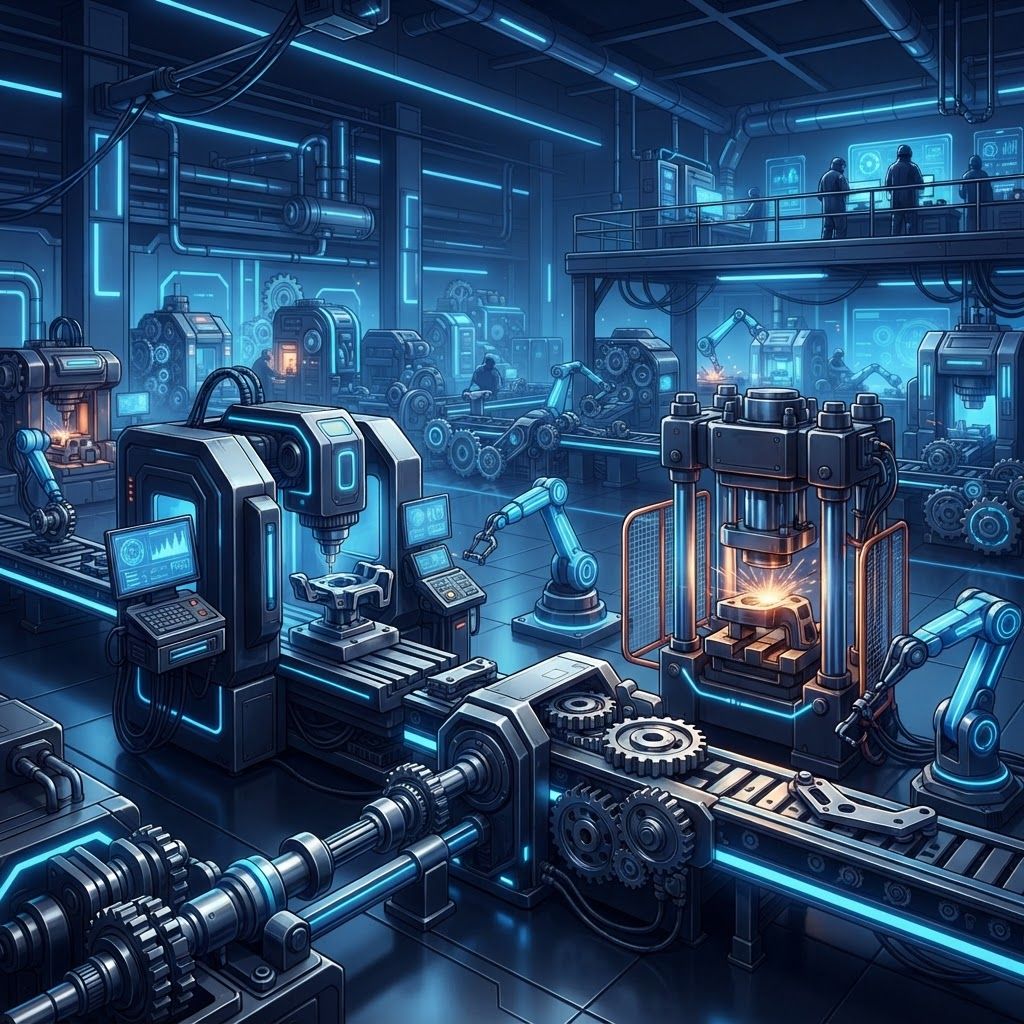
Engineering Heritage and Modern Capability
Bridgend County Borough has been an engineering town for generations. The industrial estates at Bridgend, Waterton, Brackla and Village Farm host a dense concentration of machine shops, fabricators, toolmakers and equipment builders, many of which grew up supplying the large manufacturing plants that once dominated local employment. When those anchor customers changed or departed, the strongest of these businesses diversified into aerospace, medical, renewable energy, food processing and defence work.
That diversification is the sector's defining characteristic today. A typical Bridgend precision engineering firm now serves several unrelated industries, which spreads risk and forces continuous improvement in quality systems. The result is a supply base capable of demanding tolerance work, complex fabrication and full machine build, competitive with anywhere in the United Kingdom.
Machinery and Engineering Businesses in the Area
Rockwool and comparable large process plant operators in the region maintain substantial in-house engineering teams and generate continuous demand for local machinery maintenance and bespoke equipment.
Precision machining companies on Bridgend Industrial Estate operate multi-axis CNC turning and milling centres, producing components to micron tolerances for aerospace, medical and instrumentation customers.
Toolmakers and mould manufacturers in the county borough design and produce press tools, injection moulds and jigs and fixtures, work that requires exceptional skill and long apprenticeship training.
Special purpose machinery builders in South Wales design bespoke automation, assembly and test rigs for manufacturers who cannot buy standard equipment off the shelf, integrating mechanical design, pneumatics, motion control and software.
Heavy fabrication and structural steel businesses around Bridgend produce frames, platforms, hoppers, conveyors and pressure vessels for process industries across Wales.
Conveyor and materials handling specialists supply and install systems for food producers, distribution centres and recycling operations, an area growing steadily with warehouse automation.
Hydraulics and pneumatics engineering firms in the region manufacture, repair and test power units, cylinders and control systems for industrial and mobile plant applications.
Machine tool service and retrofit companies extend the life of existing capital equipment through control system upgrades, spindle rebuilds and accuracy restoration, often more economic than replacement.
Agricultural and quarry equipment manufacturers serving the rural areas surrounding the county borough produce and refurbish specialist plant suited to Welsh conditions.
Engineering design consultancies across South Wales provide computer-aided design, finite element analysis and prototyping services that support machinery builders without in-house design capacity.
Core Capabilities in the Sector
Computer numerical control machining forms the backbone. Modern machine shops run three, four and five-axis milling centres and multi-tasking turning machines capable of producing complex geometries in a single setup. Five-axis capability is particularly valuable for aerospace and medical work, where components have compound curves and features on multiple faces.
Fabrication and welding cover everything from thin sheet enclosures to heavy structural assemblies. Coded welding to recognised standards is essential for pressure equipment and structural work, and firms typically hold approvals for multiple processes and materials including stainless steel, aluminium and duplex alloys.
Assembly and machine build bring components together into working equipment. This requires mechanical fitting, electrical panel building, control system programming, commissioning and often installation at the customer site. Machinery placed on the market must carry appropriate conformity marking and be supplied with technical documentation and risk assessment under supply of machinery safety requirements.
Metrology underpins everything. Coordinate measuring machines, optical comparators and laser scanning verify that parts meet specification, and calibration traceability to national standards is required by most quality systems.
Automation and Industry 4.0
Automation demand has accelerated sharply, driven by labour availability, wage inflation and the need for consistent quality. Bridgend machinery builders are increasingly integrating robotics, vision systems and collaborative robots into equipment for customers who previously relied on manual operations.
Digital technologies are reshaping both the machines built and the businesses building them. Condition monitoring sensors on equipment allow predictive maintenance, alerting operators to bearing wear or misalignment before failure occurs. Digital twins simulate machine behaviour before metal is cut, reducing commissioning time. Manufacturing execution systems provide real-time visibility of shop floor performance.
Additive manufacturing has found a genuine role too, not usually for production parts but for tooling, fixtures, jigs and prototypes, where printing a component overnight is far faster and cheaper than machining it.
Quality, Safety and Certification
ISO 9001 is the baseline. Aerospace customers require AS9100, medical device work needs ISO 13485, and automotive supply demands IATF 16949. Firms serving multiple sectors carry several certifications, and the documentation burden is significant but creates disciplined processes that benefit all customers.
Machinery safety is a legal obligation for builders. Designers must assess hazards, apply the hierarchy of risk reduction, specify appropriate guarding and interlocks, calculate safety-related control system performance levels and compile a technical file. Getting this wrong exposes both builder and user to serious liability.
Health and safety on the shop floor also demands attention, covering machine guarding, local exhaust ventilation for welding fume and metalworking fluid mist, noise exposure, hand-arm vibration and manual handling.
Skills and Apprenticeships
The persistent constraint on growth is skilled labour. Toolmakers, CNC setter-operators, coded welders and controls engineers are in short supply across the United Kingdom, and Bridgend is no exception. Firms that run structured apprenticeship programmes, often in partnership with Bridgend College, generally maintain better capability and retention than those relying on recruitment from competitors.
The nature of the skills is changing. Programming, simulation, robot integration and data analysis now sit alongside traditional craft skills, and the most valuable engineers combine both.
Choosing an Engineering Partner
Match capability to your requirement. A firm equipped for high-volume turned parts is not the right choice for a one-off five-axis prototype. Ask about machine list, capacity, typical batch sizes and lead times.
Assess design input. The best partners review your drawings and suggest changes that reduce cost without compromising function, such as relaxing non-critical tolerances, standardising features or selecting more machinable materials.
Visit the premises. Shop floor organisation, machine condition, measurement equipment and general order tell you a great deal about how a business operates. Discuss quality escapes openly, since how a supplier handles problems matters more than whether they occur.
Bridgend's machinery and precision engineering sector offers genuine depth, from single components to complete automated systems. For manufacturers seeking a capable United Kingdom supply partner, the county borough combines technical competence with the responsiveness that comes from working with businesses rooted in the local community.
Want your brand featured in front of decision-makers? Publish a guest post or get a link insertion in our guides through AAMAX's guest post and link insertion service.
Helpful Links
 SponsoredAAMAX — Full-Service Digital Agency
Write for Us
Share your expertise with our readers. We welcome guest contributions from industry specialists.
Pitch your idea

