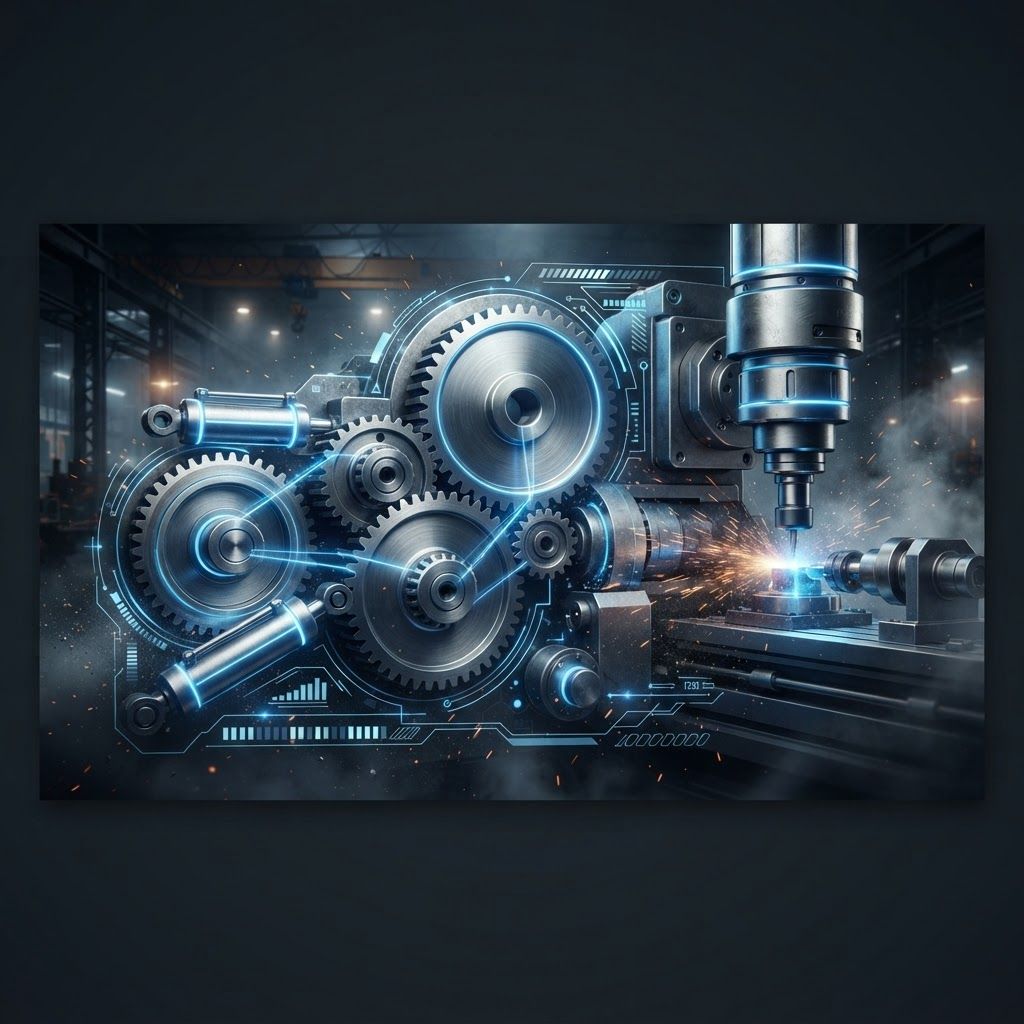
The Foundation Industry
Machinery manufacturing occupies an unusual position in industrial economies. It rarely produces consumer-facing products, receives little public attention, and yet determines what every other manufacturer can achieve. A food producer's throughput depends on its processing and packaging equipment. A logistics operator's efficiency depends on its conveyors, sorters and handling systems. A fabricator's precision depends on its machine tools. Machinery manufacturers supply all of it.
Barking and Dagenham's industrial estates host substantial engineering activity of this kind, alongside the maintenance, repair and installation businesses that support installed equipment. The borough's advantages are practical: industrial units with adequate power supply, floor loading and crane access; road connections suitable for oversized loads; and proximity to a dense concentration of manufacturing and distribution customers across London and the Thames corridor.
The Leading Machinery Manufacturers
Renishaw is among the most technically advanced engineering companies in the UK, producing metrology equipment, machine tool probes and additive manufacturing systems. Its measurement technology underpins precision manufacturing across many sectors.
Spirax Sarco specialises in steam system engineering and thermal energy management, supplying valves, controls and heat transfer equipment to food processing, pharmaceutical and industrial customers. Steam remains fundamental to many industrial processes, and efficiency improvements deliver substantial energy savings.
Weir Group manufactures heavy engineered equipment including pumps and separation machinery for demanding applications where abrasion and wear are severe.
Bosch Rexroth supplies hydraulics, linear motion technology, drives and automation control. Its components form the working elements inside a large proportion of industrial machinery.
Ishida Europe produces weighing, inspection and packaging machinery for food processing, an application area with substantial presence across east London's industrial estates. Multihead weighing technology transformed packing accuracy and giveaway reduction.
Cross Manufacturing specialises in sealing systems and precision components for demanding rotating machinery applications, where tolerance and material performance are critical.
600 Group manufactures machine tools and laser systems, supplying metal cutting and marking equipment to fabricators and precision engineers.
Bradman Lake, Riggs Autopack and Newsmith Stainless complete the leading group. Bradman Lake produces cartoning, wrapping and end-of-line packaging systems. Riggs Autopack manufactures filling and depositing machinery for food producers, particularly for viscous and particulate products. Newsmith Stainless builds hygienic stainless steel equipment and handling systems for food and pharmaceutical environments where cleanability governs design.
Engineering Capabilities and Services
Bespoke machine design addresses requirements that standard equipment cannot meet. Many production problems are specific to a particular product, facility layout or throughput target, and specialist manufacturers develop purpose-built solutions. This work requires mechanical design, controls engineering, fabrication and commissioning capability working together.
Precision machining and fabrication form the manufacturing base. Computer-controlled milling and turning, welding to qualified procedures, sheet metal work and surface treatment all contribute to machine construction. Materials selection matters greatly — stainless grades for hygienic applications, hardened steels for wear surfaces, engineering polymers for low-friction components.
Controls and automation engineering has grown into the largest share of machine value in many applications. Programmable controllers, servo drives, sensors, safety systems and operator interfaces determine machine capability and flexibility. Increasingly, machines are expected to report performance data continuously and integrate with factory information systems.
Installation and commissioning is a distinct discipline. Equipment must be positioned, connected to services, aligned, calibrated, tested against specification and handed over with operator training. Poor commissioning undermines good machinery, and it is where projects most commonly go wrong.
Service, spares and refurbishment sustain equipment through operating lives frequently exceeding twenty years. Planned maintenance, wear part replacement, control system upgrades and complete rebuilds all extend asset life economically. Refurbishment has particular appeal where a mechanically sound machine has an obsolete control system.
Trends in Machinery Manufacturing
Connectivity and data collection have become standard expectations rather than premium features. Machines report throughput, downtime causes, energy consumption and component condition, enabling both immediate response and longer-term analysis. Predictive maintenance based on vibration, temperature and current monitoring reduces unplanned stoppages substantially.
Energy efficiency has moved up the specification hierarchy as industrial electricity costs have risen. Variable speed drives, regenerative braking, improved thermal insulation, compressed air optimisation and heat recovery all reduce operating cost, and payback periods have shortened considerably.
Flexibility has become more valuable than maximum speed for many customers. Shorter production runs and more product variants mean changeover time increasingly determines effective output. Machines designed for rapid, tool-free changeover often outperform faster equipment requiring lengthy setup.
Robotics and collaborative automation continue to spread, particularly for palletising, machine tending, inspection and handling. Collaborative robots that operate safely alongside people have lowered the barrier for smaller manufacturers previously unable to justify guarded automation cells.
Additive manufacturing has found a practical role in machinery production for complex low-volume parts, tooling, jigs and legacy component replacement. It has not displaced conventional machining but complements it usefully.
Selecting a Machinery Supplier
Define the requirement in performance terms rather than equipment terms. Specifying throughput, product characteristics, accuracy, available space and service constraints allows suppliers to propose appropriate solutions rather than quoting against a preconceived design that may be suboptimal.
Examine reference installations. Machinery performance claims are best verified by observing comparable equipment in operation and speaking to operators about reliability, changeover and support quality.
Assess after-sales capability seriously. Machine downtime cost typically dwarfs the price difference between suppliers. Response times, spares availability, engineer coverage and remote diagnostic capability all deserve scrutiny before purchase.
Clarify compliance responsibility. Machinery supplied in the UK must meet safety requirements, with appropriate conformity assessment, risk analysis and documentation. Where equipment is combined into a production line, responsibility for overall conformity needs explicit agreement.
Consider lifecycle cost including energy, consumables, maintenance and expected life rather than capital cost alone. Well-engineered machinery frequently costs more initially and considerably less over twenty years.
Conclusion
Machinery manufacturing relevant to Barking and Dagenham supplies the productive capability on which the borough's food processing, logistics, fabrication and construction sectors depend. The strongest manufacturers combine mechanical engineering depth with controls expertise, realistic performance claims and genuine service capability. For any business investing in production equipment, that combination determines whether the investment delivers over decades or disappoints within years.
Want your brand featured in front of decision-makers? Publish a guest post or get a link insertion in our guides through AAMAX's guest post and link insertion service.
Helpful Links
 SponsoredAAMAX — Full-Service Digital Agency
Write for Us
Share your expertise with our readers. We welcome guest contributions from industry specialists.
Pitch your idea