

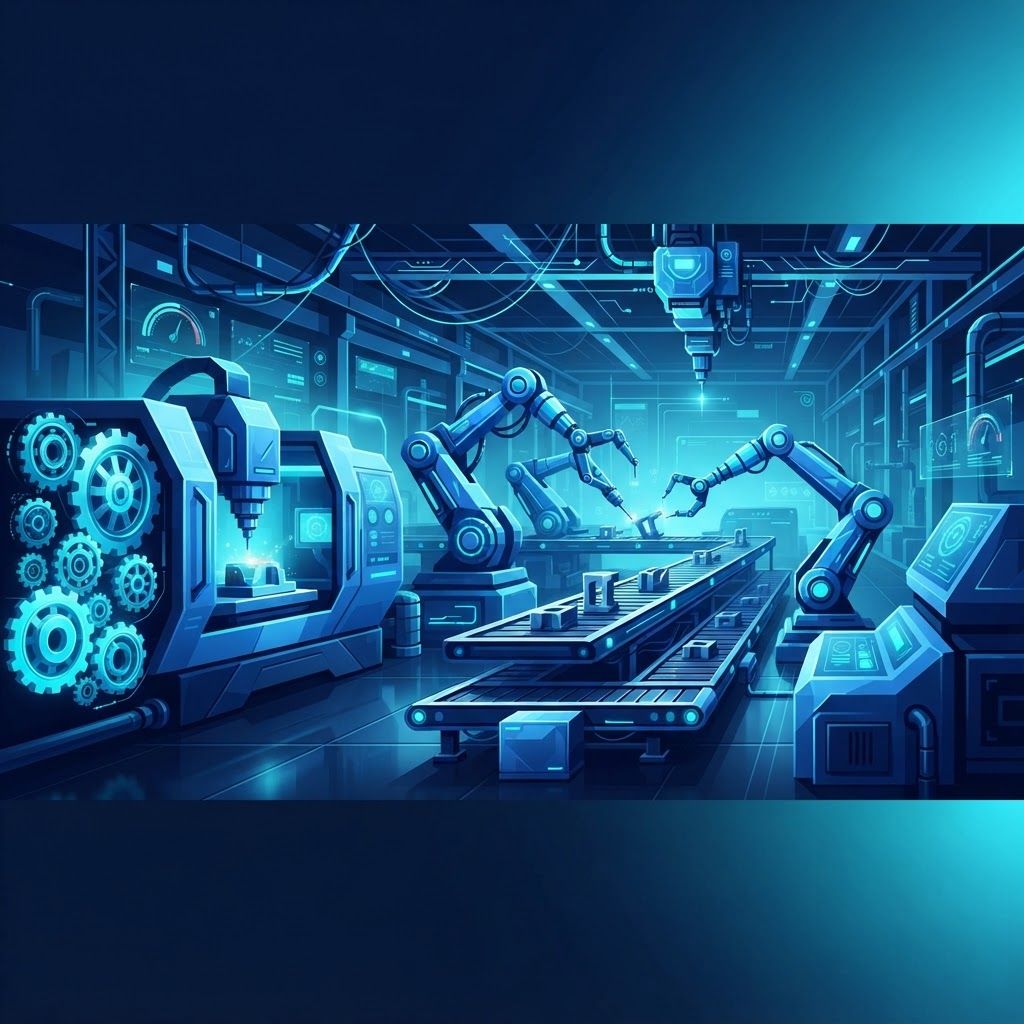
Ashford's Machinery Manufacturing Landscape
Machinery manufacturing is the industry that makes other industries possible. Around Ashford, it takes several forms: bespoke automation systems built for a single customer's process, agricultural equipment serving the surrounding Kent farmland, food processing and packaging lines, materials handling equipment and precision engineering subcontract work.
The borough's industrial estates house a concentration of engineering firms whose combined capability covers design, fabrication, machining, assembly, control systems and commissioning. Proximity to the M20 and the Channel gives these businesses access to both domestic and Continental markets, and many export a meaningful share of their output. For local manufacturers, having capable machine builders nearby means faster response when a production line stops.
The Top 10 Machinery Manufacturers in Ashford
1. Stour Engineering Systems
A bespoke machine builder specialising in automation for manufacturing and packaging. Stour Engineering Systems takes projects from concept through mechanical design, control software, build and on-site commissioning. Clients consistently praise the thoroughness of its factory acceptance testing, which reduces surprises at installation.
2. Weald Agricultural Machinery
Manufactures and adapts equipment for arable and horticultural operations across Kent, including handling, grading and crop processing machinery. Its understanding of seasonal pressure means it prioritises reliability and field serviceability over unnecessary complexity.
3. Ashford Precision Machining
A subcontract machining specialist with multi-axis capability, serving machine builders and equipment manufacturers with components to tight tolerance. Its metrology facilities and inspection reporting are strong, which matters when parts must fit first time.
4. Kentish Food Processing Equipment
Designs and builds stainless steel processing and packaging machinery for food and beverage producers. Hygienic design, cleanability and compliance with food contact requirements are central to its work, and it understands the documentation auditors expect.
5. Marsh Materials Handling
Produces conveyors, elevators, tipping units and bulk handling systems. Robust construction and straightforward maintenance access characterise its equipment, which is designed for continuous industrial duty rather than light use.
6. Brightline Automation
Focuses on robotics integration, vision systems and control engineering. Rather than building complete machines from scratch, it frequently upgrades existing lines with automation, which offers manufacturers a lower-risk route to improved throughput.
7. Repton Hydraulics and Pneumatics
Manufactures and services hydraulic power packs, cylinders and pneumatic systems. Its rapid hose and cylinder repair service is widely used by plant operators who cannot afford extended downtime.
8. Eastwell Fabrication and Machinery
Combines heavy fabrication with machine assembly, producing frames, guarding, chassis and structural elements alongside complete equipment. Welding quality and structural integrity are the foundation of its reputation.
9. Singleton Special Purpose Machines
Builds one-off machines for testing, assembly and inspection applications where no standard product exists. This is problem-solving engineering, and the company excels at translating an awkward process requirement into a reliable mechanism.
10. Pilgrims Way Machine Services
Provides refurbishment, retrofitting, relocation and preventative maintenance for industrial machinery. Extending the life of capital equipment through control system upgrades and mechanical overhaul is often far more economical than replacement, and this firm specialises in exactly that.
Specifying Machinery Correctly
Most disappointing machinery projects fail at the specification stage, not during the build. Vague requirements produce equipment that technically meets the contract but does not solve the problem. A good specification defines throughput at a stated quality level, product variants to be handled, changeover expectations, available floor space and services, integration with upstream and downstream equipment, and the environment the machine will operate in.
Equally important is defining acceptance criteria. How will performance be measured, over what period, and with what materials? Agreeing this before the build begins protects both parties and removes the ambiguity that sours otherwise successful projects.
Automation, Robotics and Realistic Expectations
Automation delivers most value where processes are repetitive, high volume and consistent. It struggles where inputs vary unpredictably or where human judgement handles frequent exceptions. Experienced Ashford machine builders will assess this honestly rather than automating a process that should first be simplified.
Collaborative robots have widened the range of viable applications by reducing guarding requirements and installation cost, making automation accessible to smaller manufacturers. Vision systems have similarly improved, allowing machines to handle greater variation than was previously practical.
Safety, Compliance and Documentation
Machinery placed into service must meet safety requirements covering risk assessment, guarding, emergency stop systems, control system reliability and residual risk communication. Proper technical files, declarations and operating manuals are legal necessities, not paperwork exercises.
When comparing suppliers, ask to see an example technical file and risk assessment. Manufacturers who take this seriously produce clear, structured documentation. Those who do not tend to produce something assembled hastily at the end of the project, which is a warning sign about the engineering behind it.
Maintenance and Whole-Life Cost
Purchase price is a fraction of total cost. Spare parts availability, ease of access for routine maintenance, use of standard rather than proprietary components, and the responsiveness of the supplier's service team all determine what the machine really costs over ten years.
Ask what the recommended maintenance schedule looks like, which parts are consumable, and how quickly critical spares can be supplied. Machines built around widely available standard components are far easier to keep running than those relying on bespoke parts from a single source.
Industry Trends
Connected machinery is becoming standard, with condition monitoring and remote diagnostics allowing faults to be predicted rather than discovered. Energy efficiency has moved up the specification list as electricity costs have risen. And modular design is increasingly favoured, letting manufacturers reconfigure equipment as products change rather than replacing entire lines.
Final Thoughts
Ashford supports a genuinely capable machinery manufacturing sector, from bespoke automation and agricultural equipment to precision machining and refurbishment. The quality of the outcome depends heavily on the clarity of the specification and the depth of the supplier's engineering. Involve the builder early, define acceptance criteria precisely, and weigh maintenance and support at least as heavily as the initial quotation.
Want your brand featured in front of decision-makers? Publish a guest post or get a link insertion in our guides through AAMAX's guest post and link insertion service.
Helpful Links
 SponsoredAAMAX — Full-Service Digital Agency
Write for Us
Share your expertise with our readers. We welcome guest contributions from industry specialists.
Pitch your idea

