

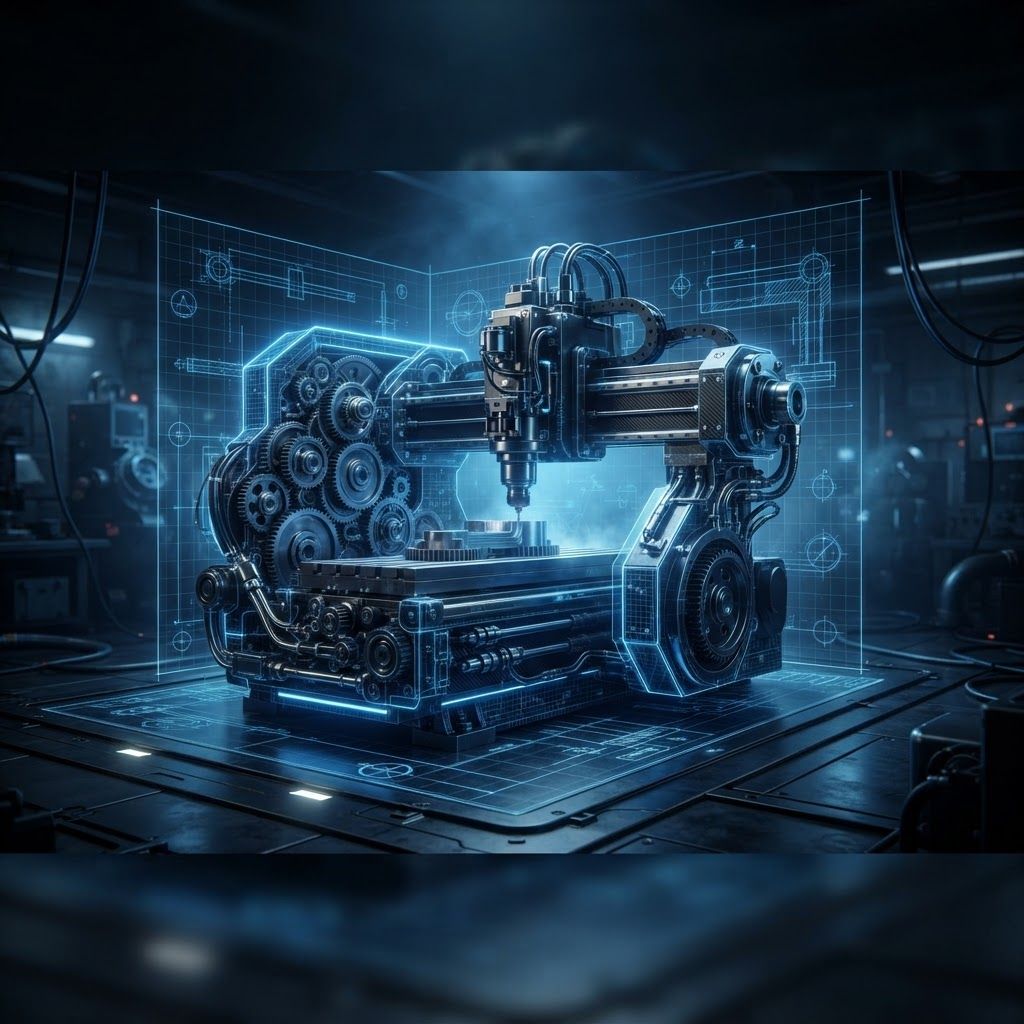
Engineering Heritage and Modern Machinery Building
Ashfield's engineering tradition was forged in the demanding environment of mining and heavy industry, where equipment had to be robust, repairable and reliable under continuous load. That culture of practical, durable engineering survived the decline of the pits and now underpins a machinery manufacturing sector producing bespoke production equipment, automation systems, material handling machinery and precision components.
Machinery manufacturing differs fundamentally from volume production. Most output is made to order, frequently to a customer's unique specification, and each project involves design, procurement, fabrication, assembly, commissioning and often operator training. The businesses that succeed combine mechanical design capability, controls engineering, fabrication skill and project management within a single organisation.
What Local Machinery Manufacturers Build
Bespoke production machinery is the flagship capability. This covers purpose-designed equipment for assembly, forming, filling, packing, testing, joining and finishing operations. Customers typically approach with a process problem rather than a specification, and the manufacturer develops the solution.
Automation and robotics integration has grown substantially. Robotic cells for welding, machine tending, palletising, pick and place and inspection are increasingly specified by manufacturers facing labour availability constraints and quality consistency demands.
Material handling equipment includes conveyors, elevators, accumulation systems, automated storage and retrieval, and bulk handling for powders and granular materials. Ashfield's logistics and food processing sectors generate steady demand.
Precision machining and toolmaking supports both machinery building and external customers, producing components to tight tolerance on computer-controlled turning and milling equipment, alongside jigs, fixtures and specialist tooling.
Fabrication and structural work covers machine frames, guarding, hoppers, tanks, platforms and access structures, involving cutting, forming, welding and surface treatment.
Control systems engineering encompasses programmable logic controller programming, human machine interface design, servo and drive systems, safety circuits and data collection integration.
Service, refurbishment and upgrade forms a substantial ongoing business, extending the life of existing equipment through mechanical overhaul, control system retrofit and safety compliance upgrades.
What Distinguishes the Best Machinery Manufacturers
Genuine design capability is the primary differentiator. Firms with in-house mechanical designers, controls engineers and simulation capability can develop original solutions rather than assembling catalogue components. Three-dimensional modelling, finite element analysis and process simulation allow problems to be identified before metal is cut.
Project management discipline matters enormously. Machinery projects involve long lead-time components, multiple disciplines and fixed installation windows. Manufacturers with structured project management, realistic scheduling and proactive communication deliver on time, while those without routinely overrun.
Compliance and safety engineering is a legal requirement rather than an option. Machinery must be designed to recognised safety standards, with risk assessment, appropriate guarding, safety-rated control circuits, conformity assessment and complete technical documentation. Manufacturers treating this as an afterthought expose their customers to serious liability.
Commissioning and support capability determines the real-world outcome. A machine that works in the builder's workshop but fails to integrate with the customer's existing line has not solved the problem. The best manufacturers plan integration carefully, commission on site, train operators thoroughly and provide responsive breakdown support.
Documentation quality is frequently overlooked but hugely valuable. Complete drawings, electrical schematics, parts lists, maintenance schedules and operating manuals determine whether equipment can be maintained economically over a twenty-year life.
Trends in Machinery Manufacturing
Industrial digitalisation is embedding sensors, connectivity and data analytics into new equipment as standard, enabling condition monitoring, predictive maintenance and production performance analysis.
Collaborative robotics has lowered the barrier to automation for smaller manufacturers, allowing robots to work alongside operators without extensive guarding where risk assessment permits.
Labour constraint is the strongest current driver of automation investment, as manufacturers struggle to recruit for repetitive or physically demanding roles.
Energy efficiency has become a design consideration, with variable speed drives, regenerative braking, efficient pneumatics and reduced compressed air consumption all reducing operating cost.
Retrofit and life extension is growing as capital budgets tighten, with control system upgrades and safety compliance retrofits offering much of the benefit of new equipment at lower cost.
Choosing a Machinery Manufacturer
Define the problem rather than the solution. Describing your process, throughput requirement, product variability and quality targets allows the manufacturer to propose the most effective approach, which may differ from your initial assumption.
Review comparable projects and, where possible, speak to previous customers about delivery performance and post-installation support.
Clarify scope precisely, including who is responsible for installation, services connection, integration with existing equipment, conformity assessment and operator training.
Discuss the payment structure and project milestones, and understand what constitutes acceptance.
Assess spare parts and support arrangements, including availability of critical components and response times for breakdown attendance.
Consider whole-life cost rather than purchase price. A machine with lower energy consumption, better reliability and readily available parts frequently costs less over its life than a cheaper alternative.
The Outlook
Machinery manufacturing in Ashfield is well placed for continued demand as manufacturers across the region invest in automation to address labour constraints and productivity targets. Firms combining mechanical design depth with controls engineering and strong project delivery will remain the district's most capable engineering partners.
Want your brand featured in front of decision-makers? Publish a guest post or get a link insertion in our guides through AAMAX's guest post and link insertion service.
Helpful Links
 SponsoredAAMAX — Full-Service Digital Agency
Write for Us
Share your expertise with our readers. We welcome guest contributions from industry specialists.
Pitch your idea

