

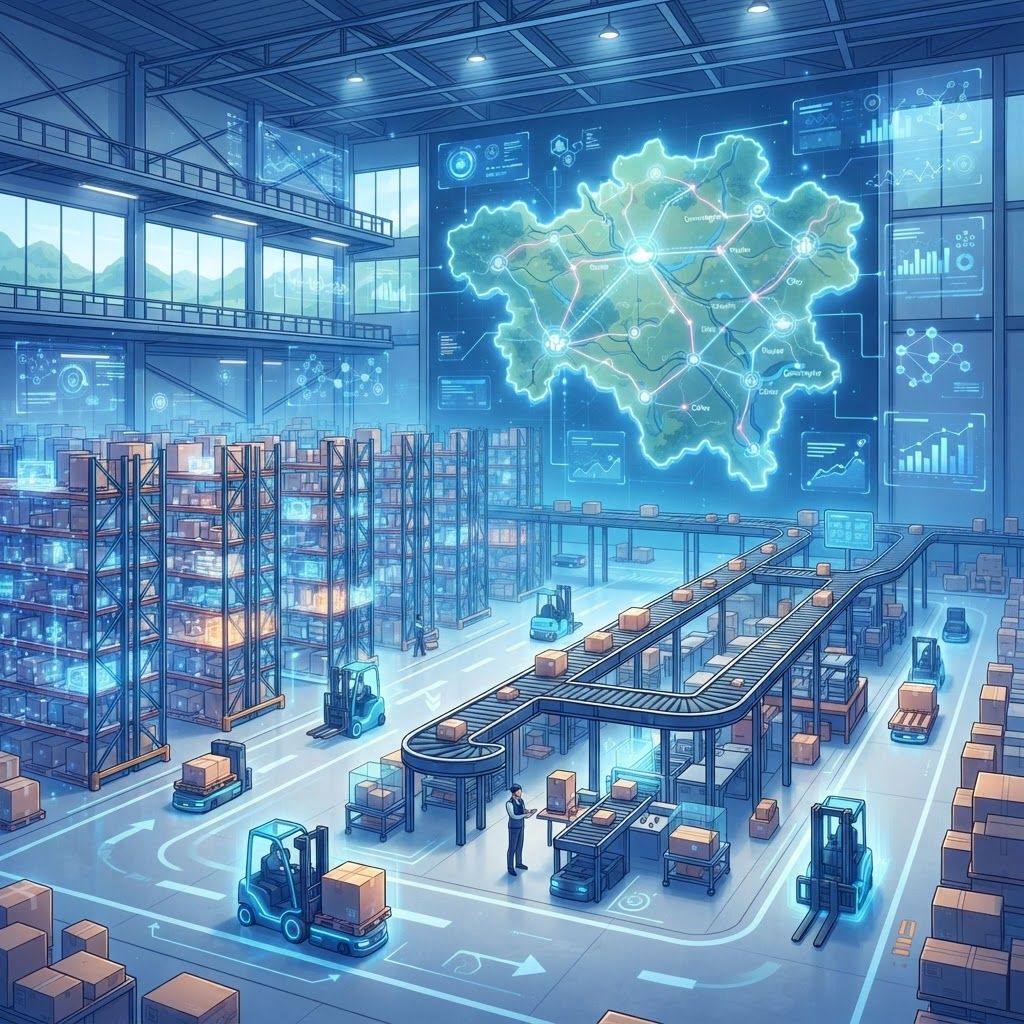
Logistics in Mid Wales
Logistics is broader than haulage. Where freight is about moving goods, logistics is about designing and running the whole chain: procurement, inbound transport, storage, inventory management, order processing, packing, outbound distribution, returns and the information systems that hold it all together. In Powys, doing this well requires solving problems that urban logistics operations rarely face.
The county has no motorway, no port, no airport and no major rail freight terminal. It has a dispersed population, a strongly seasonal agricultural economy, an expanding tourism sector that creates sharp demand peaks, and a manufacturing base spread across small industrial estates in towns such as Newtown, Welshpool, Ystradgynlais and Llandrindod Wells. Distribution here is about intelligent consolidation rather than volume density.
Ten Categories of Logistics Provider Serving Powys
1. Third-party logistics providers offering warehousing and distribution. These firms store client inventory, pick and pack orders, manage stock levels and arrange onward delivery. For a small Powys manufacturer or online retailer, outsourcing to a third-party provider converts fixed warehouse costs into variable ones and removes the need to employ warehouse staff in a tight rural labour market.
2. Agricultural supply chain and feed logistics specialists. A defining sector in this county. These operations manage the flow of animal feed, fertiliser, seed, bedding and veterinary supplies to thousands of farms, and the outbound flow of livestock, milk, grain and wool. Their scheduling must work around lambing, silage, harvest and market days.
3. Cold chain and food logistics operators. Serving dairies, meat processors, cheese makers, bakeries and drinks producers with refrigerated storage, temperature-controlled transport and full traceability. Food safety compliance and unbroken cold chain documentation are the core competencies.
4. E-commerce fulfilment providers. A fast-growing category as Powys producers of food, crafts, outdoor equipment, textiles and specialist goods sell nationally and internationally. Fulfilment partners integrate with online sales platforms, handle same-day picking, manage carrier selection and process returns.
5. Freight forwarding and customs specialists. Managing international movements for Welsh exporters, including customs declarations, export health certificates for food and animal products, incoterms advice and coordination with ports and airports outside the county. Since the customs environment changed, this expertise has become significantly more valuable to Powys businesses.
6. Construction and building materials logistics. Managing the flow of aggregates, timber, steel, plasterboard and prefabricated components to sites across a county where deliveries often go to remote locations with limited unloading equipment. Providers offering crane-equipped vehicles and just-in-time scheduling are particularly valuable.
7. Self-storage, contract storage and overflow warehousing. Facilities in and around the main towns offering flexible space for businesses with seasonal inventory swings, archive storage, equipment storage for tourism operators and overflow capacity during peak periods.
8. Reverse logistics and waste management providers. Handling returns, recycling, packaging recovery, agricultural plastics collection and commercial waste. Circular economy requirements have moved this from a peripheral service to a mainstream part of supply chain design.
9. Last mile delivery specialists for rural addresses. The hardest problem in Powys logistics. Operators who reliably deliver to farms up unsurfaced tracks, to villages with no street numbering and to properties with no mobile signal for delivery apps provide a service that national networks often struggle to replicate.
10. Supply chain consultancies and logistics technology providers. Advisers who map a business's flows, identify cost and carbon savings, implement warehouse and transport management software, and design network changes. For growing Powys manufacturers, this strategic layer often unlocks more value than changing carriers.
The Specific Challenges of Rural Logistics
Drop density is the fundamental economic issue. In a city, a delivery vehicle might complete eighty drops in a day within a few square kilometres. In Powys the same vehicle might complete fifteen across two hundred kilometres. Every cost per drop is therefore higher, and the operators who succeed are those who consolidate loads across multiple clients and plan routes with genuine sophistication.
Access constraints follow. Weight-restricted bridges, low railway arches, tight village corners, unsurfaced farm tracks and properties with no hard standing all shape which vehicle can be sent where. Experienced local operators maintain detailed site knowledge that is effectively a proprietary asset.
Seasonality creates sharp peaks. The agricultural calendar, the tourism season, the Royal Welsh Show and the Hay Festival all generate concentrated surges in demand for transport, storage and delivery, followed by quiet periods. Flexible capacity through partnerships and subcontracting is essential.
Connectivity affects operations directly. Warehouse systems, driver apps, electronic proof of delivery and real-time tracking all assume data coverage that is patchy across upland Powys. Robust operators design for offline working and synchronise when signal returns.
How to Evaluate a Logistics Partner
Begin with the systems. Ask what warehouse management and transport management software they use, whether it integrates with your own order platform or accounting system, what reporting you will receive, and how stock accuracy is measured and maintained.
Examine compliance and accreditation. Depending on sector, relevant markers include operator licensing, food safety certification, organic certification handling, hazardous goods competence, and quality management standards. For anything involving animal products crossing borders, certification capability is decisive.
Test service recovery rather than service promises. Every logistics operation experiences failures; the difference between providers is how quickly they detect a problem, how proactively they communicate it and how effectively they resolve it. Ask for specific examples.
Understand the cost structure fully. Storage charges per pallet or per square metre, pick and pack fees, carriage rates by zone and weight, fuel surcharges, minimum monthly commitments and charges for returns handling all need to be visible before comparison is meaningful.
Trends Shaping Powys Logistics
Sustainability has moved from marketing to measurement. Customers increasingly request carbon reporting for their supply chains, and providers are responding with route optimisation, load consolidation, alternative fuels and reduced packaging. In a rural county, consolidation is by far the biggest lever.
Nearshoring and supply chain resilience have encouraged some manufacturers to hold more stock closer to production, increasing demand for regional warehousing rather than reliance on distant national distribution centres.
Automation is arriving in smaller increments than in large distribution centres, but barcode and radio frequency scanning, automated documentation, and integrated carrier selection are now standard even in modest Powys warehouses.
Collaborative logistics, where several small businesses share transport and storage capacity, is growing. In a county where no single small producer generates enough volume for efficient distribution, sharing capacity is often the only route to competitive delivery costs.
Conclusion
Logistics in Powys will never enjoy the economies of scale available in the Midlands or the south east, but the county's providers have developed genuine expertise in doing difficult work reliably. For any business operating in mid Wales, the right logistics partner is not simply a cost line. It is the difference between selling only locally and competing nationally, and it deserves the same care in selection as any other strategic relationship.
Want your brand featured in front of decision-makers? Publish a guest post or get a link insertion in our guides through AAMAX's guest post and link insertion service.
Helpful Links
 SponsoredAAMAX — Full-Service Digital Agency
Write for Us
Share your expertise with our readers. We welcome guest contributions from industry specialists.
Pitch your idea

