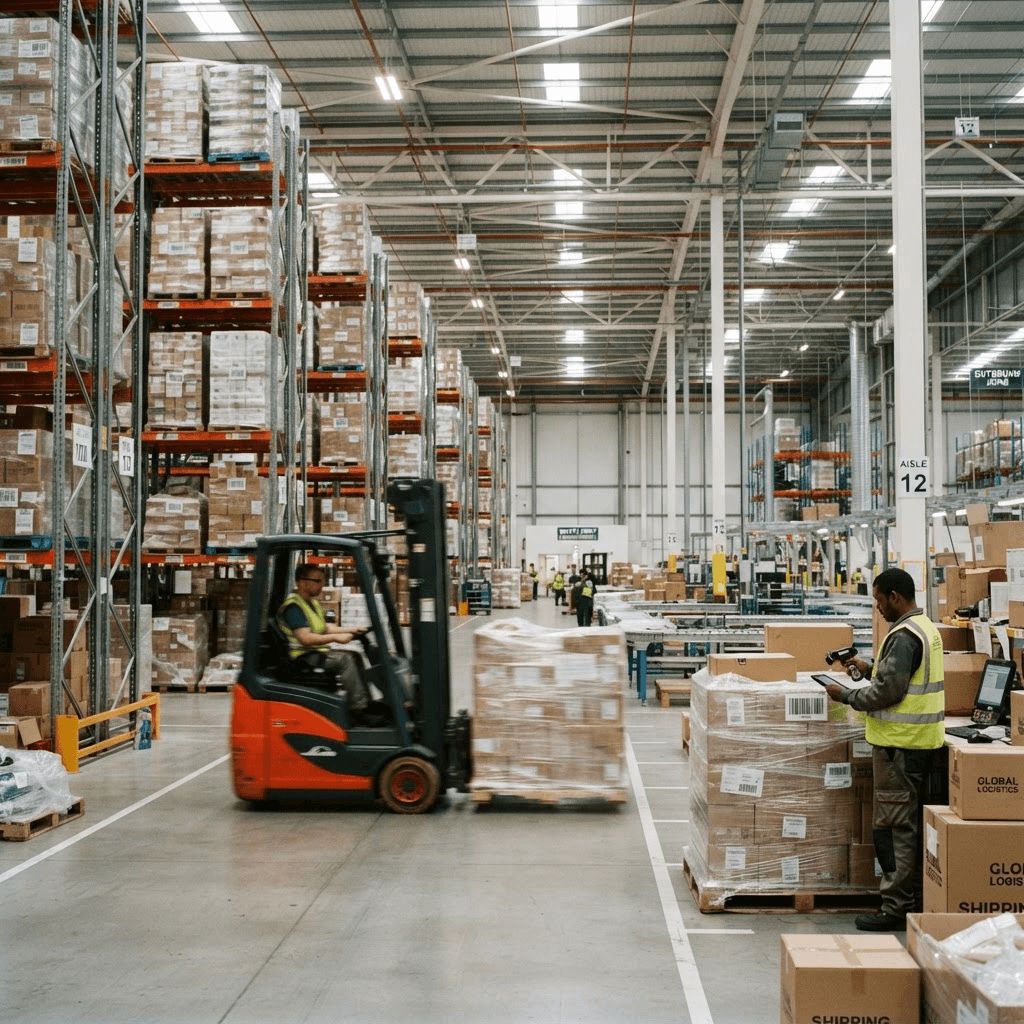
How Barnsley Became a Logistics Location
Few towns illustrate industrial reinvention as clearly as Barnsley. The collieries that once defined the borough's economy left behind something unexpectedly valuable to modern logistics: large, flat, well-connected brownfield sites adjacent to the M1. Over the past two decades, regeneration programmes across the Dearne Valley and along the motorway corridor have converted much of that land into distribution parks, contract packing facilities and fulfilment centres.
The result is a borough where logistics is now a major employer. Barnsley offers something that many established distribution locations no longer can: available modern warehouse space at costs well below those in the Midlands golden triangle, combined with drive times that still reach the majority of the UK population within a single shift. For companies distributing nationally, that arithmetic is compelling.
What Modern Logistics Actually Includes
Logistics extends considerably further than moving boxes. A full-service provider may handle inbound freight receipt, quality inspection, put-away and storage, inventory management, pick and pack, kitting and co-packing, labelling and rework, order despatch, carrier management, returns processing and reverse logistics. Increasingly it also includes data services: demand forecasting, stock optimisation and reporting integrated directly with a client's own systems.
Understanding this breadth matters because businesses often approach logistics providers asking only about storage rates, when the real cost drivers are handling volumes, order profiles and value-added activities.
Ten Leading Logistics Providers and Specialisms in Barnsley
1. Large-scale third-party logistics operators on the M1 corridor. National 3PL businesses operate substantial warehouse campuses in and around the borough, offering multi-client shared-user facilities alongside dedicated space. Their strengths are scalability, established warehouse management systems, national carrier buying power and the ability to absorb seasonal peaks that would overwhelm smaller providers.
2. E-commerce fulfilment specialists. The growth of online retail created a distinct category of provider geared entirely around single-item orders. These operations integrate directly with Shopify, Amazon, eBay and other marketplaces, offering same-day despatch cut-offs, branded packaging and streamlined returns handling that direct-to-consumer brands depend on.
3. Contract packing and co-packing businesses. Barnsley has a genuine cluster of contract packers, handling promotional multipacks, shrink wrapping, display units and retail-ready packaging. For food, drink and household goods brands supplying supermarkets, these providers make short-run promotional activity commercially viable.
4. Temperature-controlled and food logistics providers. Chilled and ambient food distribution requires audited hygiene standards, temperature monitoring and strict traceability. Providers serving this sector in South Yorkshire typically hold BRC storage and distribution certification and work to retailer-specific compliance regimes.
5. Freight forwarding and customs specialists. With Humber and Immingham ports nearby and Manchester and East Midlands airports accessible, freight forwarders based in the region arrange sea, air and road movements internationally. Their customs expertise, including deferment accounts and commodity classification, became substantially more valuable following changes to UK import and export procedures.
6. Regional warehousing and storage companies. Independent warehouse operators offer flexible pallet storage on shorter commitments than large 3PLs typically accept. For businesses with fluctuating stock levels, overflow requirements or seasonal inventory, this flexibility is often the deciding factor.
7. Contract distribution and dedicated fleet providers. Some operators combine warehousing with a dedicated vehicle fleet liveried in the client's branding. This model gives growing manufacturers a complete outsourced supply chain without the capital cost of buildings, racking, handling equipment or an operator's licence.
8. Reverse logistics and returns management specialists. Returns are now a defining cost in retail. Providers focused on this area inspect, grade, refurbish, repackage and reintroduce returned stock, recovering value that would otherwise be written off. Demand has grown sharply alongside online apparel and electronics sales.
9. Supply chain consultancies and 4PL managers. Rather than owning assets, fourth-party providers design and manage supply chains on a client's behalf, selecting and coordinating carriers and warehouses. Businesses use them for network modelling, tender management and cost reduction programmes where independence from asset ownership is an advantage.
10. Courier consolidators and multi-carrier managers. These companies aggregate parcel volumes to secure improved carrier rates and provide software that automatically routes each order to the most suitable carrier by size, destination and service level. For mid-sized online retailers the savings are frequently significant.
Technology That Defines Good Logistics Today
A credible logistics partner should offer a modern warehouse management system with real-time stock visibility through a client portal or API integration. Barcode and increasingly RFID scanning underpin inventory accuracy, and automated data exchange with a client's ERP or e-commerce platform eliminates the manual reconciliation that causes so many stock discrepancies.
Automation is advancing in local facilities too. Conveyor and sortation systems, goods-to-person picking stations, automated carton erectors and warehouse robotics are appearing in higher-throughput operations. Meanwhile analytics and machine learning tools are being applied to demand forecasting and slotting optimisation, improving pick efficiency without physical investment.
Accreditation, Insurance and Due Diligence
Before appointing a provider, verify the fundamentals. ISO 9001 for quality and ISO 14001 for environmental management indicate mature processes. Warehouse-specific standards such as BRC apply to food and consumer goods. Authorised Economic Operator status matters for international trade. Confirm goods-in-transit and stock insurance limits, ask whether cover is on a per-claim or aggregate basis and check bonded or duty-suspended capability if you import.
Equally important are operational references. Ask for inventory accuracy figures, order accuracy rates, on-time despatch performance and average time to resolve a claim. Visit the site. A well-run warehouse is visibly organised, with clear aisle marking, orderly racking and disciplined goods-in areas.
Cost Structures and Negotiation
Logistics pricing typically combines storage charged per pallet or per square foot per week, handling charged per inbound pallet and per outbound order line, plus carriage and value-added service charges. Businesses are often surprised by handling costs because these scale with order volume rather than stock volume. Model your true order profile before comparing quotations.
Negotiate on the variables that actually move: minimum volume commitments, peak season surcharges, notice periods, service level agreements with meaningful remedies and annual price review mechanisms tied to transparent indices rather than open-ended increases.
Sustainability and the Road Ahead
Environmental performance has moved from marketing claim to procurement requirement. Providers in Barnsley are investing in solar installations on warehouse roofs, LED lighting, electric handling equipment, packaging reduction programmes and route optimisation to cut vehicle mileage. Larger clients increasingly request carbon reporting at consignment level.
Looking forward, the borough's logistics sector appears well placed. Continued warehouse development, a workforce with growing supply chain skills supported by local college provision, and cost advantages over southern locations suggest Barnsley will remain a serious contender for distribution investment.
Making the Right Choice
The best logistics partner is rarely the largest or the cheapest. It is the one whose operational strengths match your order profile, whose systems integrate cleanly with yours and whose account team treats your business as a priority rather than a rounding error. Given the depth of provision in and around Barnsley, businesses here have the luxury of being genuinely selective.
Want your brand featured in front of decision-makers? Publish a guest post or get a link insertion in our guides through AAMAX's guest post and link insertion service.
Helpful Links
 SponsoredAAMAX — Full-Service Digital Agency
Write for Us
Share your expertise with our readers. We welcome guest contributions from industry specialists.
Pitch your idea