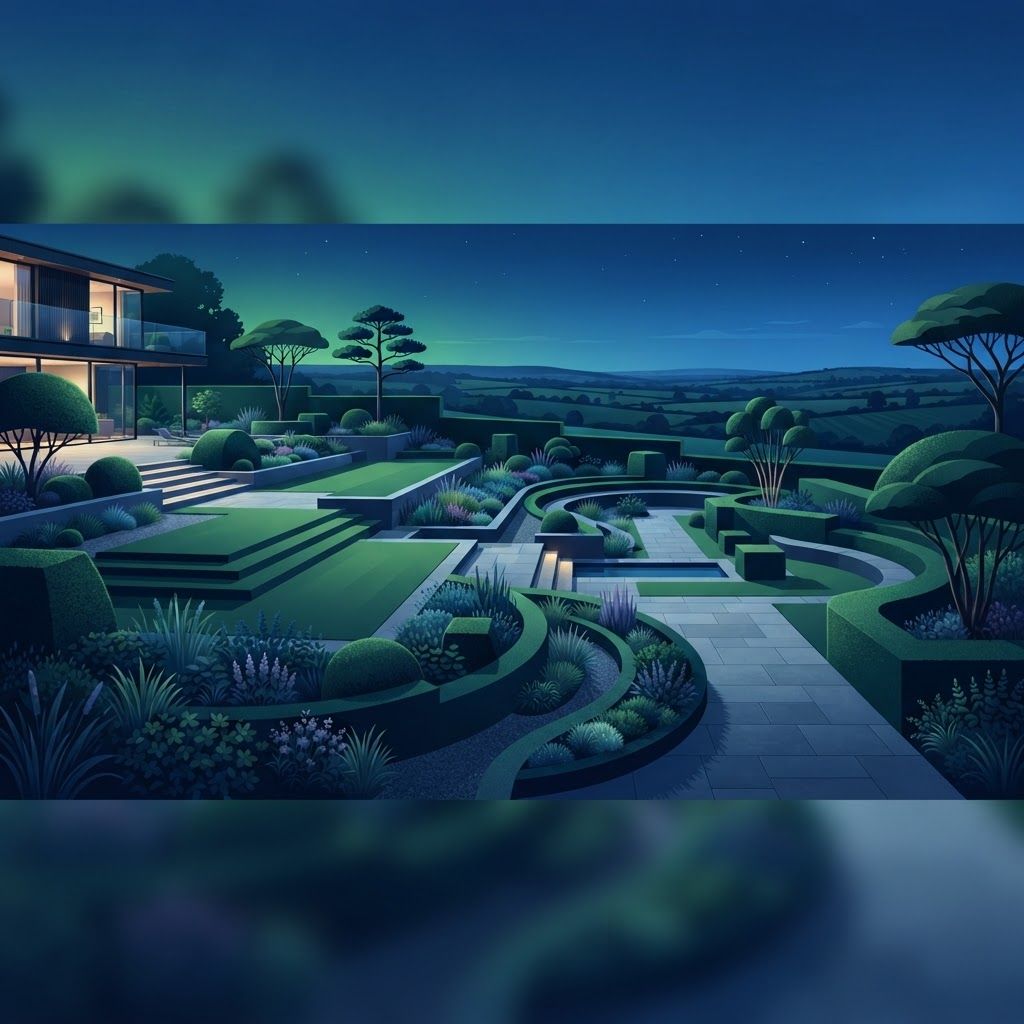
Gardening on Chalk and Clay
North Hertfordshire sits where the Chiltern chalk meets heavier boulder clay, and the soil beneath a garden fundamentally shapes what can be grown there. Thin, free-draining alkaline chalk soils around Royston, Therfield and the downland villages suit Mediterranean planting, lavender, rosemary, cistus and ornamental grasses, while punishing acid-lovers such as rhododendrons and camellias. Heavier clay soils elsewhere hold moisture and nutrients well but compact easily and crack in drought.
The best landscaping companies in the district begin with soil assessment rather than a plant list. Testing pH and structure, identifying drainage patterns and observing existing vegetation tells a designer far more about what will thrive than any catalogue. Working with the ground rather than against it produces gardens that establish quickly and need less intervention over time.
The Garden City Design Legacy
Letchworth Garden City was founded on the principle that landscape and housing should be planned together, and that legacy remains visible in generous gardens, tree-lined avenues, grass verges and hedged boundaries. Many properties in the town fall within a scheme of management that governs alterations to front gardens, boundary treatments and tree removal.
Landscaping companies experienced in Letchworth understand these constraints and design within them, choosing boundary hedging and planting that suits the town's character rather than imposing generic contemporary schemes. Similar sensitivity is needed in the conservation areas of Hitchin, Baldock and Ashwell.
Hard Landscaping Standards
Patios, paths, driveways, retaining walls, steps and garden structures form the skeleton of a garden, and they are where quality is most enduring and most expensive to correct. Proper construction means excavating to an adequate depth, installing a compacted sub-base of appropriate thickness, laying on a full mortar bed rather than spot bedding, and building in falls that direct water away from buildings.
Drainage deserves particular attention. Planning rules require that new driveways either use permeable surfaces or direct runoff to a soakaway rather than the highway drain. Permeable block paving, resin-bound gravel and properly designed soakaways have consequently become standard specifications. On the district's clay soils, soakaway sizing must account for slow infiltration rates.
Material choice matters aesthetically too. Locally appropriate materials, clay pavers, reclaimed brick, flint detailing and natural stone with a subdued tone, sit far better against the district's older buildings than bright imported porcelain.
Soft Landscaping and Planting Design
Planting is where a garden acquires character. Skilled designers work in layers: structural trees and shrubs providing year-round form, perennial planting delivering seasonal movement and colour, and ground cover suppressing weeds and protecting soil.
There is strong momentum towards naturalistic, resilient planting. Drought-tolerant perennials and ornamental grasses require less irrigation, tolerate the increasingly hot, dry summers the region has experienced, and support pollinators. Native hedging such as hawthorn, blackthorn, field maple and hornbeam provides habitat value and suits the rural edges of the district far better than close-boarded fencing.
Lawn treatment is changing too. Many clients now accept a more relaxed lawn with clover and wildflower margins rather than a striped monoculture requiring constant feeding and watering.
Sustainable and Climate-Resilient Gardens
Water management has become central to good landscape design. Rainwater harvesting from roofs, rain gardens that absorb runoff, permeable surfacing and thoughtful mulching all reduce mains water dependence and cope better with both drought and heavy rainfall.
Biodiversity is increasingly a design objective rather than an afterthought. Log piles, native planting, ponds without fish, hedgehog corridors through boundaries and reduced lighting all support wildlife. Some landscapers now also account for the carbon impact of materials, favouring locally sourced stone and timber over imported alternatives, and reusing excavated material on site rather than sending it to landfill.
Garden Rooms, Outdoor Living and Lighting
Outdoor living space has become a priority for households across the district. Garden rooms serving as offices or studios, outdoor kitchens, pergolas and covered seating areas extend how gardens are used through the year. These projects often require coordination between landscapers, electricians and sometimes building control, and companies that manage that coordination smoothly add real value.
Garden lighting, carefully specified, transforms a space after dark. Contemporary practice favours restrained, warm, low-level lighting that highlights structure and planting while limiting light spill, which benefits both neighbours and nocturnal wildlife.
Maintenance Services
Landscapes need ongoing care. Many companies offer maintenance programmes covering seasonal pruning, border management, lawn treatment, hedge cutting and irrigation servicing. Choosing a maintenance provider who understands the original design intent prevents the gradual erosion of a scheme through inappropriate pruning and replanting.
Choosing a Landscaping Company
Look for membership of the British Association of Landscape Industries or the Association of Professional Landscapers, both of which vet members. Ask to see completed projects at least two or three years old, because that is when construction quality and planting design reveal themselves.
Insist on a detailed quotation covering excavation depths, sub-base specification, materials by name, drainage provision and plant schedules with sizes. Clarify aftercare responsibilities, particularly watering during establishment, and what plant guarantee applies. Check tree work competence separately, as it requires arboricultural qualification and awareness of tree preservation orders, which are widespread across the district.
Final Thoughts
The best landscaping companies in North Hertfordshire design with the local soil, climate and architectural character rather than applying a standard formula. Sound hard landscaping construction, climate-resilient planting and respect for the district's garden city and conservation heritage produce outdoor spaces that improve with every passing season.
Want your brand featured in front of decision-makers? Publish a guest post or get a link insertion in our guides through AAMAX's guest post and link insertion service.
Helpful Links
 SponsoredAAMAX — Full-Service Digital Agency
Write for Us
Share your expertise with our readers. We welcome guest contributions from industry specialists.
Pitch your idea