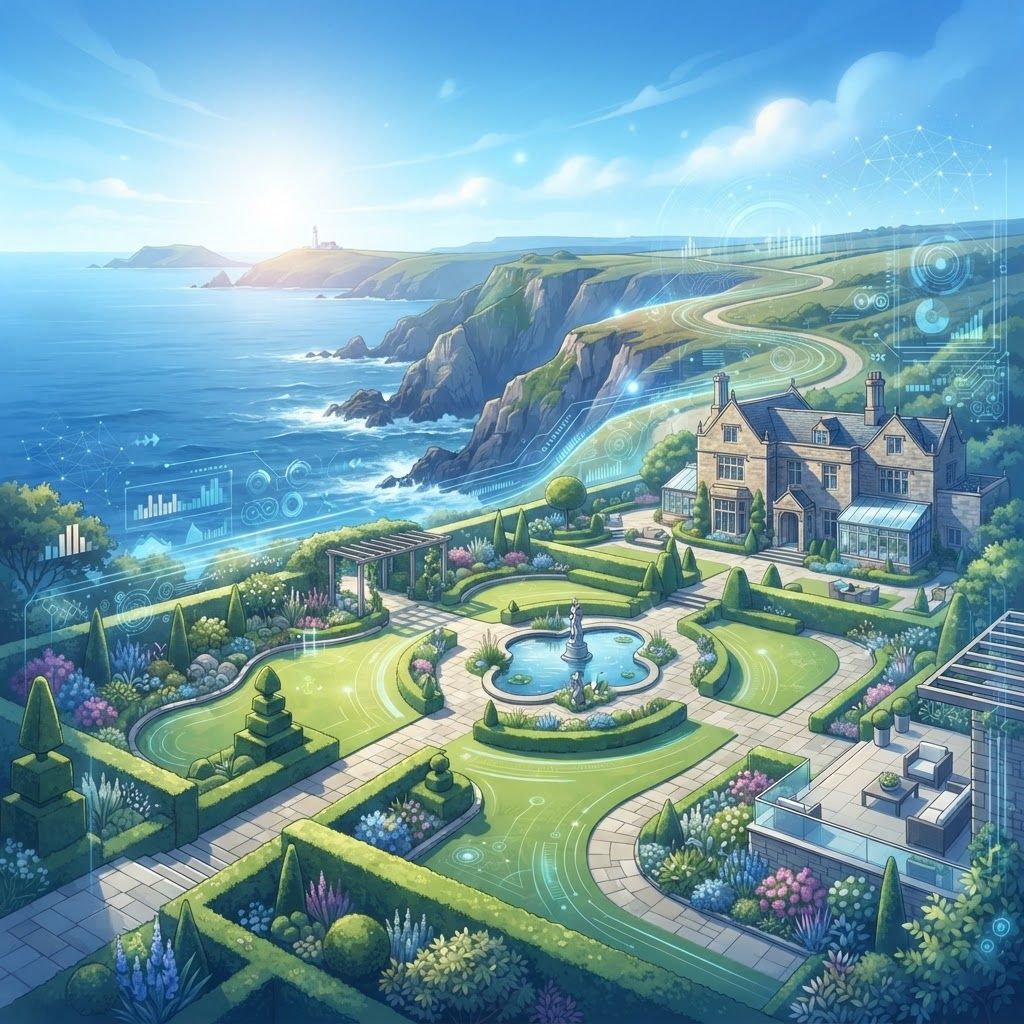
Why Landscaping on the Isle of Wight Is a Specialist Craft
Gardening on the Isle of Wight is not the same as gardening on the mainland. The island enjoys one of the sunniest and mildest climates in the United Kingdom, which allows Mediterranean and subtropical planting to thrive in places such as Ventnor and the Undercliff. At the same time, exposed sites along the Needles, Freshwater Bay and the Culver Downs face relentless salt spray and wind scorch that will kill unsuitable species within a single season. The best landscaping companies on the island understand this micro-geography in fine detail, and they design accordingly rather than importing a generic mainland planting plan.
Soil is the second complication. The island's geology shifts dramatically over short distances, from free-draining chalk on the central ridge to heavy Wealden clay in the south and sandy, acidic pockets around Parkhurst and Firestone Copse. A competent landscaper will test or at least correctly identify the substrate before recommending a scheme, because drainage failures and nutrient lock-out account for a large proportion of disappointing garden projects.
What Separates the Island's Leading Landscapers
Reputation on an island of roughly 140,000 residents travels quickly, and the strongest firms have been built almost entirely on referral. When homeowners in Newport, Ryde, Cowes and Shanklin rank landscaping companies, the same qualities come up repeatedly: reliable scheduling, transparent quotations, tidy site management, and an ability to work with the island's abundant Areas of Outstanding Natural Beauty and conservation-area restrictions without triggering planning problems.
Technical accreditation matters too. Association of Professional Landscapers membership, British Association of Landscape Industries affiliation, City and Guilds or RHS horticultural qualifications, NPTC chainsaw and machinery certification, and full public liability cover are the practical markers of a professional operation. For hard landscaping, look for demonstrated competence with permeable paving, correct sub-base depths and retaining wall engineering, since coastal ground movement and heavy winter rainfall punish shortcuts.
The Main Categories of Landscaping Providers
Island providers generally fall into several groups, and the right choice depends entirely on the scope of work.
Full-service design and build practices handle everything from initial survey and CAD visualisation through to planting and aftercare. These firms suit large private gardens, coastal properties with terracing requirements, and heritage homes where the garden must complement listed architecture. They typically employ their own hard landscaping crews alongside horticulturists.
Specialist garden designers produce planting plans, levels drawings and material schedules, then supervise a contractor. This route works well for clients who want a distinctive design identity, such as a coastal gravel garden, a naturalistic prairie scheme or a subtropical planting palette using echiums, cordylines, tree ferns and agapanthus that flourish in the island's frost-light pockets.
Grounds maintenance and estate management companies serve holiday lets, caravan parks, hotels, farm estates and commercial premises across the island. Their strength is consistency: scheduled mowing, hedge cutting, seasonal bedding rotation and site presentation throughout the tourist season.
Arboriculture and tree surgery businesses deal with crown reduction, deadwood removal, storm damage and tree preservation order applications. Given the number of mature specimen trees and protected woodland on the island, this is a distinct and heavily regulated field.
Driveway, paving and fencing contractors focus on hard surfaces, walls, decking and boundary work, frequently in natural stone, island-sourced brick, resin-bound gravel and treated softwood.
Services the Best Companies Offer
A strong island landscaping company will typically provide site surveying and level analysis, three-dimensional design visualisation, drainage and soakaway installation, natural stone and porcelain patio laying, retaining walls and terracing for sloping coastal plots, lawn renovation and turfing, wildflower meadow establishment, irrigation systems, outdoor lighting, garden rooms and pergolas, pond and water feature construction, and structured aftercare programmes. Increasingly they also offer rewilding advice, native hedgerow planting and pollinator-focused schemes that align with the island's UNESCO Biosphere Reserve status.
Trends Shaping Island Garden Design
Three trends dominate current work. The first is climate-resilient planting: designers are selecting drought-tolerant species that also tolerate wet winters, reducing irrigation dependency during increasingly dry island summers. The second is sustainable materials, with reclaimed stone, permeable surfacing and locally sourced timber replacing imported concrete products. The third is outdoor living, as holiday-let owners and residents alike invest in covered seating areas, fire pits, outdoor kitchens and lighting that extends usable garden time into the shoulder seasons, which is commercially significant on an island whose economy leans heavily on tourism.
Biodiversity is the connecting thread. Red squirrel populations, rare bat species and a nationally significant insect fauna mean that sensitive planting and habitat creation are now standard conversations rather than niche requests.
How to Choose the Right Landscaping Company
Start with scope. A patio replacement and a whole-garden redesign require different firms. Request at least three written quotations that break down labour, materials, waste disposal, and any plant guarantee. Be wary of estimates that are not itemised, because hidden groundwork costs are the most common source of dispute.
Inspect completed projects in person where possible. Island firms usually have nearby examples they can point to, and a two or three year old garden reveals far more about workmanship and planting judgement than a photograph taken on handover day. Ask specifically about aftercare, since new planting in exposed coastal conditions needs establishment watering and wind protection.
Confirm insurance, waste carrier licensing for green and hard waste removal, and whether subcontractors will be used. Finally, discuss timing. Ferry logistics affect material deliveries and can extend lead times for imported stone or bespoke joinery, so a realistic programme is a sign of an honest contractor rather than a pessimistic one.
Value, Pricing and Return on Investment
Landscaping costs on the island are broadly comparable with the south coast mainland, with a modest premium on materials reflecting ferry freight. Small refresh projects involving lawn renovation, borders and a modest patio typically sit at the lower end. Full redesigns involving terracing, drainage and structures represent a substantial investment but consistently deliver strong returns, both in property value and in the rental performance of holiday accommodation where an attractive, low-maintenance garden measurably improves booking rates.
Final Thoughts
The best landscaping companies in the Isle of Wight combine horticultural knowledge with genuine coastal engineering competence and a respect for the island's protected landscapes. Homeowners who prioritise accreditation, itemised quotations, verifiable local references and a clear aftercare plan will find no shortage of skilled professionals capable of turning a windswept plot into a garden that performs beautifully in every season.
Want your brand featured in front of decision-makers? Publish a guest post or get a link insertion in our guides through AAMAX's guest post and link insertion service.
Helpful Links
 SponsoredAAMAX — Full-Service Digital Agency
Write for Us
Share your expertise with our readers. We welcome guest contributions from industry specialists.
Pitch your idea