An Unexpectedly Rich Jewellery Region
Dumfries and Galloway is not the first place most people associate with jewellery design, yet the region supports a remarkable concentration of makers. The Artists' Town of Kirkcudbright has attracted craftspeople for well over a century, Wigtown and Castle Douglas host independent galleries, and studios are scattered across the countryside from the Machars to the Nith valley.
Several factors explain this. Studio space is affordable compared with Scotland's cities. The landscape provides genuine design inspiration, from Solway tidal patterns to granite textures and Galloway's dark skies. And a steady visitor economy, drawn by the coast, the forest park and the region's arts reputation, provides a market willing to buy original work.
Scottish Jewellery Traditions
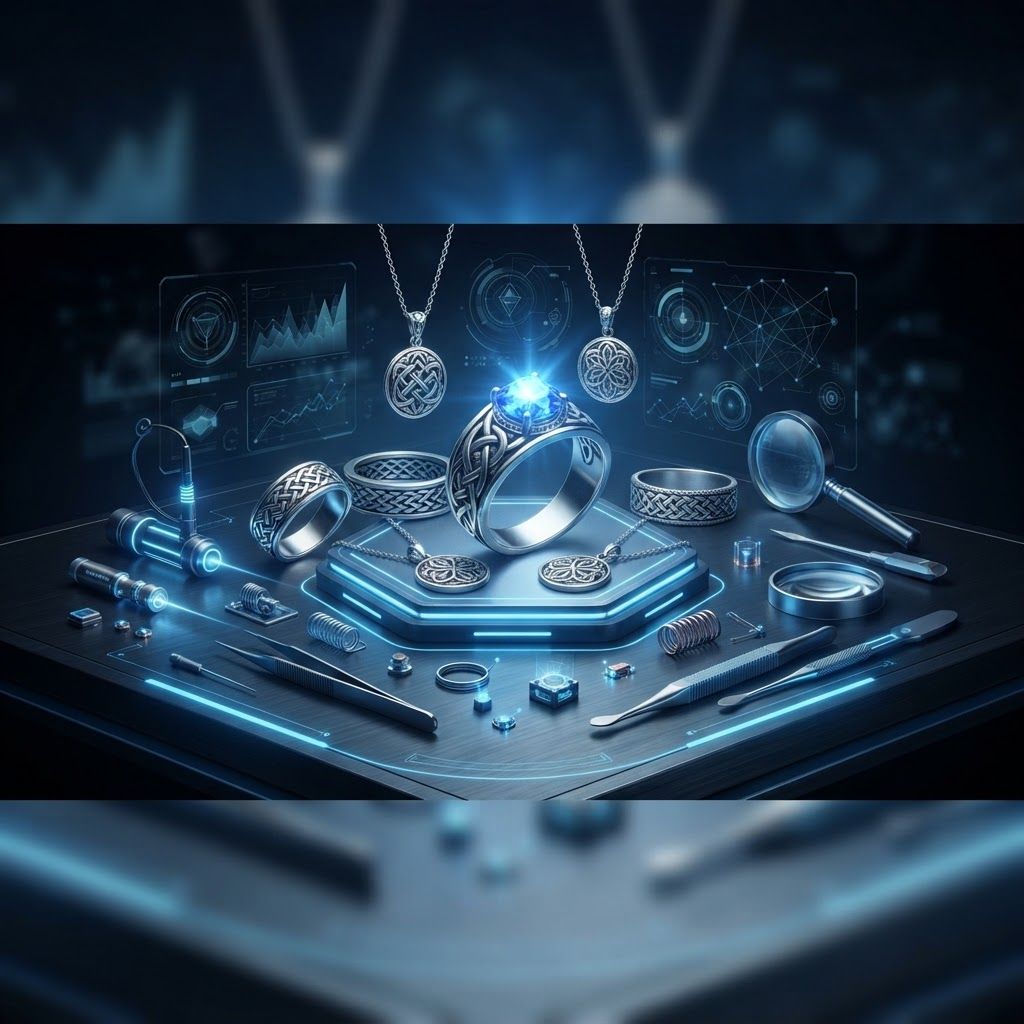
Understanding what makes jewellery from this region distinctive requires some context. Scottish jewellery draws on several overlapping traditions. Celtic and Pictish interlace patterns, derived from early medieval metalwork and carved stones, remain widely used. Luckenbooth brooches, thistle motifs and clan-associated designs carry cultural meaning. Victorian Scottish agate and pebble jewellery established a tradition of setting native stones in silver that continues today.
Contemporary Scottish jewellery has moved well beyond heritage reproduction. Makers across Dumfries and Galloway work in abstract and landscape-derived forms, using texture, oxidation and mixed metals in ways that reference place without resorting to obvious symbols.
Leading Jewellery Brands and Makers
1. Ortak is one of Scotland's best-known jewellery brands, producing silver and gold pieces influenced by Celtic and Norse design. Widely available through independent retailers across the region, Ortak offers recognisable Scottish design at accessible prices, which makes it a common choice for gifts and commemorative purchases.
2. Sheila Fleet has built an exceptional reputation for enamelled silver and gold jewellery inspired by Scottish landscape and light. The distinctive colour work, achieved through vitreous enamel, produces pieces that are unmistakably Scottish without relying on traditional motifs, and the brand is stocked by quality jewellers throughout the region.
3. Hamilton and Young produces Scottish-themed silver jewellery with a focus on heritage designs and gemstone settings. Its pieces appeal particularly to visitors seeking something authentically Scottish with a clear design lineage.
4. Kirkcudbright studio jewellers represent the region's creative core. The town's established artistic community includes silversmiths producing entirely original work, often in small batches or as one-off commissions. Buying directly from a studio here means acquiring a piece with genuine provenance and frequently meeting the maker.
5. Galloway landscape-inspired makers form a recognisable strand, translating coastal, moorland and forest forms into wearable metal. Techniques such as reticulation, fold-forming and roller-printing create surfaces echoing rock strata, tidal ripples and bark, and the results are distinctive enough to be recognisable as regional work.
6. Scottish gemstone specialists work with native and regionally significant stones. Scottish agate, jasper, serpentine and freshwater pearl have long histories in Scottish jewellery, and makers who source and cut their own material offer something genuinely unavailable elsewhere.
7. Contemporary silversmiths working to commission handle engagement rings, wedding bands and significant anniversary pieces. Commissioning locally allows clients to participate in design decisions, choose stones personally and often incorporate inherited metal or gems, which carries meaning that retail purchase cannot replicate.
8. Craft galleries and maker collectives across Castle Douglas, Wigtown, Gatehouse of Fleet and Moniaive stock work from multiple jewellers. These venues are valuable because they allow direct comparison between makers and support artists who lack the capacity to run their own retail operation.
9. Established high street jewellers in Dumfries and Stranraer provide the practical backbone of the sector, handling repairs, resizing, valuations, watch servicing and the wide range of everyday purchases. Their role in maintaining and restoring jewellery is at least as important commercially as new sales.
10. Emerging and part-time makers selling through markets, craft fairs and open studio events contribute significantly to the local scene. Events such as regional open studios weekends give buyers direct access to workshops and offer some of the best value available, since pieces are sold without gallery commission.
What to Consider When Buying
Hallmarking is the first practical check. Precious metal items sold in the UK above specified weight thresholds must be hallmarked at an assay office, and the marks identify the metal, its fineness, the sponsor and often the year. Scottish pieces frequently carry the Edinburgh Assay Office castle mark, which is itself a point of interest for collectors.
Ask about materials honestly. Sterling silver, silver plate, gold vermeil and gold-filled are genuinely different products with different lifespans, and a reputable maker will explain the distinction without prompting.
For gemstones, ask about origin and treatment. Most coloured stones on the market have been treated in some way, which is entirely normal and acceptable, but it should be disclosed. For diamonds above a meaningful size, independent certification is standard.
Consider practicality alongside beauty. Ring profiles, clasp types, earring fittings and chain gauge all determine whether a piece gets worn regularly or stays in a drawer. Makers will usually adapt these details on request.
Trends Influencing the Regional Market
Recycled precious metal has become mainstream rather than niche. Many makers in the region now work exclusively in recycled silver and gold, and customers increasingly ask about sourcing as a matter of course.
Lab-grown diamonds have expanded what is affordable at the commission end, allowing larger centre stones within realistic budgets. Opinions differ across the trade, but customer acceptance has grown quickly.
Remodelling inherited jewellery has become a significant part of many makers' work. Rather than selling unworn heirlooms, clients increasingly commission new pieces using existing stones and metal, which preserves sentimental value while producing something wearable.
Personalisation continues to grow, from coordinates and landscape outlines to fingerprint textures and hand-engraved inscriptions, and small makers are far better placed to deliver this than large retailers.
Buying Local Makes Sense Here
The argument for buying jewellery within Dumfries and Galloway is stronger than in most regions. The density of skilled makers means genuine choice, prices from studios are often below equivalent gallery or city retail, and the ability to discuss a commission face to face produces better results than remote ordering.
There is also the matter of distinctiveness. A piece made in a Galloway studio, drawing on the light and landscape of the Solway coast, carries a specificity that mass-produced jewellery cannot. For buyers marking an occasion, that connection between object and place is frequently the point of the purchase, and it is something the region is unusually well equipped to provide.
Want your brand featured in front of decision-makers? Publish a guest post or get a link insertion in our guides through AAMAX's guest post and link insertion service.
Helpful Links
 SponsoredAAMAX — Full-Service Digital Agency
Write for Us
Share your expertise with our readers. We welcome guest contributions from industry specialists.
Pitch your idea