A Region with Deep Jewellery Traditions
The Causeway Coast and Glens has a strong relationship with jewellery that goes well beyond retail. Ireland has one of the oldest goldworking traditions in Europe, and Celtic metalwork produced designs and techniques that continue to influence contemporary makers. Today the region supports a lively community of independent silversmiths, goldsmiths and designer-makers whose work draws directly on the surrounding landscape.
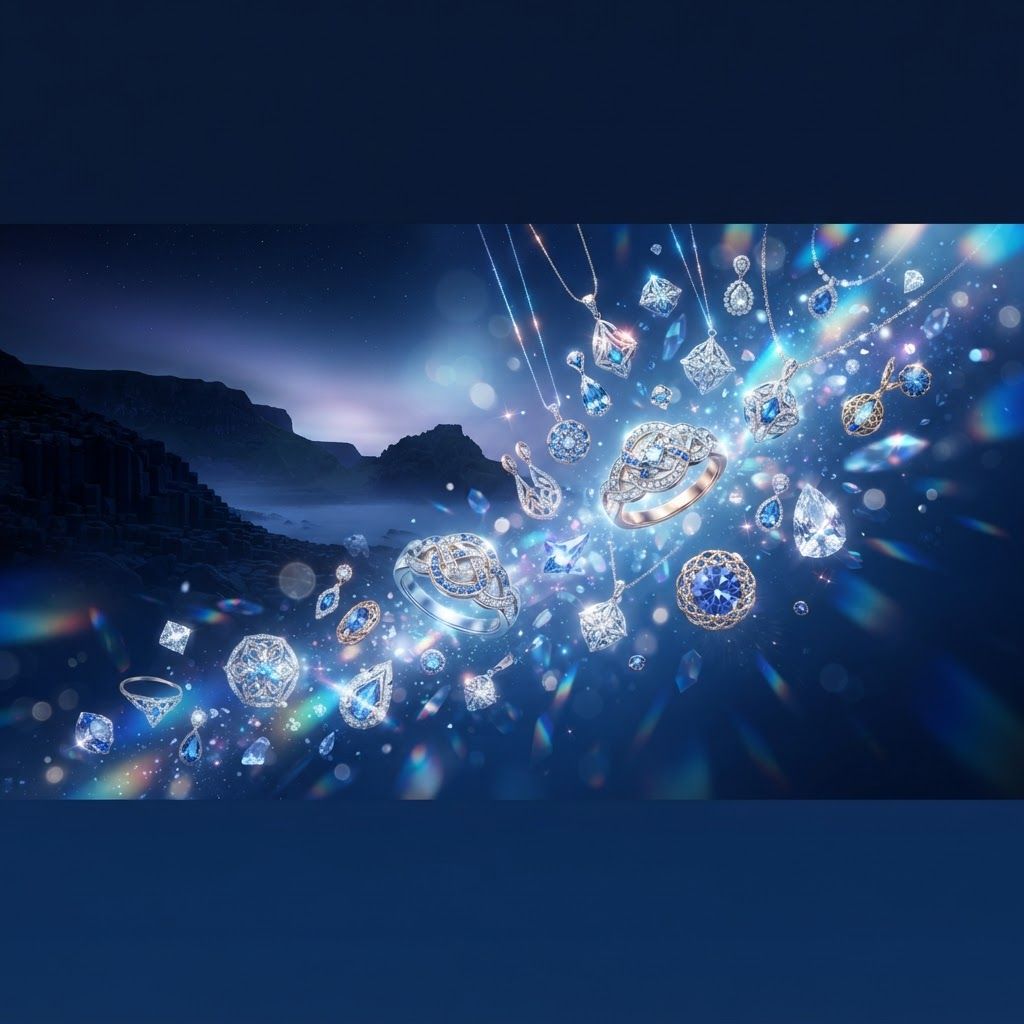
That landscape is unusually distinctive. The hexagonal basalt columns of the Causeway coastline, the sweep of Atlantic shoreline, the deep green of the Glens of Antrim and the changing sea light all appear repeatedly in local design work. Jewellery here frequently functions as a form of place-making, carrying a connection to a specific stretch of coast or glen.
Celtic Symbolism and Its Meaning
Several traditional Irish designs recur throughout the region's jewellery, and understanding their meaning helps buyers choose pieces with genuine significance.
The Claddagh design, showing hands holding a heart topped with a crown, represents friendship, love and loyalty. It has become one of the most recognised Irish jewellery motifs worldwide and remains popular for engagement and commitment pieces.
The Trinity knot, formed from a single interwoven line with no beginning or end, symbolises eternity and continuity. Celtic knotwork more broadly follows the same principle, with unbroken lines representing endless connection. The Celtic cross combines a cross with a ring, drawing on early Christian Irish stone carving.
Other motifs include the spiral, found on ancient Irish monuments, and the shamrock, associated with Ireland internationally. The best contemporary makers interpret these forms rather than simply reproducing them, creating work that references heritage while remaining current.
Ten Jewellery Brands and Makers Resonating in the Region
1. Solvar is one of Ireland's established jewellery manufacturers, known for Claddagh rings, Celtic pendants and traditional Irish designs in gold and silver. Its longevity has made it a familiar name for people buying pieces with Irish significance.
2. Boru Jewellery specialises in Celtic and Claddagh designs, with a strong focus on craftsmanship and traditional symbolism. Its range covers both classical interpretations and more contemporary adaptations of historic motifs.
3. Claddagh Design focuses specifically on Irish heritage jewellery, offering rings, pendants and wedding bands rooted in traditional forms. For couples wanting Irish symbolism in their wedding jewellery, specialists in this area offer far more choice than general retailers.
4. Fado Jewellery produces Celtic-inspired pieces with attention to the historical sources behind the designs. Makers who research the origins of motifs tend to produce more coherent and convincing work than those copying popular patterns.
5. Rachel Mulligan style independent Northern Irish designer-makers create contemporary pieces inspired by local landscape and materials. Independent studios offer distinctive work and the opportunity to speak directly with the person making the piece.
6. Steensons is a Northern Irish jewellery workshop with a strong reputation for contemporary design and craftsmanship, based in the Glens of Antrim. Its combination of a working studio and retail presence gives customers genuine insight into how pieces are made.
7. Twelve Silver Trees style small Irish studios produce handmade silver jewellery inspired by coastal and natural forms. The appeal lies in individuality, with pieces that vary slightly rather than arriving identical from a production line.
8. Cavan Crystal and comparable Irish craft producers extend the broader tradition of Irish decorative craft, and their approach to design and finishing influences expectations across the local market for handmade quality.
9. Newbridge Silverware is a well-known Irish name in silverware and jewellery, offering accessible contemporary designs. Its wide availability makes it a common choice for gifts across Ireland.
10. Local goldsmith studios along the Causeway Coast collectively represent one of the region's real strengths. Individual makers working from small workshops in towns and villages produce bespoke commissions, remodel inherited jewellery and create limited pieces drawing directly on their surroundings.
Materials and Their Characteristics
Sterling silver remains the most widely used material for Irish craft jewellery, offering good workability, an attractive bright finish and affordability that allows makers to produce ambitious designs. It tarnishes over time but cleans easily.
Gold is used across several carats, with nine carat offering hardness and affordability while eighteen carat provides richer colour and higher precious metal content. Yellow, white and rose golds each suit different designs and skin tones.
Locally relevant materials add distinctiveness. Some makers incorporate Irish marble, sea glass collected from local beaches, bog oak preserved for millennia in peat, and stones that echo coastal colours. These materials root a piece in place in a way that generic gemstones cannot.
Hallmarking and Buyer Protection
Precious metal items sold in the United Kingdom above specified weight thresholds must be hallmarked by an authorised assay office. The hallmark confirms metal purity independently and is a fundamental consumer protection.
A full hallmark includes a sponsor mark identifying the maker, a fineness mark stating metal purity, and an assay office mark. Buyers should look for these marks and ask if they are not visible. Reputable makers and retailers explain hallmarks readily, and many display the required dealer's notice explaining what the marks mean.
Commissioning Bespoke Jewellery
One of the advantages of a region with many independent makers is genuine access to bespoke work. Commissioning typically begins with a conversation about ideas, budget and materials, followed by sketches or computer-generated designs for approval.
Remodelling inherited jewellery has become particularly popular. Stones and gold from pieces that are never worn can be reworked into something that will be, preserving sentimental value while creating something wearable. Skilled makers handle this sensitively and can often incorporate original elements visibly.
Allow adequate time, as handmade commissions typically take several weeks and longer around busy periods. Discuss budget openly at the outset, since makers can design within constraints far more effectively when they know them. Ask to see previous work in person, as photographs rarely convey finish quality accurately.
Caring for Jewellery in a Coastal Environment
Salt air accelerates tarnishing, so coastal residents should clean silver more frequently and store pieces in airtight bags with anti-tarnish strips. Remove jewellery before swimming in the sea, as salt water and sand cause both tarnish and abrasion.
Have settings checked periodically, since stones can loosen over years of wear. Clean with appropriate methods for the materials involved, and avoid abrasive products on soft stones or plated finishes.
Final Thoughts
Jewellery in the Causeway Coast and Glens combines ancient Irish metalworking tradition with contemporary design shaped by an extraordinary landscape. Whether choosing a Claddagh ring with centuries of symbolic meaning, a contemporary piece inspired by basalt columns, or a bespoke commission incorporating family stones, buyers here have access to genuine craftsmanship with a real sense of place.
Want your brand featured in front of decision-makers? Publish a guest post or get a link insertion in our guides through AAMAX's guest post and link insertion service.
Helpful Links
 SponsoredAAMAX — Full-Service Digital Agency
Write for Us
Share your expertise with our readers. We welcome guest contributions from industry specialists.
Pitch your idea