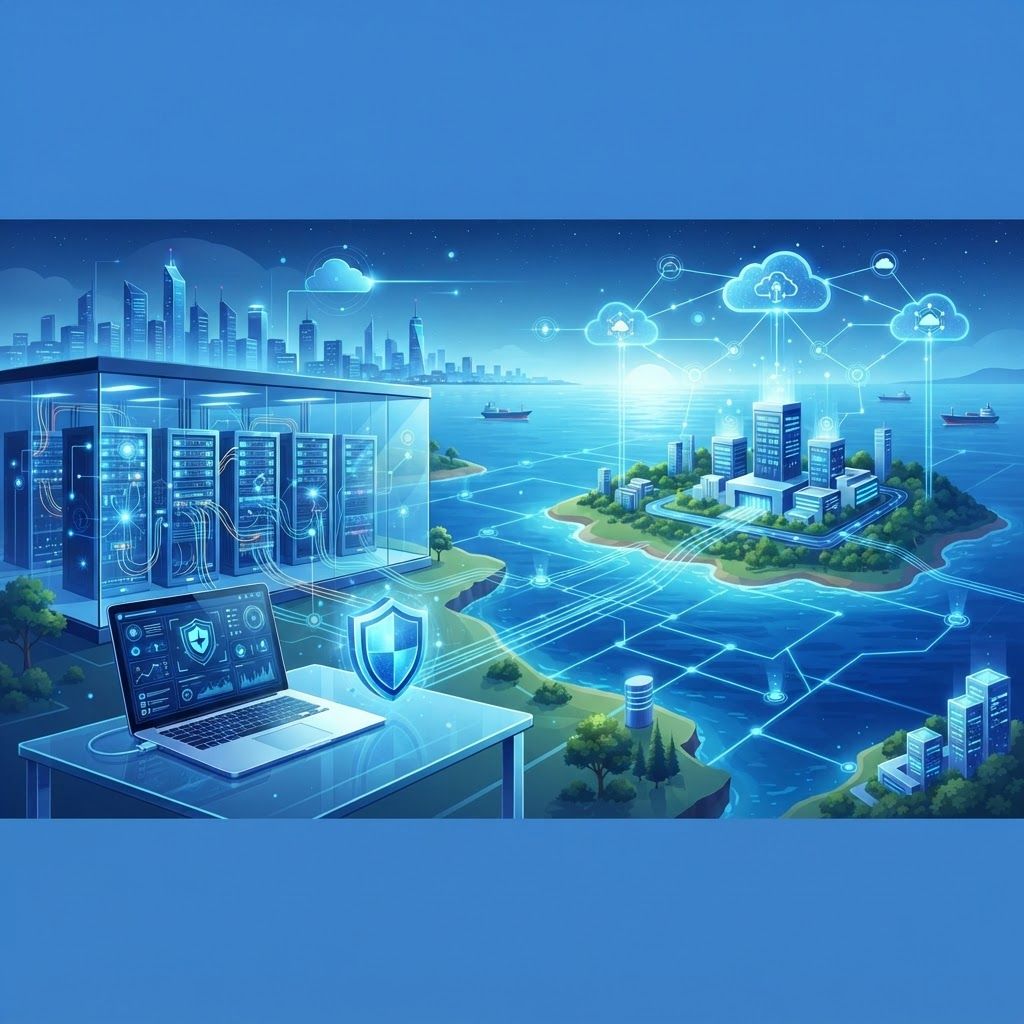
Technology and Island Business
The Isle of Wight hosts a more diverse business base than its size suggests. Advanced composites and marine engineering, aerospace and defence manufacturing, renewable energy, tourism and hospitality, agriculture and food production, professional services, healthcare and a growing remote-working population all depend on reliable technology. For many of these organisations, geography makes information technology strategically important rather than merely operational: connectivity, remote collaboration and cloud services are what allow an island business to trade nationally and internationally without friction.
That dependency raises the cost of failure. Extended downtime, a ransomware incident or a failed migration hurts an island business more than a mainland equivalent because on-site specialist support may be hours away. Good IT consulting is, in effect, business continuity insurance.
Core Services Provided
Established island IT consultancies typically offer managed services with proactive monitoring and helpdesk support, cloud migration and management across major platforms, cyber security assessment and implementation, backup and disaster recovery design, network and connectivity solutions including business broadband, leased lines and wireless, business systems consultancy covering enterprise resource planning, customer relationship management and finance systems, software development and integration, data analytics and reporting, IT strategy and budgeting, and procurement and lifecycle management of hardware.
Increasingly they also advise on compliance, including data protection obligations, sector-specific standards for healthcare and financial services, and supply-chain security requirements imposed by larger customers on island manufacturers.
Connectivity: The Island Factor
Connectivity deserves particular attention. Broadband availability across the island has improved substantially with full-fibre rollout in urban areas, but rural coverage remains uneven, and businesses in the west wight and inland farming areas often need alternative solutions. Consultants routinely design hybrid connectivity using fibre where available, fixed wireless access, bonded connections, 4G and 5G failover, and increasingly low-earth-orbit satellite for remote sites.
Resilience is the key design principle. A single connection is a single point of failure, and for businesses running cloud-based finance, booking or production systems, a secondary path with automatic failover is usually a modest cost against the alternative. The same thinking applies to voice services, where hosted telephony has largely replaced traditional lines ahead of the national switch-off of legacy telephone networks.
Cyber Security Priorities
Small and medium businesses are the primary targets of most cyber attacks, and island organisations are no exception. Phishing, business email compromise, ransomware and credential theft account for the overwhelming majority of incidents.
Effective consultants focus on fundamentals before exotic tooling: multi-factor authentication across all accounts, least-privilege access control, patch management, endpoint detection and response, email filtering, secure and tested backups held offline or immutably, and staff awareness training. Certification schemes provide a structured baseline and are increasingly required to bid for public sector and larger corporate contracts, which gives island suppliers a commercial reason to pursue them.
Incident response planning is frequently neglected. Knowing in advance who to call, how to isolate systems, where backups are and what the legal notification obligations are dramatically reduces the impact of an incident.
Types of IT Providers
Managed service providers deliver ongoing support under contract, typically with fixed monthly pricing per user or device. They suit organisations without internal IT staff and provide predictable costs and defined response times.
Strategic IT consultancies focus on advisory work: technology roadmaps, system selection, digital transformation programmes and vendor-independent procurement advice. They are valuable when a business faces a significant decision such as replacing a core system.
Software development houses build bespoke applications, integrations and websites, serving island businesses with specific operational needs that off-the-shelf products do not meet, such as tourism booking systems or manufacturing process tools.
Cyber security specialists conduct penetration testing, security audits, certification preparation and incident response.
Telecoms and connectivity providers handle broadband, leased lines, hosted telephony and mobile, often bundled with IT support.
Data and analytics consultancies help organisations use the information they already hold, building dashboards and reporting that support better decisions, particularly in hospitality and retail where seasonal demand patterns reward careful analysis.
Trends Shaping Island IT
Cloud adoption is mature, and the current wave of work concerns optimisation: controlling subscription sprawl, right-sizing services and improving security posture within cloud platforms rather than simply migrating.
Artificial intelligence has entered mainstream business discussion, with practical applications in customer service, document processing, marketing content and data analysis. Sensible consultants focus on specific, measurable use cases and on governance, including data handling rules for tools that process customer information.
Hybrid and remote work remains a permanent feature, driving demand for secure device management, collaboration platforms and identity-centric security models. For the island, remote work also represents an economic opportunity, attracting professionals who can live locally and work nationally.
Sustainability is emerging in procurement decisions, with organisations considering device lifecycle, refurbishment and energy use in on-premise equipment as reasons to consolidate into cloud services.
How to Choose an IT Partner
Assess response capability first. Ask about guaranteed response and resolution times, on-island engineer availability and out-of-hours cover. Remote support handles most issues, but some problems require someone physically present.
Review contracts carefully for scope boundaries, project work exclusions, licence pass-through costs and exit arrangements. A provider that makes it difficult to leave, by holding administrative credentials or undocumented configurations, is a long-term risk. Insist on owning your own domains, tenancies and administrative access.
Ask about security accreditations, documented processes and references from similar-sized island businesses. Finally, judge communication. The best IT consultants explain risk and options in business terms rather than technical jargon, enabling directors to make informed decisions.
Final Thoughts
The best IT consulting companies in the Isle of Wight combine resilient connectivity design, disciplined cyber security, pragmatic cloud strategy and genuine local response capability. For island organisations, choosing a partner on those criteria protects continuity and turns technology from an operational cost into a competitive advantage across the Solent and beyond.
Want your brand featured in front of decision-makers? Publish a guest post or get a link insertion in our guides through AAMAX's guest post and link insertion service.
Helpful Links
 SponsoredAAMAX — Full-Service Digital Agency
Write for Us
Share your expertise with our readers. We welcome guest contributions from industry specialists.
Pitch your idea