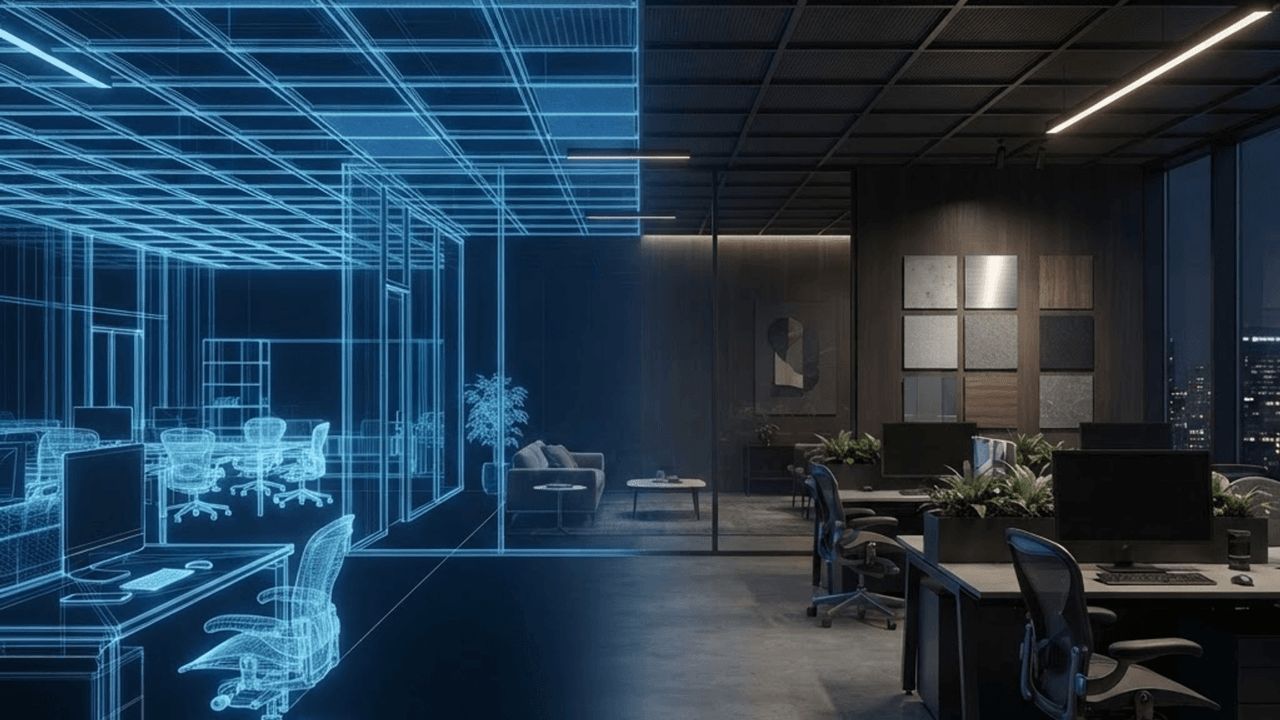
Understanding Interior Fitout Work
Interior fitout — often called tenant improvement or TI work — is the process of converting an unfinished or previously occupied commercial space into a functional environment for a specific business. A landlord delivers a shell: structure, exterior envelope, and perhaps a rough utility stub. The fitout contractor builds everything inside it: partitions, ceilings, lighting, HVAC distribution, power and data, flooring, millwork, plumbing fixtures, and finishes.
This work has a rhythm quite different from ground-up construction. Fitout projects are usually schedule-driven, because a tenant is paying rent and often has a hard opening date. They occur in occupied buildings, which imposes constraints on noise, working hours, elevator access, and dust control. And they involve three-party coordination between tenant, landlord, and contractor, with the lease dictating who pays for what. Contractors who work in this space daily manage those dynamics far better than those who treat it as an occasional side scope.
Types of Fitout and What They Require
Office fitout centers on space planning, acoustic performance, lighting quality, and technology infrastructure. The current emphasis on collaborative and hybrid work has increased demand for varied space types — focus rooms, huddle areas, and well-equipped video conference rooms — rather than uniform open plans.
Medical and dental fitout is significantly more technical. It involves specialized plumbing, medical gas, lead shielding for imaging, dedicated electrical circuits, infection control surfaces, and compliance with health facility requirements. Timelines are longer because inspections are more extensive.
Restaurant and food service fitout is arguably the most demanding category. Commercial kitchen exhaust, grease interceptors, make-up air, refrigeration, health department review, and fire suppression all intersect, and any one of them can delay opening. Contractors experienced in this category sequence long-lead equipment and inspections early rather than treating them as closeout items.
Retail fitout balances brand execution against schedule. National tenants often arrive with prescriptive design standards and fixed opening dates, requiring contractors who can execute a brand package precisely while managing landlord coordination.
Ten Fitout Companies Serving Westminster
Meridian Commercial Interiors is a full-service office fitout contractor handling projects from small suites to full-floor build-outs. Their strength is pre-construction planning: realistic budgets and schedules developed before a lease is signed, which helps tenants negotiate improvement allowances intelligently.
Westminster Tenant Improvement Group focuses on fast-turnaround suite renovations in multi-tenant buildings. Their crews are practiced at working around occupied neighbors, with after-hours scheduling and rigorous dust containment.
Clinical Space Builders specializes in medical, dental, and veterinary fitout. Their familiarity with health facility requirements, imaging shielding, and specialty mechanical systems shortens the review process on projects that generalists often stall on.
Front Range Restaurant Construction works exclusively in food service. Kitchen exhaust design, grease waste, and health department coordination are routine for them, and their long-lead equipment tracking is a genuine schedule advantage.
Summit Retail Buildout serves national and regional retail tenants. They are structured for prescriptive brand standards and hard opening dates, with dedicated project management and detailed closeout documentation.
Blue Line Workplace Solutions combines interior design with construction delivery. Clients who want space planning, furniture coordination, and construction under one contract often choose this integrated approach.
Cornerstone Industrial Interiors handles warehouse and light industrial fitout: office pods within distribution space, mezzanines, and specialized power distribution for equipment. Their scope frequently includes racking coordination and dock modifications.
Aspen Millwork & Fixture is a specialty subcontractor producing custom casework, reception desks, retail fixtures, and architectural millwork. General contractors on higher-end fitouts frequently bring them in for the visible finish elements.
Northwest Metro Fitout Partners takes on complex adaptive reuse — converting spaces from one use type to another, which often means structural modification, upgraded mechanical capacity, and accessibility improvements to meet current code.
Ridgeline Fitout & Facilities serves clients needing ongoing facility work rather than one-time projects. Their model suits property managers and multi-location businesses with continuous small-scope needs.
How to Keep a Fitout on Schedule
Long-lead items decide the schedule. Custom millwork, specialty lighting, commercial kitchen equipment, and electrical switchgear can carry lead times measured in months. Identifying and ordering these items during design rather than after permit is the most common difference between a project that opens on time and one that does not.
Permitting deserves the same early attention. Commercial interior permits require coordinated architectural, mechanical, electrical, and plumbing drawings, and in some categories a health or fire authority review as well. Submitting an incomplete set to save a week frequently costs a month in comment cycles.
Read the lease carefully with your contractor. Improvement allowances, landlord work letters, base building conditions, and restoration obligations all affect scope and cost. A contractor who reviews the work letter before bidding can flag items the tenant assumed the landlord would provide, avoiding an unpleasant surprise mid-project.
Current Trends in Commercial Interiors
Workplace design continues to move toward flexibility. Demountable partition systems, modular power and data distribution, and furniture-based zoning allow tenants to reconfigure without full reconstruction. This is particularly attractive for businesses on shorter lease terms who want the ability to adapt.
Indoor environmental quality has become a genuine specification concern rather than a marketing point. Improved ventilation rates, better filtration, low-emitting materials, and daylight access are now commonly requested. These choices affect mechanical design and material selection and must be established early.
Sustainability requirements are increasingly embedded in corporate real estate standards. Construction waste diversion, material transparency documentation, efficient lighting with advanced controls, and commissioning are becoming standard scope items rather than optional add-ons, and contractors are adapting their documentation practices accordingly.
Selecting the Right Fitout Partner
Ask for projects in your specific use type. A contractor with an excellent office portfolio may have never built a commercial kitchen, and the learning curve will be paid for by your schedule. Request references from two recent projects of similar type and scale, and ask those references specifically about schedule performance and change order volume.
Evaluate the project management capacity assigned to your job, not just the company's overall reputation. Fitout success depends heavily on the individual superintendent and project manager running the work. Meet them before signing, and confirm how many concurrent projects they are carrying.
Finally, look for contractors who communicate proactively about problems. Every fitout encounters something unexpected — an existing condition that differs from drawings, a delayed inspection, a backordered fixture. The contractors worth hiring surface those issues immediately with proposed solutions, which is precisely what keeps a Westminster tenant improvement project moving toward its opening date.
Want your brand featured in front of decision-makers? Publish a guest post or get a link insertion in our guides through AAMAX's guest post and link insertion service.
Helpful Links
 SponsoredAAMAX — Full-Service Digital Agency
Write for Us
Share your expertise with our readers. We welcome guest contributions from industry specialists.
Pitch your idea