Designing for the Tunbridge Wells Home
Interior design in Royal Tunbridge Wells is shaped by the town's architecture, which is unusually varied for a settlement of its size. A designer working here may move within a single month from a Grade II listed Georgian house near The Pantiles, where every intervention must respect statutory protection and historic fabric, to a large Victorian villa in Molyneux Park with generous proportions and original cornicing, to a contemporary apartment near the station with an open plan layout and no period features at all.
That variety demands real breadth. A designer who only knows how to deliver a contemporary minimal scheme will struggle with a listed building where the correct response is restoration and sympathetic enhancement. Equally, a designer steeped in traditional decoration may over-elaborate a modern space that needs restraint. The best practices in the town demonstrate range across both and, more importantly, the judgement to know which approach a particular building calls for.
The client base here is also distinctive. Many are families relocating from London who arrive with sophisticated expectations and a clear idea of the quality standard they want. Others are long-standing residents renovating a home they intend to keep for decades. A third group comprises developers and investors preparing property for sale or letting, where the brief is commercial rather than personal. Each requires a different balance of creativity, budget discipline and project management.
What an Interior Designer Actually Provides
There is widespread confusion between interior design, interior decoration and interior architecture, and the distinction matters when engaging a firm. Interior decoration concerns the finishes and furnishings applied to an existing space: paint, wallpaper, fabric, furniture, lighting and accessories. Interior design encompasses that but extends to the planning and function of spaces, including layout, circulation, storage and how rooms relate to one another. Interior architecture goes further still, involving structural alterations, the reconfiguration of walls and openings, and coordination with architects, structural engineers and building control.
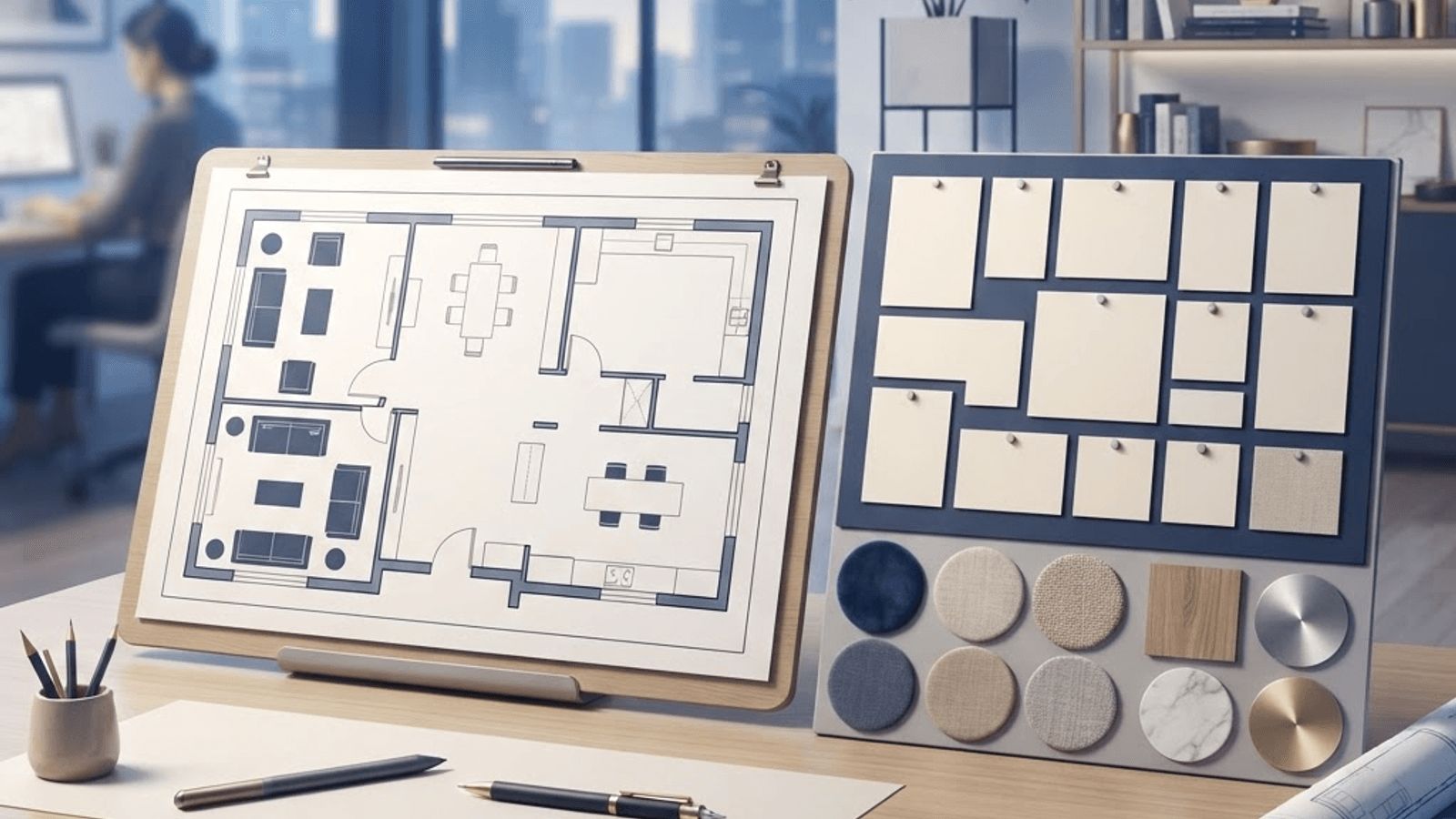
A full design service typically progresses through defined stages. The brief and survey stage establishes requirements, budget and existing conditions. Concept design produces mood boards, sketch layouts and material direction. Detailed design develops that into technical drawings, joinery specifications, electrical and lighting plans, and full schedules of finishes and furniture. Procurement covers sourcing, ordering and lead time management. Installation and project management take the scheme through construction to completion and final styling.
Fee structures vary. Some practices charge a fixed fee per project or per room, some charge hourly, some charge a percentage of the total project cost, and some operate on a mixed model with a design fee plus a margin on procured goods. Transparency here is essential. Ask explicitly whether the practice takes trade discounts and whether those are passed on, retained, or shared, because this significantly affects the true cost of a scheme.
Ten Interior Design Firms and Studios Serving Tunbridge Wells
1. Established local design studios in the town centre. Tunbridge Wells supports several independent interior design practices operating from studios and showrooms in and around the central area. Their strength is accessibility, allowing clients to see materials in person and build a working relationship over the course of a project.
2. Hetherington Newman. A design practice known in the Kent and Sussex region for kitchen and whole-house schemes, combining cabinetry design with broader interior planning, which suits clients undertaking significant renovation rather than redecoration alone.
3. Sims Hilditch style country house specialists. Practices specialising in the English country house aesthetic serve the substantial rural properties around Tunbridge Wells, where the design challenge is achieving comfort and contemporary function without losing period character.
4. Kitchen design specialists with full interior capability. Several high-end kitchen studios in the town have expanded into broader interior services. Since the kitchen is usually the largest single line in a renovation budget, starting with a specialist and extending outward is a pragmatic route for many clients.
5. Heritage and listed building consultants. Given the number of listed and conservation area properties in Tunbridge Wells, designers with specific experience of listed building consent, historic paint analysis, traditional materials and breathable construction are genuinely valuable. Using a generalist on a listed property risks both poor outcomes and enforcement issues.
6. BIID registered designers in the South East. Membership of the British Institute of Interior Design indicates verified professional standards, insurance and a code of conduct. For clients committing significant budget, engaging a registered designer provides meaningful protection.
7. Architectural practices with interiors departments. Local architects who also offer interior design deliver continuity from structural alteration through to final finishes, which avoids the coordination gaps that can arise when separate parties handle the shell and the interior.
8. Soft furnishing and curtain making ateliers. The town and surrounding villages host skilled makers producing bespoke curtains, blinds, upholstery and loose covers. For period properties with irregular windows, bespoke making is often the only route to a properly fitted result.
9. Commercial and hospitality interior specialists. Designers working on restaurants, hotels, offices and retail in the region bring a different discipline centred on durability, compliance, brand expression and operational flow, relevant to the town's active hospitality sector.
10. Online and e-design services. Remote design services delivering mood boards, layouts and shopping lists at a fixed price provide an accessible entry point for clients with smaller budgets who are willing to manage implementation themselves.
Design Directions Relevant to the Town
Several themes recur in well-executed Tunbridge Wells interiors. Sympathetic period restoration continues to dominate, with owners investing in reinstating cornicing, restoring original fireplaces, repairing sash windows rather than replacing them, and choosing historically informed colour palettes. This approach protects value in a market where period authenticity is prized.
Rear extensions with contemporary glazing remain popular, creating open kitchen and living spaces at garden level while leaving the front of the house unchanged. The design challenge is managing the junction between old and new so that the transition feels deliberate rather than accidental.
Home working space has become a permanent requirement rather than an afterthought. Well-designed schemes now incorporate acoustically considered studies, garden rooms and dual-purpose spaces with proper lighting and cable management, replacing the improvised arrangements of earlier years.
Sustainability is increasingly central. Clients are asking for natural and low-emission materials, improved insulation and airtightness, responsibly sourced timber, and furniture that will last decades rather than years. In period buildings this requires care, since inappropriate insulation can trap moisture and damage historic fabric, making specialist knowledge essential.
How to Brief a Designer Well
The quality of a design outcome correlates strongly with the quality of the brief. Be specific about how you actually live rather than how you imagine you might. Explain where the family congregates, what the morning routine looks like, how much storage you genuinely need, whether you entertain formally or informally, and what you dislike about the current arrangement. Practical detail of this kind produces better design than abstract style references.
Be honest about budget from the outset. Designers cannot deliver value if they are specifying blind, and a realistic figure allows them to allocate spend where it matters most. Establish a contingency of at least ten to fifteen per cent for renovation work in older properties, because opening up a Victorian house reliably reveals something unbudgeted.
Finally, agree the decision-making process. Projects stall when approvals require multiple household members who are never available at the same time, and long lead time items such as bespoke joinery, stone and imported furniture cannot absorb indecision without delaying the whole programme.
Final Thoughts
Tunbridge Wells offers access to interior design talent across the full spectrum, from heritage specialists who understand listed fabric to contemporary studios and affordable remote services. The right choice depends on the building, the scope and the budget, but in every case the most successful projects begin with a clear brief, an honest budget and a designer whose previous work demonstrates genuine relevance to the property in question.
Want your brand featured in front of decision-makers? Publish a guest post or get a link insertion in our guides through AAMAX's guest post and link insertion service.
Helpful Links
 SponsoredAAMAX — Full-Service Digital Agency
Write for Us
Share your expertise with our readers. We welcome guest contributions from industry specialists.
Pitch your idea