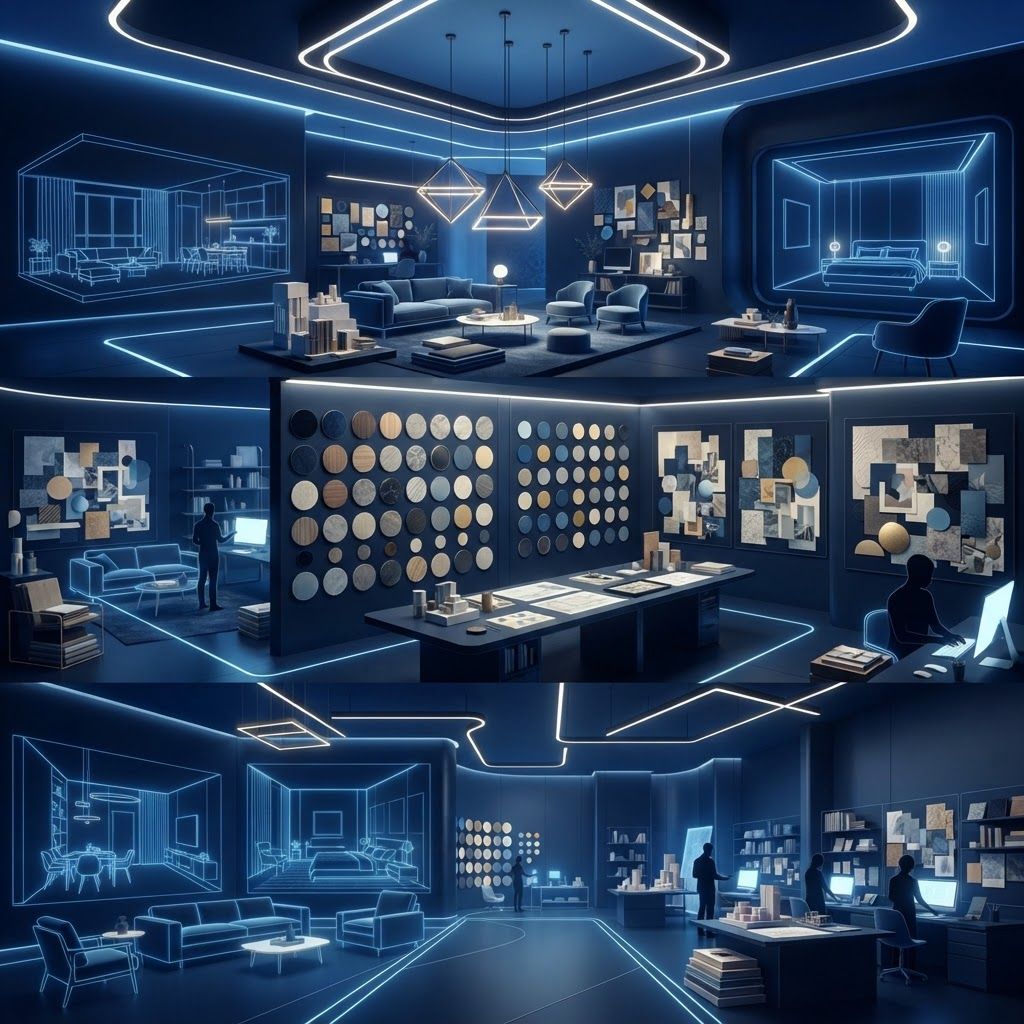
East Lothian's building stock is remarkably diverse for a county of its size. Georgian and Victorian townhouses line the streets of Haddington and Dunbar. Substantial Edwardian and inter-war villas overlook the coast at North Berwick and Gullane. Converted agricultural steadings sit across the arable belt. And thousands of new homes have been built in the past decade around Musselburgh, Tranent and Blindwells. Each type presents distinct design challenges, and the county's interior design sector has developed accordingly.
What Interior Designers Actually Do
The profession spans a wide range of service depth. At one end, a consultation or e-design service provides colour schemes, furniture recommendations and layout guidance for the client to implement. In the middle, a full design service produces detailed drawings, specifications, material selections and a procurement schedule. At the most comprehensive level, designers provide project management, coordinating trades, managing budgets and programme, and handling installation and styling on completion.
Designers also differ by specialism. Some work primarily on residential renovation, others on new-build specification, kitchen and bathroom design, commercial and hospitality interiors, or heritage and conservation work. Matching the specialism to the project matters considerably.
The Top 10 Interior Design Firms
1. Jeffreys Interiors, Edinburgh and Lothians
A long-established Scottish studio offering full residential design with an extensive fabric and furniture library. Their work across the region covers both period restoration and contemporary schemes, and the depth of supplier relationships gives clients access to products beyond retail availability.
2. Coastal Interiors, North Berwick
Designers working the coastal towns have developed a recognisable approach suited to properties defined by light, sea views and salt exposure. Material durability matters here in a way it does not inland, and specifying finishes that survive coastal conditions is genuine expertise.
3. Haddington Interior Design Studios
Serving the county town's period property stock, these studios balance conservation sensitivity with modern living requirements. Working with listed buildings and conservation area constraints requires knowledge of what can and cannot be altered.
4. Muirfield Interiors, Gullane
Design services in the premium coastal villages handle substantial family homes and second properties, often for clients who are not resident during the works and therefore require full project management rather than design alone.
5. Steading and Barn Conversion Specialists
Converting agricultural buildings presents specific challenges: large volumes, limited natural light in the deep plan, exposed stone and timber, and thermal performance. Designers who specialise in this work across the East Lothian countryside bring solutions that general residential designers often miss.
6. New Build Specification Consultants
Buyers of new homes across the county's developments increasingly engage designers at reservation stage to guide upgrade choices, flooring, lighting and joinery specification. Making these decisions well at the outset is far cheaper than changing them later.
7. Kitchen and Bathroom Design Specialists
Dedicated kitchen and bathroom studios serving East Lothian combine spatial design, appliance specification, plumbing and electrical coordination, and installation. These are the highest-value rooms in any renovation and the ones where poor planning is most visible.
8. Commercial and Hospitality Interior Designers
The county's hotels, restaurants, cafes and visitor attractions require designers who understand durability, accessibility compliance, fire regulations and commercial kitchen and service flow alongside aesthetics.
9. Sustainable and Eco-Focused Design Practices
A growing group of designers specialise in low-impact specification: natural and breathable materials for traditional buildings, reclaimed and vintage furniture, low volatile organic compound finishes, and retrofit strategies that improve thermal performance without trapping moisture in solid stone walls.
10. Independent Freelance Designers Across the County
Sole practitioners offer consultation, colour and furniture schemes at a lower cost point than full studios. For clients with a clear vision who need expert guidance rather than end-to-end delivery, this is frequently the most sensible arrangement.
How Designers Charge
Fee models vary. Hourly rates suit consultations and small advisory work. Fixed project fees provide budget certainty and are common for defined scopes such as a single room or a whole-house scheme. A percentage of project cost, typically applied to construction and furnishing spend, is used on larger renovations. Some designers work on a cost-plus basis, purchasing items at trade prices and adding a margin.
Clarify what is included: how many concept revisions, whether site visits are chargeable, whether procurement and delivery coordination is covered, and who is responsible if an item arrives damaged. These practical questions prevent most disputes.
Design Considerations Specific to East Lothian
Light is the defining factor. Scottish winter daylight is short and low-angled, which makes layered artificial lighting essential rather than decorative. Good schemes combine ambient, task and accent lighting on separate circuits with dimming, and avoid relying on a single central pendant.
Thermal performance and moisture management are critical in traditional stone properties. Applying impermeable insulation and modern sealants to solid walls built to breathe causes damp and decay. Designers working with older East Lothian housing stock should understand vapour-open construction and lime-based materials.
Coastal exposure demands robust specification. Salt air degrades metal fixtures, ironmongery and external finishes quickly, and strong light fades textiles. Specifying appropriately here is a functional decision, not an aesthetic one.
Current Design Trends
The dominant direction is warmth and materiality replacing the grey minimalism of the previous decade. Natural stone, timber, wool, linen and clay-based paints feature heavily. Colour has returned, particularly deep greens, ochres and earth tones that suit Scottish light better than cool greys.
Functionally, homes are being designed around hybrid working, with dedicated study space and acoustic consideration now standard requests. Utility and boot rooms have grown in importance in a county where mud, dogs and coastal weather are daily realities. And there is sustained interest in vintage and antique furniture, both for sustainability reasons and because it gives new-build interiors character that catalogue furnishing cannot.
Final Thoughts
Choose a designer whose completed portfolio includes properties genuinely similar to yours, and speak to previous clients about budget accuracy and communication rather than only about the finished look. Agree scope, fees and decision points in writing at the outset. Good interior design in East Lothian is as much about understanding the building and the climate as it is about taste.
Want your brand featured in front of decision-makers? Publish a guest post or get a link insertion in our guides through AAMAX's guest post and link insertion service.
Helpful Links
 SponsoredAAMAX — Full-Service Digital Agency
Write for Us
Share your expertise with our readers. We welcome guest contributions from industry specialists.
Pitch your idea