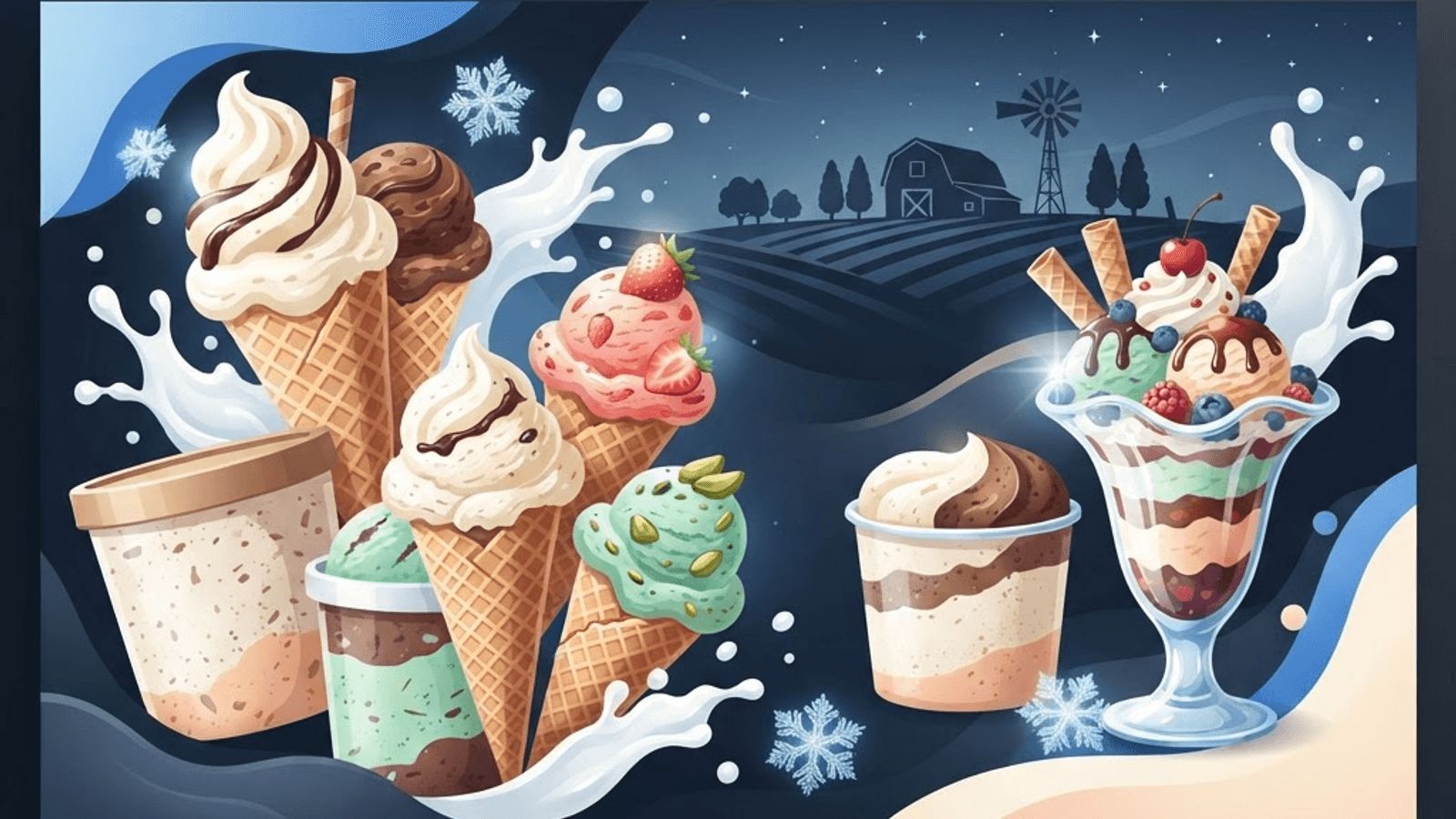
Dairy Country and Its Frozen Rewards
The countryside around Newark and Sherwood has supported dairy farming for generations. Rich pasture in the Trent valley and mixed farming across the district provided the raw material long before ice cream became a specialist craft. Today several producers have taken the logical step of processing their own milk and cream on site, turning a commodity into something with genuine character and considerably better margins.
The result is an ice cream landscape with real variety. Farm-based producers make traditional dairy ice cream with high butterfat and straightforward flavours. Gelato specialists apply Italian technique with lower fat and more intense flavour. Sorbet makers work with seasonal fruit. Plant-based producers have improved dramatically, and several now stand comparison with dairy on texture as well as taste.
What Distinguishes Quality Ice Cream
Three technical factors separate excellent ice cream from ordinary. Overrun describes how much air is whipped in; cheap products can be more than half air, while premium ice cream is dense and slower to melt. Fat content and quality determine mouthfeel, and real cream behaves quite differently from vegetable fat substitutes.
Ingredient honesty is the third. Vanilla made with actual vanilla seeds tastes nothing like vanillin flavouring. Fruit flavours made from real fruit purée have depth and slight seasonal variation that synthetic versions never achieve. A short ingredient list is usually a good sign.
1. Trent Valley Dairy Ice Cream
Trent Valley Dairy Ice Cream is a farm-based producer making ice cream from its own herd's milk. Classic flavours dominate, with clotted cream, honeycomb and traditional vanilla particularly well regarded. The density and clean dairy flavour reflect minimal processing between field and freezer.
2. Sherwood Forest Gelato
Sherwood Forest Gelato applies Italian gelato technique, producing lower-fat, intensely flavoured ice cream served at a warmer temperature for a softer texture. Pistachio, hazelnut and dark chocolate showcase the method well, and the range changes regularly.
3. Newark Creamery
Newark Creamery operates as both producer and parlour, making small batches on the premises. Its strength is inventive seasonal flavours developed around available local produce, from summer berries to autumn apple and blackberry.
4. Minster Artisan Ices
Minster Artisan Ices focuses on sorbets and water ices alongside a smaller dairy range. Intense fruit flavour with no dairy dilution appeals to those seeking something lighter, and the range works particularly well for dairy-free guests at events.
5. Beacon Farm Ice Cream
Beacon Farm Ice Cream is a diversified farming enterprise producing ice cream alongside its core agricultural business. Traditional flavours, generous portions and a farm setting make it a family destination as much as a product.
6. Fosse Plant-Based Frozen
Fosse Plant-Based Frozen makes entirely dairy-free ice cream using oat, coconut and cashew bases. The texture achieved is notably good, avoiding the iciness that affected earlier generations of vegan frozen desserts, and flavours are developed for the base rather than imitating dairy.
7. Castlegate Scoop House
Castlegate Scoop House is a parlour focused on indulgent presentation. Sundaes, waffle constructions and elaborate servings appeal to younger visitors, while the underlying ice cream is made in small batches to a decent standard.
8. Ollerton Traditional Ices
Ollerton Traditional Ices supplies vans and seaside-style serving across the district's events and attractions. Soft-serve and traditional wafer sandwiches provide the nostalgic experience that many visitors to Sherwood Forest specifically seek out on a warm day.
9. Southwell Dessert Company
Southwell Dessert Company produces ice cream cakes, bombes and frozen desserts for celebrations and restaurants. Its work bridges ice cream and patisserie, supplying trade customers as well as the public.
10. Bridge Street Frozen Yoghurt
Bridge Street Frozen Yoghurt specialises in cultured frozen desserts with live cultures and lower sugar. The tangier profile suits customers seeking something lighter, and the topping selection emphasises fresh fruit and nuts.
Seasonality and Local Ingredients
The best local producers work with the agricultural calendar. Early summer brings strawberries and elderflower. High summer offers raspberries, currants and cherries. Autumn shifts towards apples, plums, damsons and blackberries gathered from hedgerows. Winter favours richer flavours built around chocolate, nuts, spices and preserved fruit.
This seasonality is not merely marketing. Fruit at peak ripeness contains more sugar and aromatic compounds, producing noticeably better ice cream than the same variety out of season or imported.
Serving Ice Cream Well
Temperature makes a substantial difference. Ice cream straight from a domestic freezer at its coldest setting is too hard to express its flavour. Allowing five to ten minutes in the refrigerator before serving softens it enough for the aromatics to become perceptible.
Store containers at the back of the freezer rather than in the door, where temperature fluctuates and causes the ice crystal growth that ruins texture. Press a layer of greaseproof paper onto the surface of a partly used tub to limit freezer burn.
Whether visiting a farm parlour after a walk in the forest, buying a tub from a village shop or ordering a celebration dessert, the ice cream producers of Newark and Sherwood offer a genuine expression of local dairy farming and food craft. Supporting them keeps that connection between countryside and table alive.
Want your brand featured in front of decision-makers? Publish a guest post or get a link insertion in our guides through AAMAX's guest post and link insertion service.
Helpful Links
 SponsoredAAMAX — Full-Service Digital Agency
Write for Us
Share your expertise with our readers. We welcome guest contributions from industry specialists.
Pitch your idea