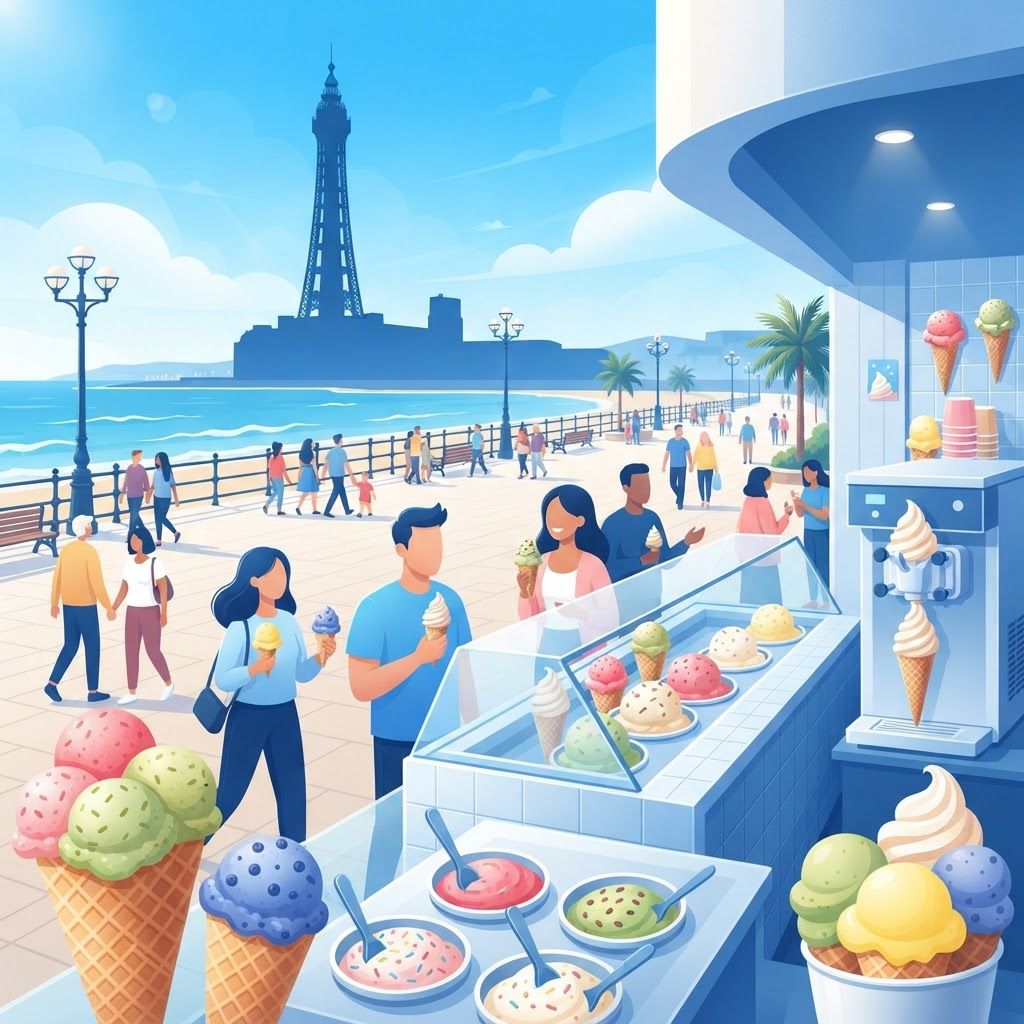
Ice Cream and the British Seaside
The association between ice cream and the British seaside is not accidental. Coastal resorts drew day-trippers long before home freezers existed, and ice cream was the perfect product: instantly gratifying, affordable, portable and impossible to take home. Blackpool, as the largest resort in the North West, developed a particularly strong ice cream culture, much of it built by families who arrived from Italy in the late nineteenth and early twentieth centuries and brought gelato-making traditions with them.
That heritage survives. Several of the town's best-known ice cream businesses trace their origins back a century or more, and the recipes and techniques have passed through several generations of the same families.
What Actually Separates Good Ice Cream From Bad
Butterfat content and overrun are the two technical measures that matter most. Butterfat carries flavour and produces a rich, smooth texture. Overrun is the amount of air whipped into the mixture; cheap ice cream can be more than half air by volume, which is why a large tub can feel surprisingly light. Dense, low-overrun ice cream costs more to make and tastes dramatically better.
Ingredient honesty is the other marker. Real vanilla shows visible seed specks and a complex aroma. Fruit sorbets made from actual fruit have a slightly variable colour and a fresh acidity that flavourings cannot replicate. Long ingredient lists heavy with stabilisers and emulsifiers usually indicate a product engineered for shelf life rather than eating quality.
The Ten Best Ice Cream Brands in Blackpool
1. Promenade Dairy Ices
Promenade Dairy Ices is a traditional family dairy producer making rich, high-butterfat ice cream from local milk and cream. Their vanilla is the benchmark against which everything else in the town is measured, and their willingness to keep the range small rather than chase novelty flavours reflects genuine confidence in the fundamentals.
2. Fylde Gelateria
Fylde Gelateria makes ice cream in the Italian style, served at a warmer temperature and with lower fat and lower overrun than British ice cream, producing an intensely flavoured and silky result. Pistachio, hazelnut and stracciatella are the standouts, made with imported nut pastes rather than flavourings.
3. Tower Creamery
Tower Creamery operates a farm-to-cone model, producing ice cream from a single herd's milk. The seasonal variation in the base is noticeable to attentive customers and considered a feature rather than an inconsistency. Their honeycomb and salted caramel are perennial favourites.
4. Sandgrown Sorbet Company
Sandgrown Sorbet Company specialises in dairy-free fruit sorbets and water ices made from whole fruit purees. The intensity of their raspberry, blood orange and mango is well beyond typical commercial sorbet, and the entire range happens to be suitable for vegan customers without being marketed primarily on that basis.
5. Northshore Artisan Ice Cream
Northshore Artisan Ice Cream focuses on inventive small-batch flavours that rotate frequently, including savoury-leaning combinations and collaborations with local bakers and coffee roasters. This is the most experimental producer in the town and rewards repeat visits.
6. Beacon Plant Based Creamery
Beacon Plant Based Creamery produces dedicated vegan ice cream using oat, coconut and cashew bases. The texture achieved is genuinely creamy rather than icy, which is the failure mode most plant-based frozen desserts suffer from, and the chocolate varieties in particular hold up against dairy competitors.
7. Clifton Traditional Ices
Clifton Traditional Ices makes classic British seaside ice cream in the whipped soft-serve style, but with a considerably better base mix than the standard commercial product. Served in a cone with a flake, it is a straightforward pleasure executed properly.
8. Ribble Valley Farmhouse Ice Cream
Ribble Valley Farmhouse Ice Cream comes from just outside the town and is widely stocked across the Fylde coast. Their range includes traditional flavours alongside seasonal specials using Lancashire fruit, and their commitment to keeping production on the farm is central to their identity.
9. Illumination Frozen Desserts
Illumination Frozen Desserts produces novelty and dessert-style frozen items including ice cream cakes, layered sundae bases and rolled ice cream. It leans toward spectacle, which suits the resort setting, but the base product quality is better than the presentation might suggest.
10. Coastal Kulfi and Frozen Sweets
Coastal Kulfi and Frozen Sweets makes traditional South Asian frozen desserts including pistachio, cardamom and mango kulfi, alongside falooda. The dense, slow-churned texture is completely distinct from Western ice cream and offers something genuinely different in the local market.
Trends in the Frozen Dessert Market
Plant-based options have moved from a small accommodation to a substantial category, and the quality gap has narrowed considerably as producers have learned to work with oat and cashew bases rather than relying on coconut, which imposes its own strong flavour.
Reduced sugar formulations are appearing, though this remains technically difficult because sugar controls freezing point and texture as well as sweetness. The successful examples use fruit and dairy solids intelligently rather than simply substituting sweeteners.
There is also a clear premiumisation trend, with customers increasingly willing to pay considerably more for a smaller portion of demonstrably better ice cream. This has been good for artisan producers and difficult for mid-market operators.
How to Choose Well
Look at the colour first. Genuinely natural ice cream tends toward muted tones. Pistachio should be a dull greenish beige rather than bright green, and strawberry should be pale pink rather than vivid. Intense colour usually indicates added colouring, which often accompanies added flavouring.
Watch how the ice cream behaves. Quality ice cream with low overrun sits heavily on the scoop and melts into a creamy liquid rather than a foamy froth. If a melted sample looks bubbly and thin, it contained a great deal of air.
Ask what is made on site. Many outlets sell bought-in product, which can still be good, but knowing the difference helps you calibrate expectations and price. Producers who make their own will always tell you enthusiastically.
Finally, judge by the plainest flavour available. Vanilla, or better yet a simple milk or fior di latte, has nowhere to hide. If a producer's vanilla is outstanding, everything else on the counter is likely to be worth trying too.
Want your brand featured in front of decision-makers? Publish a guest post or get a link insertion in our guides through AAMAX's guest post and link insertion service.
Helpful Links
 SponsoredAAMAX — Full-Service Digital Agency
Write for Us
Share your expertise with our readers. We welcome guest contributions from industry specialists.
Pitch your idea