What Home Security Actually Means Today
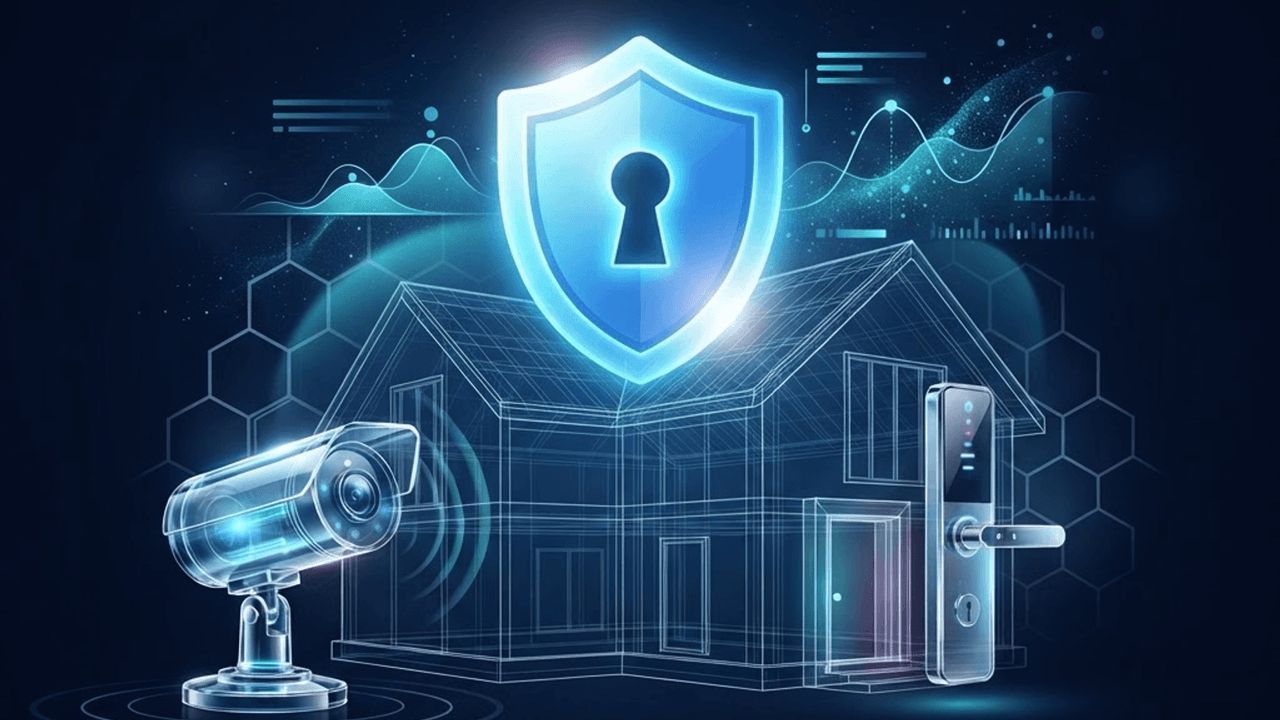
Twenty years ago, home security meant an alarm panel, a few door contacts and a siren on the front elevation. Today a typical installation might include intruder detection, external cameras with analytics, video doorbells, smart locks, lighting control and remote monitoring accessible from a phone anywhere in the world.
That capability is genuinely useful, but it has also created confusion. Many households now own several disconnected products from different manufacturers, each with its own app, none of which talk to each other and several of which have never been properly configured. A professionally designed system, whether simple or sophisticated, is coherent: every component contributes to detection, deterrence, verification or response.
The Layers of a Well-Designed System
Deterrence comes first and is the cheapest layer. Good external lighting, visible cameras, gravel paths, secure gates, well-maintained boundaries and the absence of climbing aids near windows all reduce the likelihood of a property being selected in the first place.
Physical security is the second layer, and it is the one most often neglected in favour of electronics. British Standard locks, anti-snap cylinders on uPVC doors, laminated glazing in vulnerable locations, hinge bolts, secure window locks and a properly fitted garage door do more to prevent entry than any camera.
Detection is the third layer: motion sensors, door and window contacts, glass break detectors and external beams. Verification is the fourth: cameras that let you or a monitoring centre confirm whether an activation is genuine. Response is the fifth, whether that means a monitoring centre contacting keyholders or a police response, which in the United Kingdom requires a system installed and maintained to recognised standards.
Ten Home Security Companies Serving Rugby
1. Avon Security Systems. A full-service installer covering intruder alarms, CCTV and access control for homes and small businesses, offering both bells-only and monitored options.
2. Midland Alarm and Monitoring. Focused on professionally monitored systems installed to recognised standards, with connection to an alarm receiving centre and keyholder response arrangements.
3. Swift CCTV Installations. Specialists in camera systems, including high-resolution recording, night capability, motion analytics that reduce false alerts, and compliance guidance where cameras overlook public areas.
4. Caldecott Locksmiths and Physical Security. Providing lock upgrades, anti-snap cylinders, door and window reinforcement, safes and emergency lockout services alongside security surveys.
5. Bilton Smart Home Security. Integrating smart locks, video doorbells, connected lighting and sensors into a single coherent platform rather than a collection of separate apps.
6. Dunchurch Fire and Security. Combining intruder protection with fire detection, carbon monoxide monitoring and interlinked alarm systems, which is increasingly the expected standard.
7. Newbold Perimeter Protection. Concentrating on external detection, gates, automated gate systems, driveway sensors and outbuilding security for rural and larger properties around the borough.
8. Rokeby Security Maintenance. Offering servicing, fault repair, battery replacement and takeover of existing systems installed by companies that are no longer trading.
9. Clifton Landlord Security Services. Serving rental property with tamper-resistant equipment, simple user interfaces, coded entry systems and compliance documentation.
10. Houlton Connected Home Protection. Focused on newer properties, providing wireless systems, app-based control, cloud recording and integration with existing home automation.
Monitoring, Standards and Police Response
Systems fall broadly into three categories. A bells-only system sounds a siren and relies on neighbours reacting, which in practice they frequently do not. A self-monitored system sends alerts to your phone, which is useful if you are able and willing to respond. A professionally monitored system routes alarms to a staffed receiving centre that verifies and escalates.
Police response is only available where a system is installed and maintained by a company certified to the relevant standards and where the system has a unique reference number. False alarms matter: too many and response is withdrawn. This is precisely why confirmed activation technology, requiring two detectors or video verification, has become the norm.
Insurers may require a specific standard of system for certain properties or premium reductions, so it is worth checking your policy wording before specifying equipment.
Privacy and Legal Considerations
Cameras that capture only your own property are generally straightforward. Cameras that capture the pavement, a neighbour's garden or shared access areas bring data protection obligations, including being able to justify the coverage, informing people that recording takes place, and responding to requests for footage. Angling cameras carefully and using privacy masking to exclude neighbouring property is both good practice and good neighbourliness.
Audio recording is treated more sensitively than video, and many video doorbell disputes centre on audio capture of conversations on a public footpath. Disabling audio where it is not needed avoids the issue entirely.
Practical Advice for Homeowners
Begin with a survey of how a stranger would actually approach your property. Rear access, side gates, flat roofs beneath first floor windows, unlit corners and concealed doorways are the vulnerabilities that matter. Fixing those is more valuable than adding another camera to the front.
Keep the system usable. The most common cause of an unset alarm is an over-complicated system that irritates the household. Zoning, so that the ground floor can be armed overnight, and reliable pet-tolerant detectors are worth specifying.
Ask about ongoing costs before signing. Monitoring subscriptions, cloud storage fees, annual servicing and cellular communication charges all recur, and some long contracts are considerably more expensive over their term than the equipment cost suggests. Confirm whether you own the equipment outright and whether another company could service it later.
Finally, remember the basics that cost nothing: locking doors even when at home, not leaving keys visible near the letterbox, storing car keys away from the front of the house, cancelling deliveries when away, and keeping tools and ladders locked up. A capable Rugby security company will raise every one of these points before recommending hardware, and that willingness is the clearest indicator of a firm interested in your security rather than your order value.
Want your brand featured in front of decision-makers? Publish a guest post or get a link insertion in our guides through AAMAX's guest post and link insertion service.
Helpful Links
 SponsoredAAMAX — Full-Service Digital Agency
Write for Us
Share your expertise with our readers. We welcome guest contributions from industry specialists.
Pitch your idea