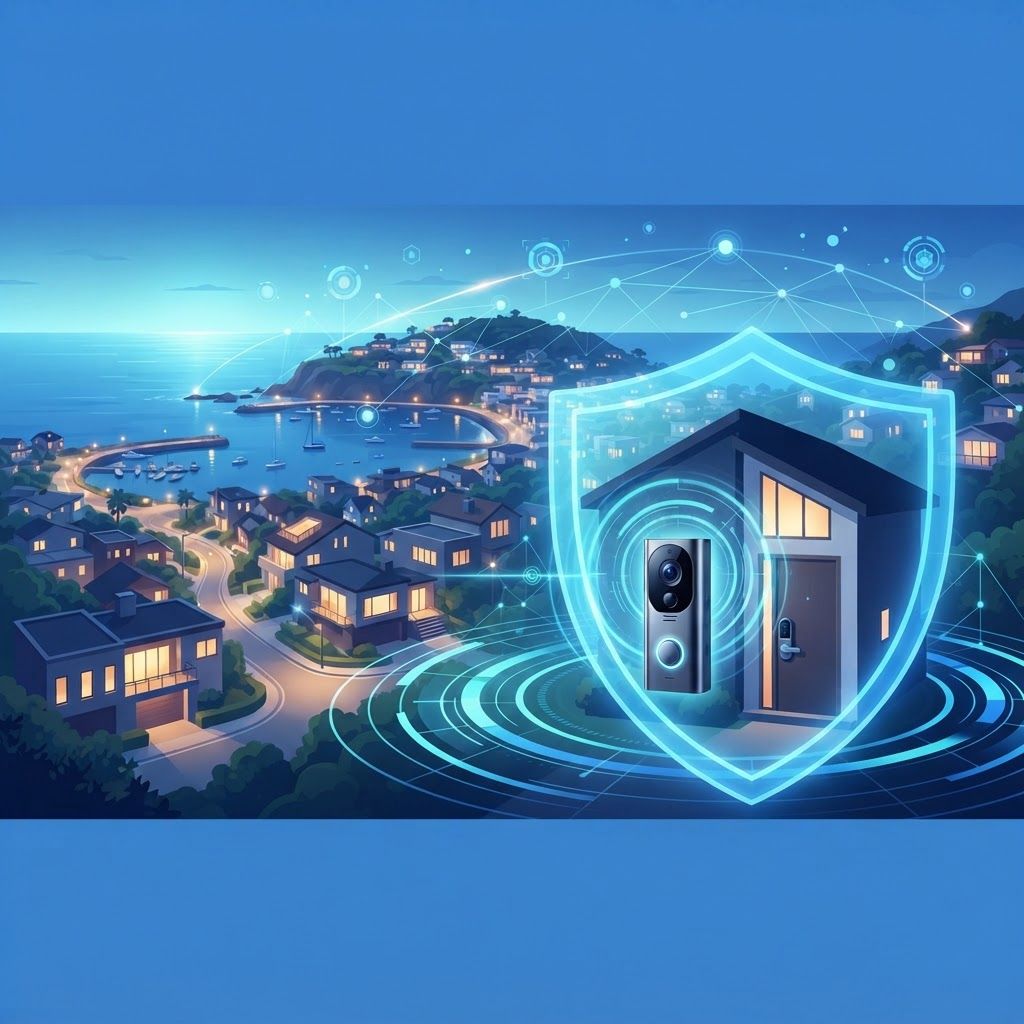
Understanding Home Security on the Isle of Wight
The Isle of Wight consistently records lower crime levels than most of mainland England, and that statistic shapes local attitudes to security. Yet the island's particular residential profile creates risks that are easy to underestimate. A very large proportion of island housing stock consists of second homes, seasonal holiday lets and rural properties that stand empty for long stretches. Opportunistic theft, outbuilding break-ins, tool and boat equipment theft, and damage caused by undetected water leaks or storms are far more common than dramatic burglary scenarios.
Geography matters as well. Emergency response times to remote locations near Chale, Brighstone or the Bembridge marshes can be longer than in Newport or Ryde, which increases the value of verified alarm monitoring and remote video confirmation. For coastal properties, corrosion-resistant hardware and weather-rated cameras are not optional extras but basic specification requirements.
What the Leading Security Companies Provide
The strongest providers on the island have moved well beyond simple bell-box alarm installation. A modern service portfolio typically includes intruder alarm design and installation to recognised grading standards, professionally monitored alarm receiving centre connections, high-definition CCTV with analytics, smart video doorbells, access control for gates and communal entrances, smart locks, environmental sensors for smoke, carbon monoxide, water leaks and freezing pipes, and integrated app control that lets an owner check a property from anywhere.
For the island's substantial holiday-let sector, providers increasingly offer keyless entry with time-limited codes, occupancy and noise monitoring that respects guest privacy, and automated arming schedules linked to booking calendars. For farms and equestrian properties, wireless perimeter detection, solar-powered cameras and machinery trackers address the specific problem of high-value assets stored in unlit outbuildings.
Accreditation and Standards to Look For
Security is one of the few home services where formal certification directly affects outcomes. Installers accredited by the National Security Inspectorate or the Security Systems and Alarms Inspection Board work to recognised British and European standards, and only certificated systems can be granted a police response reference for confirmed activations. Insurers frequently specify a graded, professionally maintained system as a condition of cover on higher-value properties, so the paperwork has real financial consequences.
Equally important is the maintenance regime. A monitored system requires annual servicing, battery replacement and communication path testing. Companies that offer clear, fixed-price maintenance contracts and rapid local callout tend to outperform remote national suppliers, simply because an engineer already on the island can attend the same day rather than waiting for a ferry slot.
Types of Providers on the Island
Independent local installers are the backbone of the island market. Their advantage is familiarity with property types, fast response, and a willingness to design bespoke systems for awkward period buildings where cabling routes are constrained by listed status.
National alarm and monitoring brands operate across the island through approved engineers and offer large monitoring centres, standardised equipment and long warranty terms. They suit customers who value scale and formal service level agreements.
Smart home and automation specialists integrate security with lighting, heating and audio. These firms appeal to owners of newly built or fully renovated homes who want a single unified control platform rather than separate apps.
Locksmiths and physical security firms handle the unglamorous but decisive layer: British Standard locks, window restrictors, reinforced door frames, security grilles, safes and gate hardware. Physical security remains the single most cost-effective deterrent.
Commercial and marine security providers serve boatyards, marinas, retail premises and hospitality businesses, and often bring enterprise-grade CCTV analytics that filter false alarms triggered by wildlife, weather or vegetation.
Technology Trends Shaping the Market
Three developments are reshaping island home security. Artificial intelligence video analytics can now reliably distinguish a person from a cat, a branch or a passing headlight, dramatically reducing the false alarm rate that historically undermined confidence in CCTV. Cloud recording with encrypted offsite storage protects footage even if the recorder is stolen. Cellular and dual-path signalling ensures an alarm still reports when broadband fails, which matters in rural parts of the island where connectivity can be inconsistent.
Energy-aware design is another quiet trend. Solar and long-life battery devices allow cameras and sensors to be positioned on gates, paddocks and outbuildings far from mains power, a practical advantage on larger rural plots.
Choosing the Right Security Company
Begin with a proper risk assessment rather than a product list. A reputable company will visit the property, walk the perimeter, identify weak entry points, consider sightlines and lighting, and then specify equipment. Any provider that quotes over the phone without a survey is selling hardware rather than security.
Ask directly about monitoring arrangements, including which alarm receiving centre is used and what happens at each escalation stage. Clarify contract length, whether equipment is owned or rented, and what happens if you cancel monitoring. Confirm data protection practices for CCTV, since recording beyond your boundary carries legal obligations under UK data protection law.
Request local references from similar properties. On an island, verifiable nearby examples are easy to obtain and highly informative. Finally, compare total cost of ownership over five years rather than the installation price alone, because monitoring fees and maintenance dominate long-term spend.
Practical Steps Every Homeowner Can Take
Technology works best alongside sound habits. Maintain good exterior lighting, keep tools and ladders locked away, avoid advertising absence on social media, install a key safe only where it is not visible from the road, and ensure that any holiday-let changeover routine includes arming instructions for guests. For empty winter properties, environmental sensors that detect low temperature and water leaks often prevent losses far greater than any burglary.
Final Thoughts
The best home security companies in the Isle of Wight combine recognised accreditation, genuine local response capability and a design-first approach that starts with the property rather than the product catalogue. Whether protecting a coastal cottage, a rural smallholding or a busy holiday let, the right provider will deliver a system that is reliable, insurable and simple enough that it actually gets used every day.
Want your brand featured in front of decision-makers? Publish a guest post or get a link insertion in our guides through AAMAX's guest post and link insertion service.
Helpful Links
 SponsoredAAMAX — Full-Service Digital Agency
Write for Us
Share your expertise with our readers. We welcome guest contributions from industry specialists.
Pitch your idea