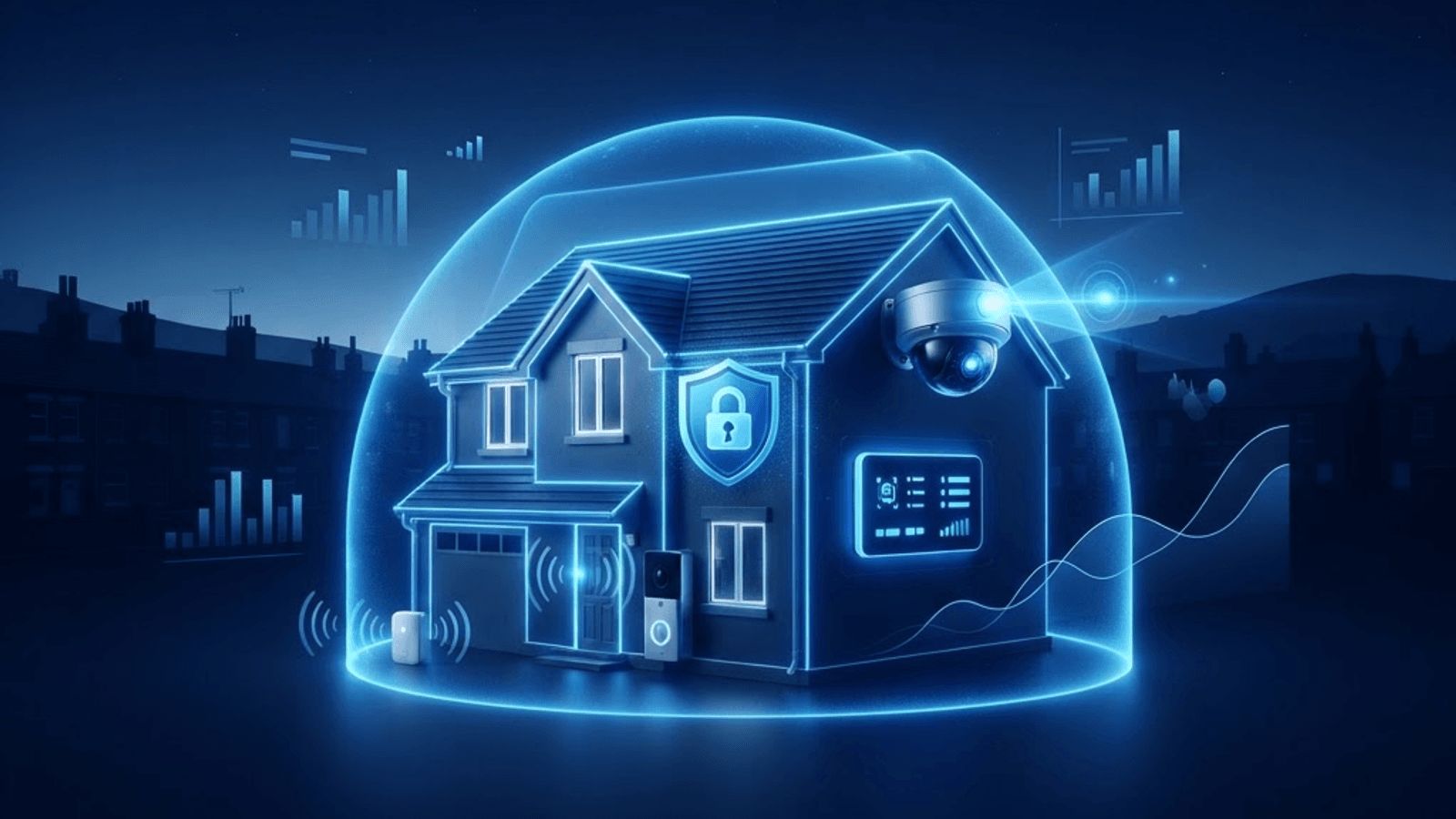
Home Security in a Changing Landscape
Home security has changed more in the last decade than in the previous forty years. Bell-only alarm boxes and simple door contacts have given way to monitored systems, high-definition cameras with intelligent detection, smart locks and integrated automation. For Chorley homeowners, this means more capability at lower cost, but also a more confusing market to navigate.
The borough's residential character influences what works well. Terraced streets near the town centre have shared access routes and rear alleys that favour perimeter lighting and camera coverage. Detached and semi-detached homes across Euxton, Whittle-le-Woods and Clayton-le-Woods tend to have larger plots where external detection and gate security become relevant. Rural properties toward Heath Charnock and Rivington face different challenges again, including outbuilding security and limited natural surveillance.
Leading Security Providers in the Area
Firms that have built strong local reputations include Chorley Security Systems, Lancashire Alarm Services, Astley Park Security, Buckshaw Smart Security, Yarrow Valley Fire and Security, Pennine Surveillance Solutions, Euxton Alarm Company, Coppull Security Installations, Northern Guard Systems and Rivington Protection Services. The market includes traditional alarm engineers, CCTV and access control specialists, and newer companies focused on smart home integration.
The most capable providers survey the property properly, design a system around actual vulnerabilities, and avoid selling standardised packages that ignore how a particular home is laid out and used.
Intruder Alarm Systems
Intruder alarms remain the backbone of home security. Modern systems use a control panel, door and window contacts, passive infrared or dual-technology motion detectors, and an external sounder. Wireless systems have improved dramatically in reliability and are now the default for retrofit installations because they avoid extensive cabling in finished properties.
The key decision is monitoring. A bell-only system makes noise and may deter an opportunist, but nobody is obliged to respond. A monitored system connects to an alarm receiving centre that verifies the activation and escalates to keyholders or, where the system meets police response criteria, to the police themselves. Monitoring involves an ongoing subscription but transforms the practical value of the installation.
Systems intended for police response must be installed and maintained to recognised standards by a company accredited by the NSI or SSAIB. This is an important distinction, since a system fitted outside those standards cannot obtain a police response reference regardless of its technical quality.
CCTV and Video Surveillance
Camera systems have become extremely capable. Current installations typically deliver high-resolution imaging, infrared or low-light colour capability, and intelligent analytics that distinguish people and vehicles from animals, foliage movement and weather. This dramatically reduces false alerts, which was historically the main reason homeowners stopped paying attention to their cameras.
Design matters more than camera count. Cameras positioned to capture faces at entry points and number plates at driveway entrances are worth far more than a larger number of wide overview shots. Lighting, mounting height, lens choice and angle all influence whether footage is actually usable as evidence.
Data protection deserves consideration. Domestic CCTV that captures only your own property is outside data protection legislation, but coverage extending onto pavements, neighbouring gardens or shared access falls within it. Reputable installers advise on privacy masking and signage, and will discuss neighbour relations before positioning cameras that overlook adjoining property.
Smart Home Integration and Access Control
Video doorbells have become the most widely adopted security device in the country, and for good reason: most residential security incidents begin at the front door. They provide recorded evidence, remote answering and a visible deterrent at modest cost.
Smart locks allow keyless entry, temporary access codes for trades or family, and audit logs of who entered and when. Quality varies considerably, and the mechanical lock behind the smart mechanism still needs to meet insurance-approved standards. Good installers emphasise this point rather than glossing over it.
Integration with lighting, heating and occupancy simulation adds practical deterrence. Lights and blinds operating on realistic randomised schedules while a household is away are more convincing than a single timer switch.
Physical Security Fundamentals
Technology should supplement rather than replace physical security. Doors should be fitted with anti-snap, anti-bump cylinders to the relevant British Standard, since cylinder snapping remains one of the most common forced entry methods on uPVC doors. Window locks, laminated glazing in vulnerable positions and secure patio door mechanisms all matter.
External lighting, particularly on approach routes and around rear access, provides both deterrence and better camera performance. Gravel surfaces, defensive planting, secure gates and well-maintained boundaries all contribute. Outbuildings and garages, often the weakest point on a property, deserve proper locks and ideally their own detection.
Choosing an Installer
Accreditation with the NSI or SSAIB is the primary indicator of a properly assessed security company. Membership requires audited technical standards, vetted personnel and documented procedures. For insurance purposes, some policies specifically require an accredited installation.
Ask for a site survey rather than accepting a quote over the phone. The survey should identify entry points, discuss household routines, consider pets that may trigger detection, and result in a written system design specifying every device and its location.
Clarify ongoing costs. Maintenance visits, monitoring subscriptions, cloud storage for footage and any SIM or connectivity charges all recur. Understand what happens if you wish to change monitoring providers later, since some systems are more portable than others.
Insurance and Practical Benefits
Many insurers offer premium reductions for accredited alarm installations, and some policies for higher-value properties require them. Keep certification documents accessible, maintain the system as specified, and inform your insurer of the installation.
Beyond insurance, the practical benefit is confidence. Being able to verify what triggered an alert, check on the property while away, and grant access remotely changes the everyday experience of home ownership considerably.
Final Thoughts
Chorley's home security sector offers everything from straightforward wireless alarms to fully integrated monitored systems with intelligent surveillance. Start with physical security fundamentals, layer detection and cameras where they address genuine vulnerabilities, use an accredited installer, and be realistic about ongoing costs. A well-designed system deters, detects and documents, and those three functions together are what actually protect a home.
Want your brand featured in front of decision-makers? Publish a guest post or get a link insertion in our guides through AAMAX's guest post and link insertion service.
Helpful Links
 SponsoredAAMAX — Full-Service Digital Agency
Write for Us
Share your expertise with our readers. We welcome guest contributions from industry specialists.
Pitch your idea