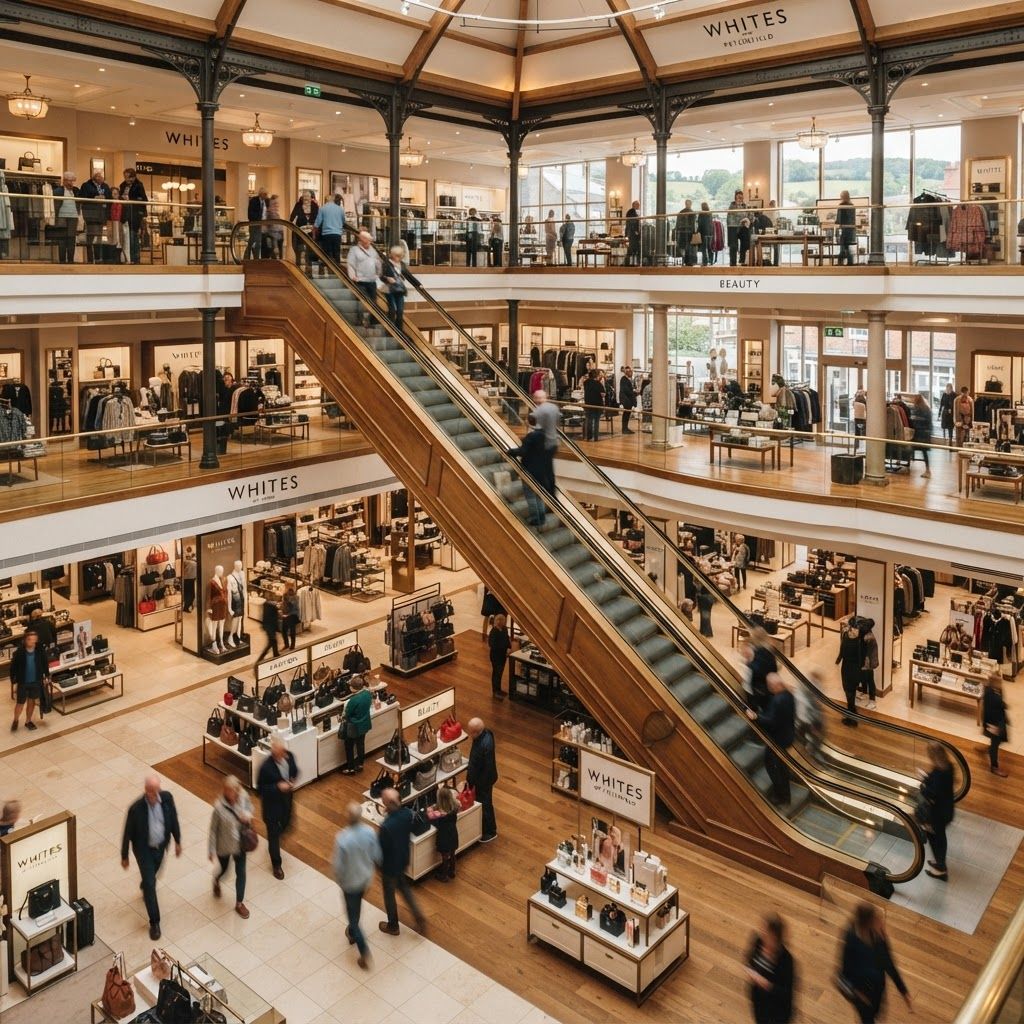
Decorating in a District Defined by Its Architecture
Stratford-on-Avon presents an interesting problem for anyone furnishing a home. The district's building stock leans heavily towards the historic: timber-framed cottages, Georgian townhouses, Victorian and Edwardian terraces, converted barns and stone farmhouses on the Cotswold fringe. These interiors come with low ceilings, uneven walls, deep window reveals, exposed beams and fireplaces that dominate a room whether you want them to or not. Furniture designed for a rectangular new-build living room frequently looks wrong in them.
The result is a local market that skews towards pieces with presence and provenance rather than volume retail. Solid timber, natural fibres, hand-finished ceramics, antique and vintage sourcing, and made-to-measure upholstery all perform well here because they sit comfortably against old fabric. At the same time the district has a substantial stock of modern homes in Bishopton, Long Marston and the villages, where clean-lined contemporary design reads correctly, and a growing appetite for the kind of restrained modern interior that works in both contexts.
What to Look for in a Home Decor Supplier
Quality in furnishing is easier to assess than most people assume, provided you know what to ask. In upholstery, the frame matters most: kiln-dried hardwood, jointed and glued rather than stapled, will outlast a softwood or particleboard frame by decades. Suspension should be sprung, either serpentine or hand-tied eight-way, rather than elastic webbing alone on anything intended to last. Cushion fill affects both comfort and longevity, with feather-wrapped foam offering a reasonable compromise between support and softness. All upholstered furniture sold in the UK must meet fire safety regulations, and the permanent label confirming this should be present.
In case goods, look at how drawers are constructed. Dovetailed joints and solid bases indicate a different manufacturing philosophy from stapled boxes with hardboard bottoms. Solid timber will move with humidity, which is a feature rather than a fault, but veneered board is not automatically inferior if the substrate is good and the veneer well laid. For textiles, rub-test ratings indicate abrasion resistance and matter for anything upholstered in a busy household.
Service considerations are equally important. A supplier who measures, advises on scale and delivers to room of choice with assembly saves considerable difficulty, particularly in period houses where access is genuinely restricted. Made-to-measure lead times of eight to twelve weeks are normal for bespoke upholstery and should be planned for rather than resented.
Ten Home Decor Brands and Showrooms in the Stratford-on-Avon Area
Avon House Interiors operates as a full-service showroom combining furniture, lighting, textiles and an in-house design consultancy. Their strength lies in whole-room schemes: presenting fabric, paint, flooring and furniture together so clients can judge how a space will resolve rather than assembling it piece by piece. They are frequently engaged by owners of larger period properties who want coherence across multiple rooms.
Shakespeare Country Furnishings specialises in solid timber furniture in oak, ash and walnut, much of it made to order in dimensions that suit older houses. Their sideboards, dressers and refectory tables are the sort of pieces that anchor a room, and the ability to adjust dimensions by a few centimetres to fit an alcove is precisely what a fitted-looking result requires.
Warwickshire Home and Living covers a broader, more accessible range, with sofas, beds, dining sets and accessories at mid-market price points. The showroom is organised as room sets, which helps clients visualise combinations, and delivery across the district is handled in-house rather than subcontracted.
Riverside Textiles and Soft Furnishings concentrates on curtains, blinds, cushions and upholstery. Made-to-measure curtains with hand-finished headings, interlining for period windows and correctly specified pole or track systems are their core business. In houses with deep reveals and draughty openings, properly made and interlined curtains contribute meaningfully to comfort as well as appearance.
Cotswold Edge Interiors works in the natural-material register associated with the wider Cotswold aesthetic: linen and wool upholstery, limewashed and chalk-finished timber, stoneware ceramics and muted, earth-derived palettes. Their sourcing favours British and European makers, and the studio provides colour consultation alongside furnishing.
Stratford Antiques and Vintage Decor serves the substantial local appetite for pieces with history. Georgian and Victorian furniture, mid-century seating, decorative mirrors, lighting and objects are sourced and, where appropriate, restored. For period interiors this is often the most sympathetic route, and it is unquestionably the most sustainable.
Feldon Lighting and Design focuses exclusively on lighting, which is arguably the most under-considered element of English interiors. The showroom covers decorative pendants, wall lights, table and floor lamps alongside architectural and track solutions, and the team provides lighting plans specifying layers of ambient, task and accent light. In low-ceilinged period rooms, where a single central fitting produces flat and unflattering light, this expertise transforms a space.
Bard's Kitchen and Dining Studio works at the intersection of fitted and freestanding, supplying handmade kitchens, dressers, islands and dining furniture. Their in-frame cabinetry and painted finishes are chosen frequently for period properties where a gloss slab kitchen would jar, and they coordinate with local fitters and stone suppliers.
Alveston Rugs and Flooring supplies natural-fibre and wool rugs, runners for the awkward turning staircases common locally, and a range of hard flooring including engineered oak and reclaimed boards. Their advice on underlay, acoustic performance and suitability over underfloor heating is more detailed than the market average.
Henley Street Home Accessories is a smaller boutique operation dealing in ceramics, glassware, candles, artwork, throws and the finishing layer that makes a scheme feel inhabited. They favour independent British makers and rotate stock frequently, which makes the shop a genuine source of pieces that will not appear in every other house in the street.
Interior Trends Influencing Local Homes
Several directions are clearly visible in the district. The most durable is a move away from disposable furnishing towards fewer, better pieces. Clients increasingly ask about repairability, reupholstery potential and whether a manufacturer will supply replacement covers in five years. Antique and vintage buying has shed any suggestion of thrift and become an aspirational choice, partly for sustainability and partly because older pieces suit older buildings.
Colour has warmed and deepened. Cool greys that dominated for a decade have given way to clay, ochre, olive, deep green and warm off-whites, which sit far better against oak beams and brick than a blue-grey does. Textural contrast is doing the work that pattern once did: bouclé, linen, wool, rattan and unglazed ceramic used together in a limited palette.
Multifunctional space is another persistent theme, driven by home working. Studies carved from box rooms, joinery that conceals a desk, and dining rooms that must also serve as workspaces have created demand for furniture that closes down neatly at the end of the day. In houses that were never designed for a second work location, bespoke joinery frequently provides the only elegant answer.
Furnishing a Period Home Sensibly
Measure everything twice, including the route into the room. A sofa that fits the space but not the staircase is a common and expensive mistake in Stratford's older houses, and reputable suppliers will ask about access before taking an order. Where access is genuinely impossible, modular or knock-down frames solve the problem.
Resist the urge to furnish an entire house at once. Live with a room for a season before committing to the pieces that will define it, particularly where light changes dramatically between summer and winter. Buy the structural items first, then layer.
Finally, let the building lead. Period interiors respond well to natural materials, unfussy shapes and a restrained palette, because the architecture already provides the visual interest. Modern homes in the district can carry more graphic contrast precisely because they offer a neutral shell. Matching the approach to the building, rather than importing a look wholesale, is what separates interiors that feel settled from those that feel staged.
Want your brand featured in front of decision-makers? Publish a guest post or get a link insertion in our guides through AAMAX's guest post and link insertion service.
Helpful Links
 SponsoredAAMAX — Full-Service Digital Agency
Write for Us
Share your expertise with our readers. We welcome guest contributions from industry specialists.
Pitch your idea