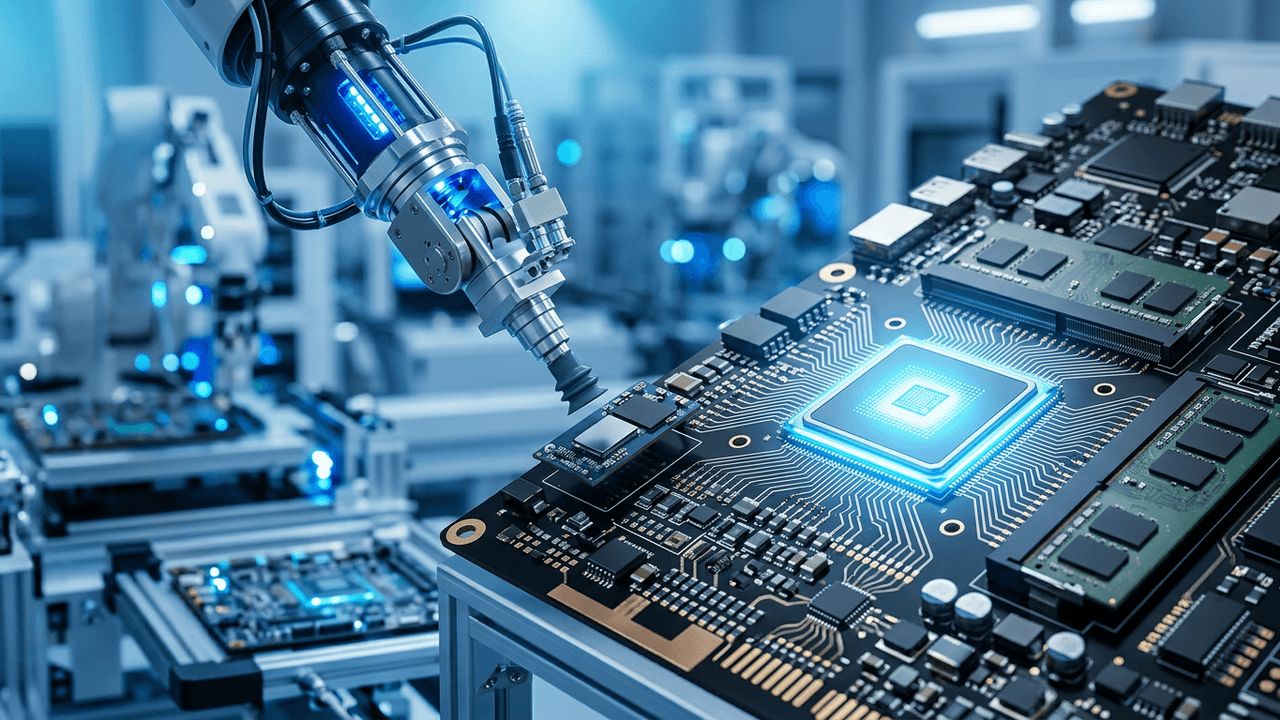
Why West Lothian Became a Hardware Manufacturing Powerhouse
Few places in the United Kingdom carry an industrial nickname as evocative as Silicon Glen, and West Lothian remains one of its beating hearts. From the 1970s onwards, Livingston developed as a purpose-built new town with generous industrial land, motorway access along the M8 corridor and a workforce trained in precision assembly. That combination attracted semiconductor fabrication, contract electronics manufacturing and specialist engineering firms that still anchor the local economy today.
The region's advantages are practical rather than sentimental. Edinburgh Airport is roughly fifteen minutes from Broxburn, the Forth ports handle freight for export markets, and universities in Edinburgh, Glasgow and Stirling supply a steady stream of engineering graduates. Manufacturers in Bathgate, Livingston, Whitburn and Armadale therefore benefit from a rare mix of skilled labour, logistics and proximity to research institutions. For buyers, that means shorter lead times and better technical support than many offshore alternatives can offer.
What Distinguishes a Leading Hardware Manufacturer
Choosing a hardware partner is rarely about price alone. The strongest manufacturers demonstrate depth across four areas: certified quality systems such as ISO 9001 and AS9100, genuine design-for-manufacture input at the prototype stage, transparent supply chain traceability, and the ability to scale from a handful of units to volume production without retooling delays. West Lothian firms have leaned heavily into the higher-value end of this spectrum, competing on engineering intelligence rather than low-cost labour.
Sustainability has become a decisive differentiator too. Customers increasingly ask about energy sourcing, solvent recovery, waste diversion and the recyclability of enclosures and packaging. Several West Lothian operations have invested in on-site renewable generation and closed-loop water systems, partly to meet Scotland's ambitious climate targets and partly because efficiency lowers unit costs in energy-intensive processes such as wafer fabrication and metal finishing.
The Top 10 Hardware Manufacturers in West Lothian
1. Diodes Incorporated, Greenfield, Bathgate — The former Motorola and Freescale wafer fabrication site at Greenfield is the region's most significant semiconductor asset. Operating within the Diodes Incorporated group, the facility produces discrete and analogue semiconductor products for automotive, industrial and consumer applications. Its reputation rests on high-volume wafer output, automotive-grade quality discipline and a long institutional memory of chip manufacturing in central Scotland.
2. Sky, Livingston manufacturing and technology operations — Sky's long-standing Livingston presence has been central to the assembly, refurbishment and logistics of set-top boxes and broadband hardware for the UK and Ireland. The site is widely recognised for pioneering circular-economy practices, recovering and remanufacturing returned units at scale rather than sending them to waste, and for the sophistication of its testing and fulfilment systems.
3. Mitsubishi Electric Air Conditioning Systems Europe, Livingston — This substantial Livingston plant manufactures air conditioning and heat pump equipment for European markets. It is respected for lean manufacturing discipline, high automation levels and a strong focus on energy-efficient heating technology, positioning it well as the UK transitions towards low-carbon heating. The site also runs extensive apprenticeship and continuous-improvement programmes.
4. Jabil, Livingston — As one of the world's largest contract manufacturing organisations, Jabil's Scottish operations provide electronics manufacturing services, design support and supply chain management. Clients value the combination of global procurement leverage with local engineering teams, making it a natural choice for regulated sectors where documentation and traceability matter as much as the assembly itself.
5. Alexander Dennis supply network — Though headquartered just beyond the county boundary, Alexander Dennis anchors a bus and coach manufacturing supply chain that draws heavily on West Lothian fabricators, trim specialists and component suppliers. Its shift towards battery-electric vehicles has created demand for local expertise in high-voltage assemblies, lightweight structures and thermal management.
6. Semefab silicon foundry services — Semefab operates as a specialist silicon foundry serving sensor, power and MEMS customers who need moderate-volume, high-mix wafer processing. Its strength lies in flexibility: supporting niche device physics and legacy process nodes that larger fabs decline, which makes it invaluable to European sensor and medical device developers.
7. Bathgate corridor precision electronics operations — The Bathgate corridor retains a cluster of precision electronics and cable assembly businesses descended from the region's contract manufacturing heritage. These operations specialise in wiring harnesses, control panels and box-build assemblies for rail, energy and industrial automation customers, with a reputation for handling complex, low-volume builds that automated lines cannot economically serve.
8. Broxburn and Winchburgh precision engineering firms — A group of CNC machining and sheet metal specialists in Broxburn, Winchburgh and Uphall serve oil and gas, subsea, food processing and renewables clients. Typical capabilities include five-axis milling, laser cutting, powder coating and welded fabrication to coded standards, often delivered on lead times measured in days rather than weeks.
9. Whitburn and Armadale industrial component manufacturers — The western towns of the county host manufacturers of plastic mouldings, rubber components, industrial fasteners and enclosures. Their competitive advantage is toolmaking capability held in-house, allowing rapid design iteration for product developers who need functional prototypes before committing to volume tooling.
10. Livingston medical device and instrumentation manufacturers — A growing cohort of firms produces diagnostic instruments, laboratory equipment and single-use medical components under ISO 13485 quality systems. Cleanroom assembly, validated processes and full device history records are standard, and many of these businesses work closely with Scotland's life sciences research base to move academic innovation into manufacturable products.
Industry Trends Reshaping Local Manufacturing
Three forces dominate conversations across West Lothian factory floors. The first is reshoring: after years of supply chain disruption, European brands are moving critical production closer to end markets, and Scottish manufacturers with certified quality systems are direct beneficiaries. The second is electrification, which is generating demand for power electronics, battery enclosures, thermal components and high-voltage harnesses.
The third is industrial digitalisation. Sensors on production equipment, predictive maintenance analytics and digital work instructions are reducing scrap rates and improving first-pass yield. Smaller firms have adopted these tools selectively, often starting with machine monitoring before extending to full manufacturing execution systems. The result is a manufacturing base that looks nothing like the labour-intensive assembly halls of the 1980s.
How to Choose the Right Manufacturing Partner
Start with a clear technical package: drawings, tolerances, materials, test requirements and expected annual volumes. Ask prospective partners how they would change your design to reduce cost, and treat the quality of that answer as a proxy for engineering capability. Request evidence of relevant certifications, visit the shop floor if possible, and clarify who owns tooling, inspection data and intellectual property.
Consider commercial resilience as well. Dual-sourcing critical components, agreeing consignment stock for long-lead parts and setting realistic capacity reservations all reduce risk. West Lothian's manufacturers are generally open to collaborative commercial structures, particularly with customers who share forecasts honestly.
Final Thoughts
West Lothian's hardware manufacturing sector has survived several industrial cycles by moving steadily up the value chain. Semiconductors, low-carbon heating equipment, medical instrumentation and precision engineering now sit alongside traditional contract assembly. For product developers and procurement teams, the region offers something increasingly scarce: experienced engineers within driving distance, backed by facilities capable of taking a concept from prototype to certified production without leaving central Scotland.
Want your brand featured in front of decision-makers? Publish a guest post or get a link insertion in our guides through AAMAX's guest post and link insertion service.
Helpful Links
 SponsoredAAMAX — Full-Service Digital Agency
Write for Us
Share your expertise with our readers. We welcome guest contributions from industry specialists.
Pitch your idea