

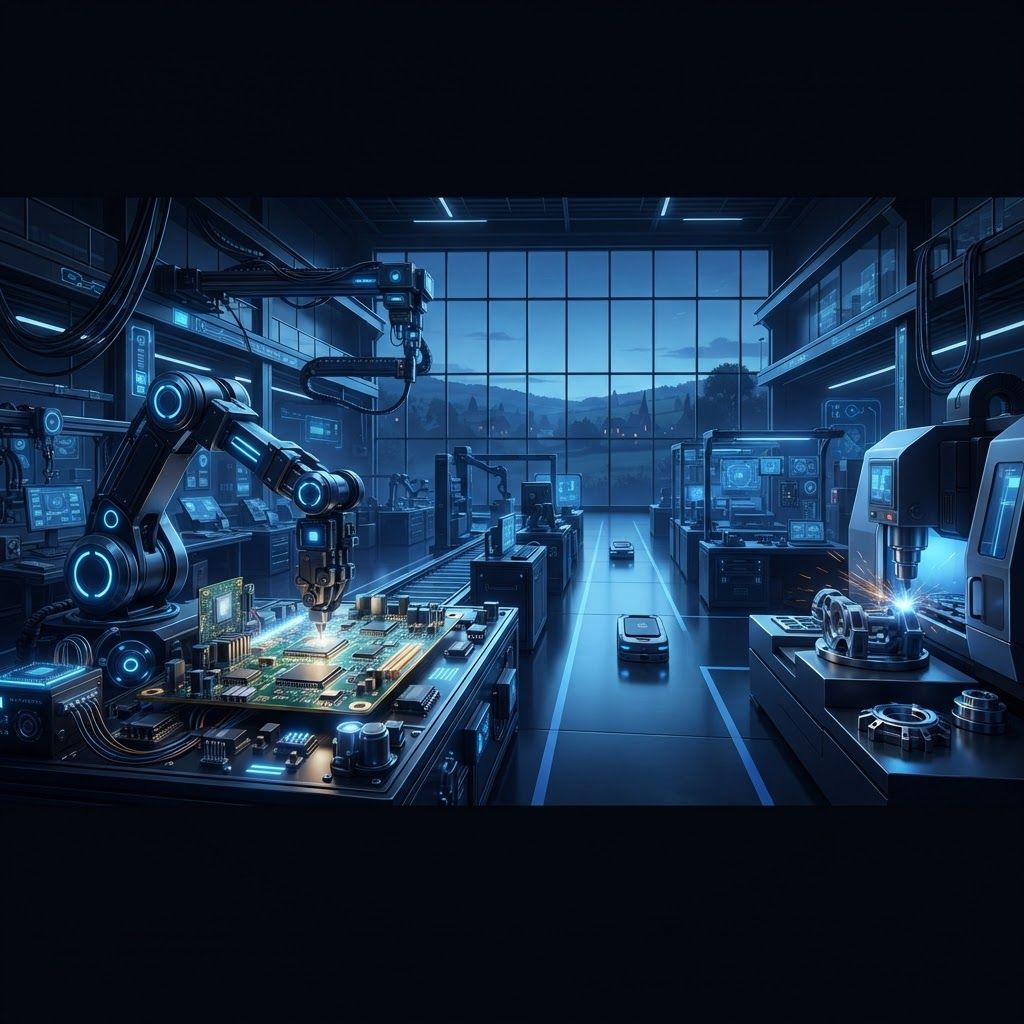
A Manufacturing Town With Deep Roots
Stroud's industrial identity was forged in the woollen trade, when the fast-flowing streams of the five valleys powered dozens of mills. Those mills have since been reinvented as workshops, studios and light industrial units, and the engineering skills they nurtured never left. Today the district supports a remarkable concentration of hardware manufacturers, from precision machinists and electronics assemblers to specialist producers of scientific instruments and renewable energy equipment.
What makes the local sector distinctive is its scale. Most firms are small to medium sized, family owned or employee owned, and built around deep technical specialism rather than volume production. That gives Stroud manufacturers a strong position in low-volume, high-complexity work where responsiveness and engineering judgement matter more than unit cost alone.
Capabilities Available in the District
Buyers in the Stroud area can access an unusually complete supply chain. CNC milling and turning, sheet metal fabrication, welding, injection moulding, printed circuit board assembly, cable harness manufacture, precision grinding, surface finishing and final product integration are all available within a short drive. Several firms also offer design for manufacture support, helping product companies refine concepts before committing to tooling.
Quality accreditation is widespread, with many workshops holding recognised management system certification and maintaining full material traceability, which is essential for aerospace, medical and automotive customers.
The Top 10 Hardware Manufacturers in Stroud
1. Five Valleys Precision Engineering. A benchmark for the district, this firm delivers tight-tolerance machined components for aerospace and scientific instrumentation clients. Multi-axis machining, in-house metrology and rigorous documentation underpin its reputation for reliability.
2. Stroudwater Electronics Manufacturing. Specialising in printed circuit board assembly and box build, Stroudwater Electronics Manufacturing serves product developers who need small to medium production runs with strong testing discipline and clear traceability.
3. Rodborough Metalcraft. A sheet metal and fabrication specialist producing enclosures, brackets, frames and bespoke structures. Laser cutting, forming and powder coating are handled under one roof, which shortens lead times considerably.
4. Cotswold Instrument Works. This manufacturer builds scientific and measurement instruments, combining mechanical assembly with calibration and validation. Its work for laboratory and environmental monitoring clients demands exceptional consistency.
5. Thrupp Polymer Products. Focused on plastics, Thrupp Polymer Products offers injection moulding, tooling support and assembly for consumer and industrial goods, with a growing line in recycled and bio-based materials.
6. Severn Vale Power Systems. Serving the renewable energy sector, this firm manufactures control cabinets, inverter housings and mounting systems for solar and small-scale hydro installations, reflecting the district's strong green energy presence.
7. Painswick Tooling and Dies. A traditional toolmaking business that has modernised successfully, producing press tools, jigs and fixtures for manufacturers across the South West and supporting customers through prototype to production transitions.
8. Chalford Composite Solutions. Working with carbon fibre, glass fibre and hybrid laminates, Chalford Composite Solutions supplies lightweight structural components to motorsport, marine and specialist vehicle customers.
9. Nailsworth Industrial Assembly. A contract assembly operation offering kitting, sub-assembly, testing and packaging, frequently used by product companies that want to outsource logistics-heavy stages of production.
10. Minchinhampton Machine Tools. Rounding out the list, this manufacturer produces and refurbishes specialist machinery, providing bespoke automation solutions for food, packaging and engineering customers.
Trends Reshaping Local Manufacturing
Automation is arriving in a measured way. Rather than replacing skilled staff, Stroud manufacturers are adopting collaborative robots, automated inspection and machine monitoring to remove repetitive tasks and improve consistency. Data from connected machines is increasingly used to plan maintenance and reduce unplanned downtime.
Reshoring is another significant force. Supply chain disruption over recent years has pushed many product companies to source closer to home, and Stroud's combination of technical capability and geographic accessibility has attracted work that previously went overseas. Shorter supply chains also support the carbon reduction commitments that customers increasingly demand.
Sustainability shows up throughout the sector. Energy-efficient plant, solar generation on factory roofs, closed-loop coolant systems, scrap recovery and a shift towards recycled materials are now routine considerations rather than optional extras.
How to Select a Manufacturing Partner
Match capability to requirement honestly. A precision machinist optimised for aerospace tolerances may be an expensive choice for a simple bracket, while a general fabricator will struggle with micron-level work. Visit the workshop if you can; the condition of equipment, organisation of the shop floor and quality of documentation tell you a great deal.
Discuss capacity and lead times candidly, ask how design changes are handled, and clarify tooling ownership before committing. For any regulated sector, confirm certification status and request evidence of traceability procedures.
Skills, Apprenticeships and the Next Generation
One reason the district sustains so much engineering capability is a deliberate investment in training. Several Stroud manufacturers run apprenticeship programmes in partnership with Gloucestershire colleges, bringing school leavers into machining, electronics and fabrication roles and developing them over several years. This matters commercially as well as socially, because the tacit knowledge involved in setting a machine correctly or diagnosing an intermittent fault is learned on the shop floor rather than in a classroom.
Employers also report that younger entrants arrive comfortable with digital tools, computer-aided design and data systems, which accelerates the adoption of modern production methods. For buyers, a manufacturer with a healthy apprenticeship pipeline is usually a good sign of long-term stability and continued investment in capability.
Final Thoughts
Stroud's hardware manufacturers represent a rare combination of heritage craftsmanship and modern engineering discipline. For product companies that need responsive, high-quality production without the rigidity of large-scale contract manufacturing, the district offers an exceptionally capable and accessible supplier base.
Want your brand featured in front of decision-makers? Publish a guest post or get a link insertion in our guides through AAMAX's guest post and link insertion service.
Helpful Links
 SponsoredAAMAX — Full-Service Digital Agency
Write for Us
Share your expertise with our readers. We welcome guest contributions from industry specialists.
Pitch your idea

