

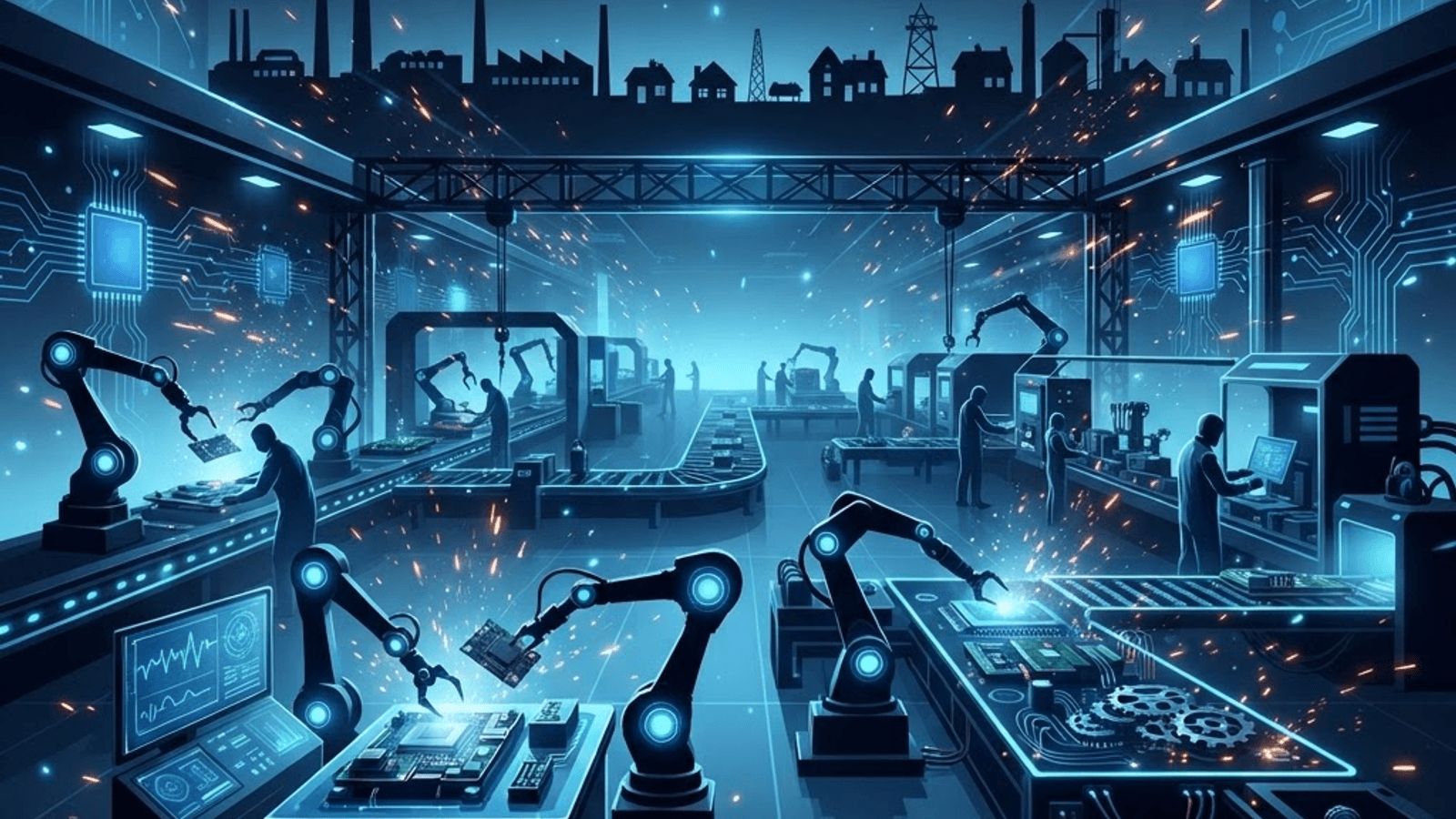
Manufacturing Heritage and Modern Capability
North Staffordshire's manufacturing reputation was built on ceramics, and that industry still shapes the region's industrial character. What is less widely recognised is the breadth of manufacturing capability that developed around it: kiln engineering, materials handling, precision tooling, industrial electronics and specialist machining all emerged to serve the potteries and subsequently diversified into other sectors.
Newcastle-under-Lyme benefits directly from this ecosystem. The borough and surrounding area host manufacturers with genuine engineering depth, established quality systems and supply chains refined over decades. Combined with operating costs below southern England and improving transport links, this makes the area a credible location for both domestic production and reshored manufacturing.
1. Ironmarket Precision Engineering
Ironmarket Precision Engineering produces machined components to tight tolerances for demanding applications. Its capability spans multi-axis machining, turning, grinding and finishing, supported by metrology equipment capable of verifying the tolerances it claims. Aerospace, medical device and industrial equipment customers form its core base, and its documentation and traceability systems meet the requirements those sectors impose.
2. Castle Electronics Manufacturing
Castle Electronics Manufacturing provides contract electronics assembly. Surface mount and through-hole assembly, cable harnessing, box build and functional testing make up its service. It handles both prototype volumes and production runs, and its willingness to support low-volume specialist work makes it accessible to product developers who larger contract manufacturers decline.
3. Keele Instrumentation
Keele Instrumentation designs and manufactures measurement and control equipment. Sensors, data acquisition systems, laboratory instruments and specialist test equipment form its output. Close relationships with research organisations mean much of its work involves equipment that does not exist commercially, produced in small quantities to specific scientific requirements.
4. Lyme Industrial Systems
Lyme Industrial Systems builds process equipment and production machinery. Conveying systems, material handling, automated assembly and bespoke production machines form its output. Its engineers work directly with customers to understand process requirements before design, which produces equipment suited to actual operating conditions rather than idealised specifications.
5. Silverdale Enclosures & Fabrication
Silverdale Enclosures & Fabrication produces sheet metal work, enclosures, frames and structural components. Laser cutting, forming, welding and powder coating are performed in-house, which shortens lead times and simplifies quality accountability. Electronics manufacturers, machinery builders and equipment integrators form its customer base.
6. Wolstanton Plastics
Wolstanton Plastics manufactures polymer components through injection moulding, vacuum forming and machining. It supports customers from design through tooling to production, advising on material selection, wall thickness, draft angles and other factors that determine whether a part can be produced economically. Early engagement in design consistently reduces tooling cost.
7. Clayton Ceramics Technology
Clayton Ceramics Technology applies the region's ceramic heritage to technical rather than decorative applications. Wear-resistant components, thermal management parts, electrical insulators and specialist substrates form its output. Technical ceramics serve demanding environments where metals and polymers fail, and the accumulated regional expertise in ceramic processing provides genuine competitive advantage.
8. Trent Vale Tooling
Trent Vale Tooling produces tooling, jigs, fixtures and dies supporting other manufacturers' production. This work is largely invisible outside the industry but fundamental to it, since production capability depends on the tooling behind it. The company's ability to produce and repair tooling locally reduces downtime substantially compared with overseas sourcing.
9. Chesterton Product Development
Chesterton Product Development provides design and prototyping services for physical products. Concept development, mechanical design, prototyping, design for manufacture and production introduction form its offer. It bridges the persistent gap between product idea and manufacturable design, a gap where many otherwise promising products fail.
10. Madeley Small Batch Manufacturing
Madeley Small Batch Manufacturing serves customers requiring modest quantities. Short production runs, prototype builds, specialist assemblies and legacy part reproduction form its work. Larger manufacturers typically cannot serve these requirements economically, and the company fills a genuine and persistent market gap across the region.
Selecting a Manufacturing Partner
Capability assessment should extend beyond equipment lists. Ask about quality systems, inspection procedures, traceability, and how non-conformance is handled. A manufacturer's response to problems reveals more about the relationship you will have than its response to straightforward orders.
Visit the facility. Physical inspection reveals a great deal that documentation does not: organisation, cleanliness, equipment condition, work in progress management and the demeanour of staff. Manufacturers reluctant to accommodate visits warrant caution.
Understand the true cost structure. Unit price is only part of the picture. Tooling costs, minimum order quantities, lead times, payment terms, transport and the cost of quality failures all affect total cost. The cheapest unit price frequently proves the most expensive overall, particularly when reject rates or delivery reliability are poor.
Assess capacity and dependency in both directions. A manufacturer operating at full capacity cannot accommodate growth or urgent requirements. Conversely, becoming a disproportionately large customer of a small supplier creates mutual risk that should be acknowledged and managed.
Design for Manufacture Matters
The greatest cost savings available in manufacturing typically come from design decisions rather than production negotiation. Component count reduction, tolerance relaxation where function permits, standard material specification, assembly simplification and tooling-friendly geometry all reduce cost substantially.
Engaging manufacturing expertise during design rather than after it consistently produces better outcomes. Manufacturers can identify features that are expensive to produce and suggest alternatives achieving the same function more economically. Designs finalised in isolation and then sent for quotation routinely cost considerably more than necessary.
Reshoring and Supply Chain Resilience
Recent years have demonstrated the fragility of extended international supply chains. Shipping disruption, geopolitical tension and lead time volatility have prompted many organisations to reconsider distant sourcing.
Local manufacturing offers shorter lead times, easier communication, simpler quality resolution, reduced inventory requirements, lower transport emissions and substantially reduced disruption risk. Unit costs may be higher, but total cost including inventory holding, expediting, quality management and disruption frequently favours regional sourcing more than headline comparison suggests.
Technology in Modern Manufacturing
Manufacturing in the borough is more technically sophisticated than public perception typically allows. Computer-controlled machining, automated inspection, additive manufacturing, digital production planning and data-driven maintenance are widespread among competitive producers.
Additive manufacturing has become particularly valuable for prototyping, tooling and low-volume complex parts, though it complements rather than replaces conventional processes for most production applications. Automation continues to increase, driven as much by persistent skilled labour shortages as by cost reduction.
For organisations sourcing manufactured components, the practical conclusion is that Newcastle-under-Lyme and its surrounding area offer capability that is frequently overlooked in favour of distant alternatives, often to the buyer's disadvantage.
Want your brand featured in front of decision-makers? Publish a guest post or get a link insertion in our guides through AAMAX's guest post and link insertion service.
Helpful Links
 SponsoredAAMAX — Full-Service Digital Agency
Write for Us
Share your expertise with our readers. We welcome guest contributions from industry specialists.
Pitch your idea

