

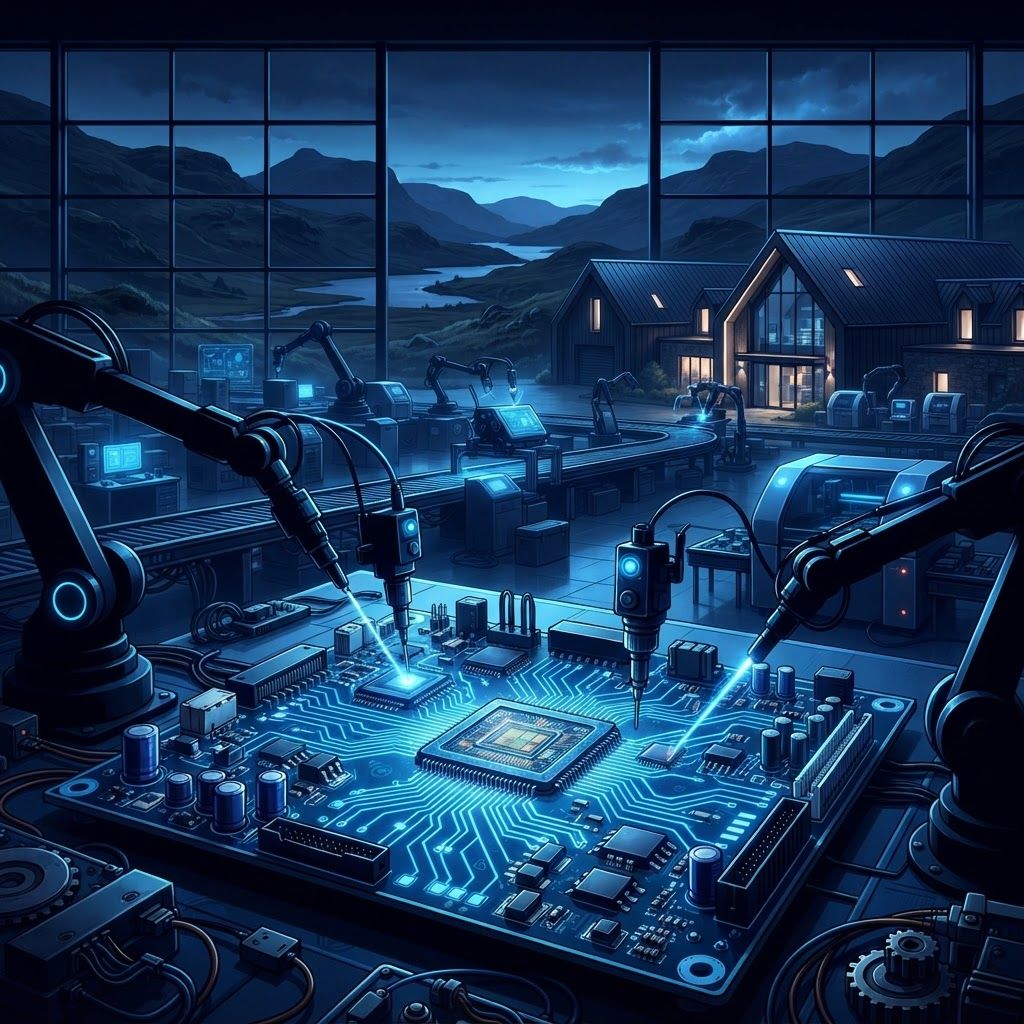
Manufacturing Heritage and Modern Engineering
East Ayrshire's industrial story stretches back through coal, textiles and heavy engineering. While those industries have contracted, the engineering culture they created has persisted, evolving into a modern manufacturing base focused on electronics, precision components and specialist industrial equipment. Kilmarnock in particular retains substantial engineering capacity, supported by an experienced workforce and a network of suppliers built up over generations.
What makes the current generation of manufacturers distinctive is their adaptability. Rather than competing on volume with overseas production, most have positioned themselves around low-to-medium volume, high-complexity work where engineering support, quality assurance and responsiveness matter more than unit cost alone. Reshoring trends and supply chain disruption have made that positioning considerably more attractive in recent years.
Categories of Hardware Manufacturing
Hardware manufacturing covers a wide range of capabilities. Electronics manufacturing services handle printed circuit board assembly, testing and box build, taking a design through to a finished product. Precision engineering focuses on machined components, often to tight tolerances for demanding applications. Fabrication covers sheet metal, welding and structural work. Contract assembly brings components together into finished equipment.
Many organisations need several of these, and a key decision is whether to coordinate multiple specialists or work with a single partner who manages the supply chain. Each approach has merit depending on volume, complexity and internal engineering capacity.
The Leading Hardware Manufacturers in East Ayrshire
Kilmarnock Electronics Manufacturing is the region's principal electronics assembly operation, providing surface mount and through-hole assembly, functional testing and full product build. Its design-for-manufacture review service helps customers identify costly production problems while changes are still inexpensive.
Ayrshire Precision Engineering specialises in machined components, operating multi-axis machining capability for complex parts. Sectors served include energy, transport and specialist industrial equipment where tolerance and material certification are critical.
Cumnock Industrial Systems designs and builds bespoke industrial machinery and automation equipment, combining mechanical engineering, control systems and software into complete production solutions.
Loudoun Metal Fabrication provides sheet metal work, enclosures, frames and structural fabrication, supporting both one-off requirements and repeat production runs with in-house finishing.
Irvine Valley Control Systems manufactures control panels, electrical assemblies and instrumentation systems, serving manufacturers, utilities and process industries with certified build standards.
Stewarton Product Engineering works with companies developing new physical products, offering prototyping, design refinement and transition to production, which is often the stage where inexperienced product teams struggle most.
Doon Valley Cable Assemblies produces wiring looms, cable assemblies and connector solutions for industrial, transport and equipment manufacturers, an unglamorous but essential specialism.
Galston Sensor Technologies develops and manufactures sensing and monitoring hardware for industrial and environmental applications, increasingly with connected data capabilities built in.
Auchinleck Tooling and Moulding provides tooling design, injection moulding and plastic component production, supporting customers from initial tool development through to volume supply.
Ayrshire Contract Assembly completes the list with full product assembly, packaging and fulfilment services, effectively acting as an outsourced production function for companies without their own facilities.
Trends in Manufacturing
Supply chain resilience has become a dominant concern. The disruption of recent years exposed how fragile extended international supply chains can be, and many organisations have consequently moved production closer to home or dual-sourced critical components. Regional manufacturers with genuine capacity have benefited considerably.
Digitalisation on the shop floor continues to advance. Machine monitoring, digital work instructions, automated quality recording and production scheduling systems are improving both efficiency and traceability. Customers increasingly expect detailed production records as a standard deliverable rather than an extra.
Sustainability requirements are also reshaping practice. Energy usage, material selection, waste reduction and end-of-life considerations now feature in customer evaluations, particularly for organisations with their own environmental reporting obligations.
Skills remain the persistent challenge. Experienced engineers and machinists are retiring faster than replacements are being trained, which has prompted several regional manufacturers to invest seriously in apprenticeship programmes.
Selecting a Manufacturing Partner
Visit the facility. No amount of documentation substitutes for seeing how a workshop is organised, how work in progress is managed and how quality issues are handled. Well-run operations are visibly well-run.
Examine quality systems in detail. Ask about inspection procedures, calibration records, non-conformance handling and traceability of materials. For regulated or safety-critical applications, verify relevant certifications and ask to see recent audit outcomes.
Discuss capacity honestly. A manufacturer operating at full capacity may struggle to absorb your work without affecting lead times. Conversely, one with substantial spare capacity may be experiencing difficulties worth understanding.
Clarify intellectual property, tooling ownership and what happens if the relationship ends. Tooling in particular can become a point of leverage if ownership is ambiguous.
Finally, involve manufacturing early in product design. The cost of a product is largely determined by decisions made during design, and manufacturers who review designs before production frequently identify savings that dwarf any difference in unit price between suppliers.
Final Thoughts
East Ayrshire's hardware manufacturers offer a combination of engineering depth, practical problem-solving and geographic proximity that has become increasingly valuable. From electronics assembly to precision machining and complete equipment build, the regional capability covers most requirements. For businesses weighing local production against distant alternatives, the advantages of short lead times, direct communication and the ability to walk the factory floor are considerable and often underestimated.
Want your brand featured in front of decision-makers? Publish a guest post or get a link insertion in our guides through AAMAX's guest post and link insertion service.
Helpful Links
 SponsoredAAMAX — Full-Service Digital Agency
Write for Us
Share your expertise with our readers. We welcome guest contributions from industry specialists.
Pitch your idea

