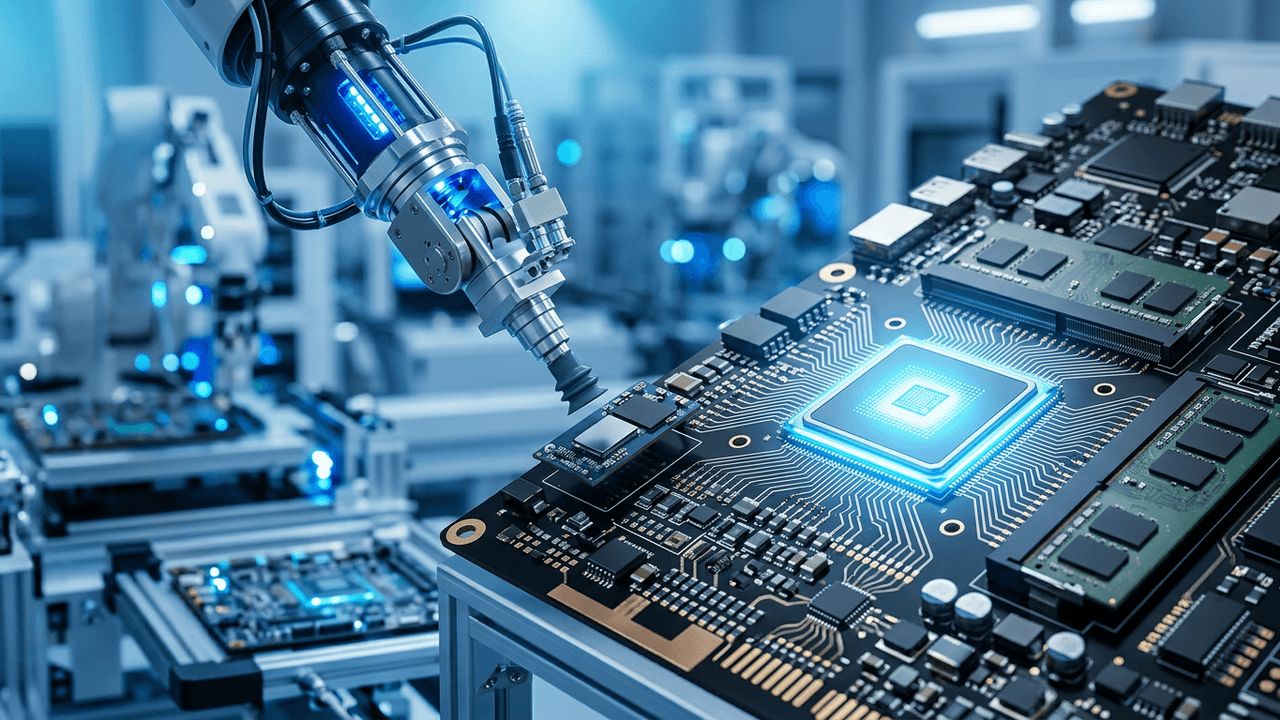
Cambridge as a Hardware Engineering Centre
Cambridge is often described in terms of software and life sciences, yet its hardware credentials are extraordinary. Processor architectures designed here run in a majority of the world's connected devices. Single-board computers conceived in the city transformed computing education globally. Industrial printing, radio communications, displays and precision aerospace engineering all have deep local roots. The common thread is a research-to-manufacturing pipeline in which physics and materials expertise translate into products, supported by contract manufacturers, prototyping workshops and test facilities across the surrounding region.
1. Arm
Arm is Cambridge's most globally influential technology company, designing processor architectures and intellectual property licensed to semiconductor manufacturers worldwide. Its designs prioritise performance per watt, which is why they dominate mobile, embedded and increasingly server and automotive markets. Rather than fabricating chips, Arm supplies the blueprints and software ecosystem around them. That model has made the city a permanent fixture in global silicon roadmaps and a magnet for chip design talent.
2. Raspberry Pi
Raspberry Pi, developed in Cambridge, created an entirely new category of affordable single-board computers used in education, industry and hobbyist projects. Beyond the boards themselves, the organisation designs microcontrollers, cameras and accessories, with much manufacturing carried out in the United Kingdom. Its influence on engineering education has been profound, giving a generation practical exposure to computing hardware. Industrial adoption for embedded control and prototyping has become a major part of the story.
3. Domino Printing Sciences
Domino Printing Sciences designs and manufactures industrial coding, marking and digital printing systems used on production lines worldwide. Its equipment applies batch codes, dates and traceability marks to packaging at high speed and in harsh environments. The engineering combines fluid dynamics, precision mechanics, control software and consumable chemistry. Long-standing Cambridgeshire manufacturing operations and global service networks make it one of the region's most substantial hardware employers.
4. Marshall of Cambridge
Marshall has engineered aerospace structures and specialist vehicles from Cambridge for over a century, with capabilities spanning aircraft conversion, maintenance, advanced composites and defence support solutions. Work of this kind demands exacting certification, traceability and long-life documentation. The organisation demonstrates that Cambridge manufacturing extends well beyond electronics into large-scale precision engineering, and it remains a significant local employer of skilled technicians and design engineers.
5. Sepura
Sepura designs and manufactures professional digital radio equipment used by emergency services, transport operators and industrial users internationally. Products must survive extreme conditions while delivering reliable, secure voice and data communication. Engineering challenges include radio frequency design, battery efficiency, ruggedisation and interoperability with national networks. The company reflects Cambridge strength in wireless technology, a lineage that also produced influential local expertise in short-range connectivity.
6. Xaar
Xaar develops industrial inkjet printheads used in printing on ceramics, packaging, textiles, labels and increasingly in additive manufacturing and functional material deposition. Producing microscopic, precisely controlled droplets millions of times per second is formidable engineering involving microfluidics, piezoelectric actuation and materials science. The technology enables digital manufacturing processes that replace traditional analogue printing, and it exemplifies how Cambridge physics research becomes exportable industrial hardware.
7. Cambridge Display Technology
Cambridge Display Technology pioneered light emitting polymer research that underpins modern organic display and lighting technologies. Its work on printable, flexible light emitting materials influenced an entire global industry now visible in televisions, phones and wearables. The organisation illustrates the long arc of Cambridge innovation, in which fundamental discovery in university laboratories is developed, patented and licensed into worldwide manufacturing supply chains over many years.
8. Cambridge Mechatronics
Cambridge Mechatronics develops shape memory alloy actuator technology used in compact optical systems such as smartphone camera modules for autofocus and image stabilisation. The approach delivers precise movement in extremely small packages with attractive power characteristics. Working with global manufacturers, the company shows how a specialised Cambridge engineering team can supply critical enabling components inside consumer products shipped in enormous volumes.
9. Nu Quantum
Nu Quantum builds quantum photonic hardware, including single photon components and networking equipment intended to connect quantum processors. This is early-stage manufacturing at the boundary of research, requiring optics, cryogenics, electronics and control software to work together. The company represents the next generation of Cambridge hardware, where the product is infrastructure for a computing paradigm still being established, and where precision fabrication capability is a strategic asset.
10. The Technology Partnership and Contract Engineering Firms
Around Cambridge sits a network of product development and contract engineering organisations, including well-known technology partnerships, that design and industrialise hardware for clients. Services span concept engineering, prototyping, design for manufacture, pilot production and supply chain setup. For companies with an idea but no factory, these partners are essential. Their presence explains how so many hardware ventures reach market from a city without large-scale volume manufacturing plants.
Manufacturing Trends in the Region
Several forces are reshaping local hardware. Demand for energy-efficient computing is driving specialised silicon and heterogeneous designs. Supply chain resilience has become a board-level concern, encouraging dual sourcing and regional assembly. Sustainability requirements are influencing material selection, repairability and end-of-life planning. Meanwhile the boundary between hardware and software continues to blur, with products increasingly defined by firmware updates and embedded intelligence rather than fixed capability at shipment.
Working With a Hardware Partner
Engage manufacturing expertise earlier than feels comfortable, because design decisions made in weeks can determine costs for years. Discuss tolerances, test strategy, certification requirements and component availability during concept work. Clarify tooling ownership, intellectual property and minimum order quantities before committing. Expect several prototype iterations, and budget for compliance testing, which frequently surprises first-time hardware teams with both cost and lead time.
Final Thoughts
Cambridge hardware capability ranges from world-defining processor architecture to industrial printing, radio, displays, actuators and quantum photonics. What unites these organisations is a willingness to solve genuinely difficult physical engineering problems and then industrialise the result. For anyone building a physical product, the concentration of design, prototyping and specialist manufacturing expertise here is a significant strategic advantage.
Want your brand featured in front of decision-makers? Publish a guest post or get a link insertion in our guides through AAMAX's guest post and link insertion service.
Helpful Links
 SponsoredAAMAX — Full-Service Digital Agency
Write for Us
Share your expertise with our readers. We welcome guest contributions from industry specialists.
Pitch your idea