

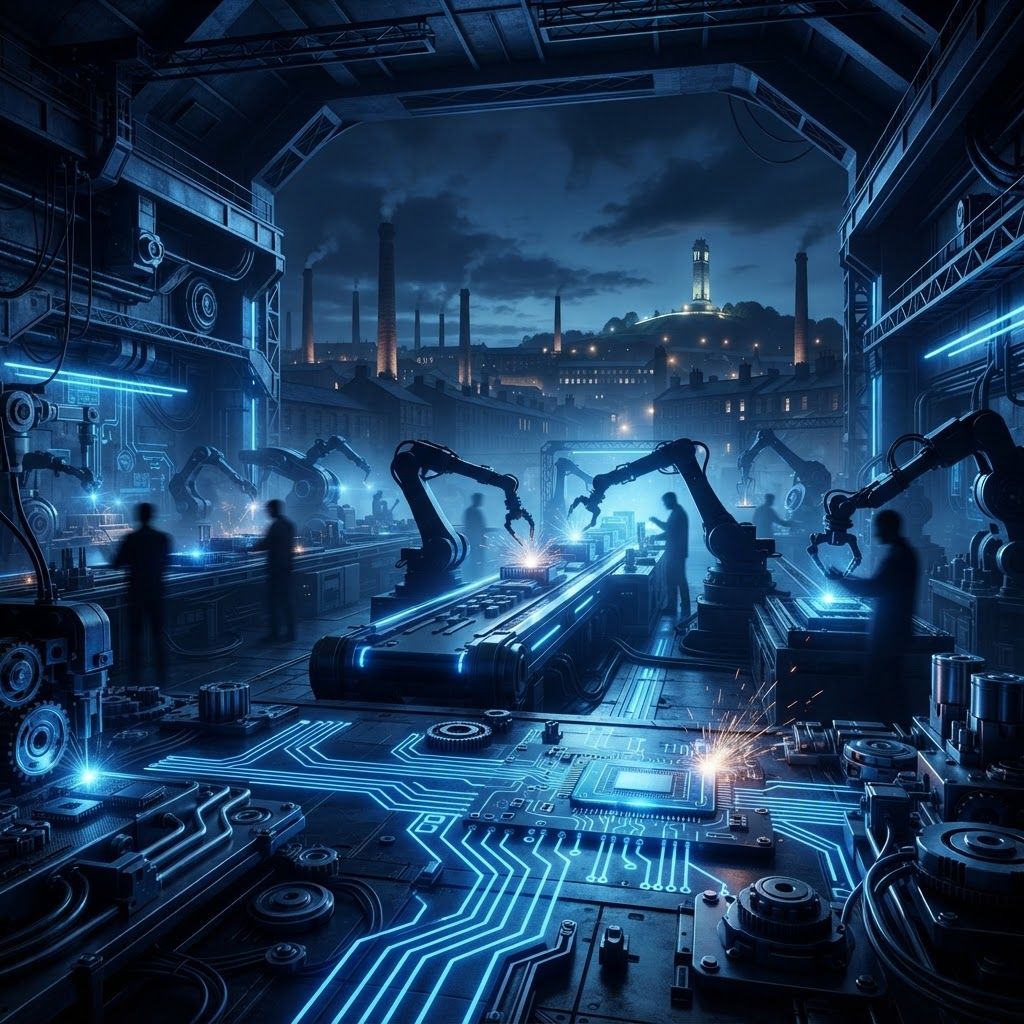
Manufacturing Heritage and Modern Capability
Bury's industrial history runs deep. The town grew on textiles, engineering and papermaking, and while the industries have changed, the practical engineering culture has not disappeared. Today the borough hosts precision machining, electronics assembly, control systems and specialist fabrication businesses that supply customers across the United Kingdom and internationally.
Modern hardware manufacturing here looks quite different from its predecessors. Production is smaller in volume but higher in value, with an emphasis on quality certification, traceability and engineering support alongside the physical product. Many firms operate as development partners rather than simple suppliers, contributing design input from an early stage.
What Local Hardware Manufacturers Produce
The range is broad. Electronic assembly businesses populate and test circuit boards for industrial, medical and instrumentation customers. Machining companies produce precision components for automation, transport and energy applications. Control and panel builders integrate electrical systems for machinery and building services. Enclosure and sheet metal specialists supply protective housings for equipment used in demanding environments.
Alongside production, several firms offer design for manufacture consultancy, helping customers adjust product designs so they can be produced reliably and economically. This is often where the greatest cost savings are found, well before the first unit is built.
Top 10 Best Hardware Manufacturers in Bury
1. Millgate Precision Engineering is among the most respected manufacturers in the area, specialising in close-tolerance machined components with comprehensive inspection and certification.
2. Irwell Electronics Assembly provides surface mount and through-hole assembly, functional testing and low-to-medium volume production for industrial customers.
3. Northgate Control Systems designs and builds control panels and automation assemblies, combining electrical manufacturing with commissioning support.
4. Elton Metalcraft focuses on sheet metal fabrication and enclosures, offering laser cutting, forming, welding and powder coating under one roof.
5. Radcliffe Instrumentation manufactures sensors and measurement devices for process industries, with strong calibration and traceability capability.
6. Tottington Toolmaking produces tooling, jigs and fixtures, supporting other manufacturers as well as producing its own component ranges.
7. Prestwich Cable Solutions manufactures wiring harnesses and cable assemblies to customer specification, serving transport and machinery clients.
8. Whitefield Plastics Engineering specialises in injection moulding and machined polymer components, including technical materials for demanding applications.
9. Ramsbottom Prototype Works offers rapid prototyping and low-volume production, bridging the gap between design and full manufacture.
10. Peel Industrial Products completes the list, producing mechanical assemblies and providing contract assembly services with full material traceability.
Choosing a Manufacturing Partner
Quality systems are the first consideration. Recognised quality management certification, documented inspection procedures and calibrated measurement equipment indicate a business capable of consistent output. For regulated sectors, sector-specific approvals may be essential.
Capacity and flexibility matter almost as much. Ask about typical lead times, how urgent orders are handled and what happens when demand fluctuates. A supplier operating permanently at full capacity carries risk, however capable it may be technically.
Engineering support is the differentiator that customers most often undervalue. A manufacturer willing to review a design and suggest changes that reduce cost or improve reliability delivers value that no unit price comparison captures.
Technology and Process Trends
Several developments are visible across local manufacturers. Automation and robotic handling have become viable at lower volumes, improving consistency while reducing repetitive manual work. Digital measurement and inspection systems provide traceable quality records rather than paper certificates.
Additive manufacturing has settled into a practical role, used for prototypes, tooling, fixtures and occasionally low-volume end-use parts where geometry justifies it. Meanwhile, production planning software and shop-floor data capture give managers visibility of throughput and bottlenecks that was previously guesswork.
Energy efficiency has become a significant commercial concern. Manufacturers have invested in efficient compressed air systems, lighting, heat recovery and machine monitoring, driven by both cost and customer requirements around emissions reporting.
Supply Chain Resilience
Recent years have taught manufacturers hard lessons about dependency. Component shortages, freight disruption and currency movement all hit hardware businesses directly. The response has been more dual sourcing, greater willingness to hold strategic stock of critical items, and closer collaboration with customers on forecasting.
For buyers, this means UK-based manufacturing has regained appeal. Shorter supply lines, easier communication, straightforward site visits and simpler quality resolution carry real value even where unit costs are higher than distant alternatives.
The Outlook for Bury Manufacturing
The borough's manufacturers are unlikely to compete on volume, and most have stopped trying. Their strength lies in engineering judgement, responsiveness, quality assurance and the ability to support customers through development as well as production.
For organisations developing physical products, the local sector offers something increasingly valuable: capable manufacturing partners close enough to visit, small enough to care about a modest order, and experienced enough to prevent expensive design mistakes.
Supply Chain Resilience in Northern Manufacturing
Recent years have taught manufacturers in Bury and the surrounding Greater Manchester belt a hard lesson about dependency. Component shortages, extended lead times and volatile freight costs disrupted production schedules across the sector, and the response has been a steady move toward resilience. That means dual sourcing critical parts, holding strategic buffer stock of long-lead components, qualifying alternative suppliers in advance and, increasingly, bringing selected processes back within the region.
Reshoring has been helped by automation. When labour costs are offset by robotics and improved process control, producing closer to the customer becomes commercially viable as well as strategically safer. Shorter supply chains also cut transport emissions and shorten the feedback loop between design and production, which speeds up iteration on new products.
Skills, Apprenticeships and the Next Generation
The persistent constraint is people. Precision engineering, electronics assembly, quality inspection and maintenance all require skills that take years to build, and the sector faces an ageing workforce. Manufacturers in the borough have responded with apprenticeship programmes, partnerships with local colleges and structured progression routes that allow production staff to move into programming, quality or design roles. Investment in training has become as important to competitiveness as investment in machinery.
Want your brand featured in front of decision-makers? Publish a guest post or get a link insertion in our guides through AAMAX's guest post and link insertion service.
Helpful Links
 SponsoredAAMAX — Full-Service Digital Agency
Write for Us
Share your expertise with our readers. We welcome guest contributions from industry specialists.
Pitch your idea

