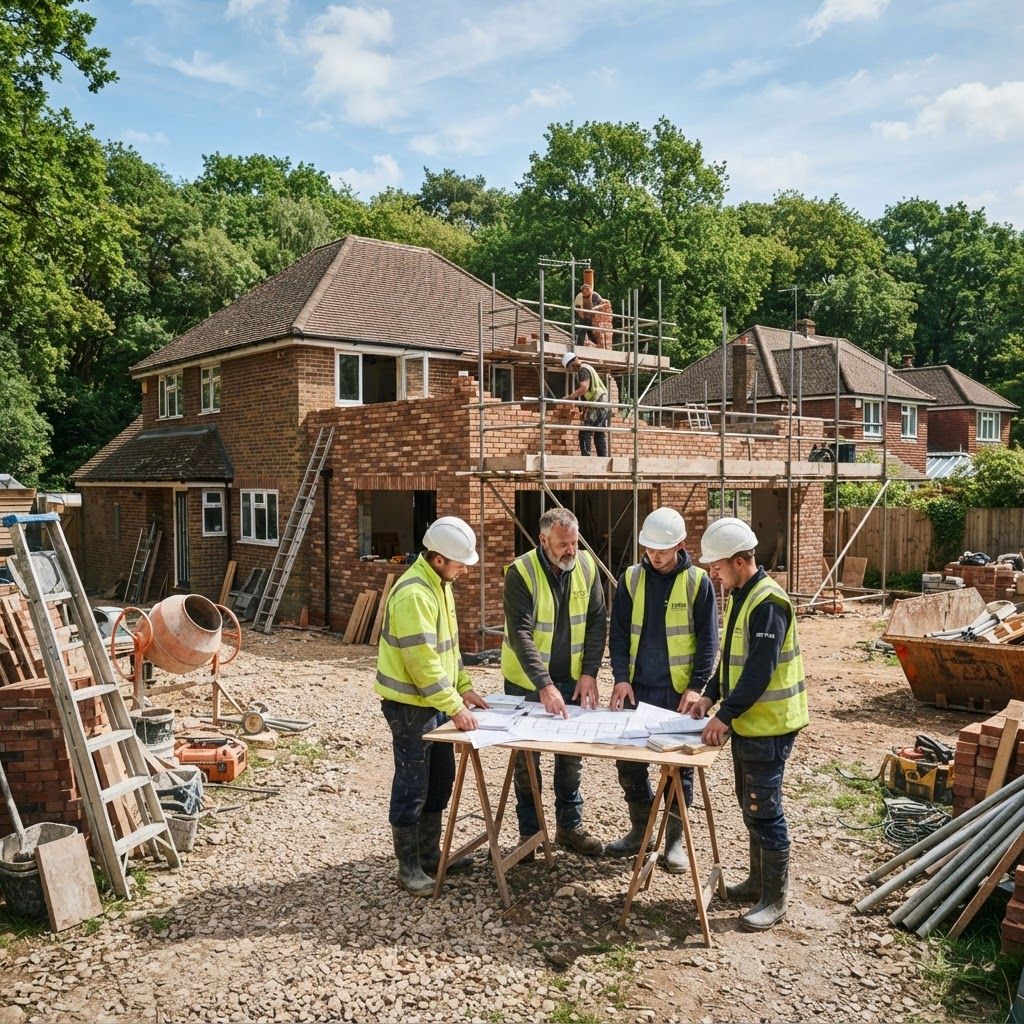
The Role of the General Contractor
A general contractor takes responsibility for delivering a construction project as a whole. Rather than a homeowner or business coordinating a bricklayer, an electrician, a plumber, a roofer and a plasterer independently, the contractor manages programme, procurement, subcontractors, site safety, building control liaison and quality across every trade. On any project beyond the simplest, that single point of accountability is the difference between a controlled build and a sequence of disputes.
In Epping Forest, that coordination role is unusually demanding. The district contains substantial Green Belt land, multiple conservation areas, listed and period properties, and a housing stock that ranges from Victorian terraces in Loughton to substantial detached homes in Chigwell and traditional cottages across the rural parishes. Each brings planning, structural and heritage complications that a contractor must anticipate before work starts.
The Local Building Context
Planning is the defining local constraint. Green Belt policy significantly restricts new build and extension scale across much of the district, pushing many projects towards basements, loft conversions, garage conversions and carefully proportioned rear extensions rather than outward expansion. Conservation area status adds material and design controls in several settlements. Tree preservation orders are common given the district's landscape character, and ancient woodland proximity brings further restrictions on excavation and root protection.
Contractors who work here regularly understand these constraints and design around them from the outset. Those who do not tend to discover the problem at validation stage, after the client has already paid for drawings that cannot be built.
What Excellent Contractors Do Differently
The first mark of quality is pre-construction rigour. Strong contractors invest time before a spade touches the ground: site survey, drainage investigation, soil assessment where foundations are unusual, party wall identification, utility location and a realistic programme. Projects that fail almost always failed at this stage rather than during the build.
The second is contractual clarity. A proper contract specifies scope, specification, staged payments tied to completed milestones rather than dates, a retention arrangement, variation procedures and a defects liability period. Verbal agreements and rolling invoices are the single most common source of dispute in domestic construction.
The third is site management. Good contractors control access, protect existing finishes, manage dust and noise, sequence trades so they do not obstruct one another, and keep the site tidy. In a district with narrow lanes and tight residential streets, they also manage deliveries, skips and parking considerately, which prevents neighbour complaints escalating into planning enforcement issues.
Common Project Types
Across Epping Forest, contractors most frequently deliver single and double storey rear extensions, side return infills, loft conversions with dormers or rooflights, garage conversions, outbuilding and garden room construction, full house refurbishments, basement excavation in higher-value areas, and barn or outbuilding conversions in rural parishes. Commercial work includes shopfitting, office refurbishment, light industrial units around the district's trading estates and retail conversions.
Heritage work forms a distinct specialism. Listed building consent, lime mortar and lime plaster work, sash window restoration, traditional roofing and breathable insulation strategies all require knowledge that general builders frequently lack. Using modern cement-based materials on a solid-wall period property causes damp and long-term damage, and contractors who understand this are worth seeking out for older homes.
Regulation, Warranties and Compliance
Building Regulations approval is mandatory for structural work, and the contractor should be clear about whether local authority building control or an approved inspector is being used, and who is booking inspections. Structural calculations from a chartered engineer are required for beams, openings and foundations. Party Wall agreements must be served in advance where work affects a shared or adjacent structure, which is common in the district's terraced and semi-detached stock.
Credible contractors carry public liability insurance, employer's liability where they have staff, and contract works insurance covering the build itself. Membership of recognised trade bodies and structural warranty provision on larger projects give additional protection. Clients should verify insurance documents directly rather than accepting a claim of cover.
Cost, Programme and Realism
Domestic construction costs in the Epping Forest area reflect its proximity to London, with labour and access costs above the national average. Clients should be sceptical of a quote that is significantly below the rest of the field, as it usually indicates an incomplete scope, low-grade specification or an intention to recover margin through variations.
A proper quotation is itemised, states what is included and explicitly lists exclusions such as kitchens, bathrooms, decoration, landscaping or planning fees. A provisional sum should be labelled as such. Programme realism matters too: a contractor who promises a major extension in an implausibly short period is either inexperienced or managing expectations poorly.
Sustainability and Modern Methods
Energy performance has moved to the centre of construction decisions. Contractors working to current standards handle improved insulation continuity, airtightness detailing, thermal bridging, mechanical ventilation with heat recovery, air source heat pump installation and solar photovoltaic integration. Retrofit of the district's older housing stock is a growing market, and it requires careful moisture management rather than simply adding insulation.
Offsite manufacture is also increasing, with structural insulated panels, timber frame kits and prefabricated roof cassettes shortening onsite programmes and improving accuracy.
How to Appoint Well
Obtain at least three comparable tenders based on the same drawings and specification, so the comparison is meaningful. Visit completed projects and speak to previous clients about communication and problem handling, not just finish quality. Check trading history and financial stability, since contractor insolvency mid-project is genuinely damaging. Agree a written contract before any payment, never pay large sums in advance of work, and hold a retention until the defects period closes.
Final Thoughts
The best general contractors in Epping Forest combine technical competence with genuine local planning knowledge and disciplined project management. In a district where conservation status, Green Belt policy and period construction complicate almost every project, appointing a contractor who understands that context before work begins is the most important decision a client makes.
Want your brand featured in front of decision-makers? Publish a guest post or get a link insertion in our guides through AAMAX's guest post and link insertion service.
Helpful Links
 SponsoredAAMAX — Full-Service Digital Agency
Write for Us
Share your expertise with our readers. We welcome guest contributions from industry specialists.
Pitch your idea