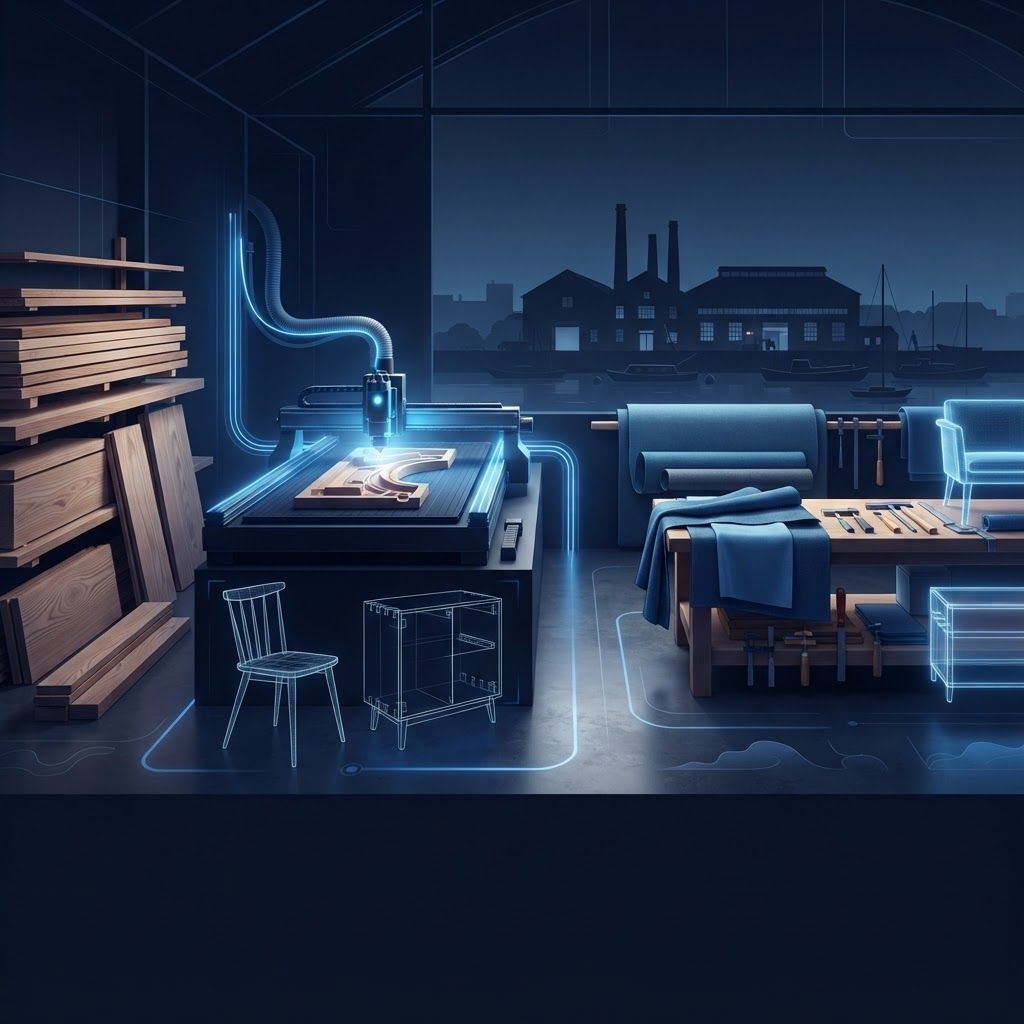
Furniture Making in South Tyneside Today
Furniture manufacturing in Britain went through decades of contraction as production shifted overseas, but the industry that remains is meaningfully different from the one that was lost. What survived, and what has grown back, focuses on bespoke work, contract projects, fitted furniture and quality that justifies a domestic price. South Tyneside has developed a healthy cluster of exactly these kinds of businesses across South Shields, Jarrow, Hebburn and the Boldon area.
The borough's advantages are straightforward. Workshop and factory space on established industrial estates remains affordable compared with southern England, the region retains a strong woodworking and joinery skills tradition, and demand from Newcastle, Sunderland, Durham and the wider North East supports a substantial local customer base. Commercial fit-out work for offices, hospitality venues, education buildings and healthcare facilities has been particularly important, since these projects require made-to-measure furniture that cannot be imported from a catalogue.
Technology has changed the economics considerably. Computer numerical control routers, beam saws, edgebanders and nesting software allow small workshops to produce complex, accurately cut components at a rate that would once have required a large factory. This has enabled genuinely small businesses to compete for substantial contracts, and it has narrowed the cost gap between bespoke and mass-produced furniture.
Materials, Sustainability and Design Trends
Timber sourcing has become a central concern. Customers and specifiers increasingly require certification demonstrating that wood comes from responsibly managed forests, and manufacturers have adapted their supply chains accordingly. Engineered panel products, including birch plywood, medium density fibreboard and chipboard with decorative laminates, dominate volume work because of dimensional stability and material efficiency, while solid hardwood is reserved for pieces where the grain is part of the appeal.
Durability and repairability have gained prominence as buyers grow weary of furniture that fails within a few years. Manufacturers emphasising solid construction, replaceable components and refinishable surfaces are finding receptive audiences, particularly among commercial clients calculating cost over a fifteen-year building lifecycle rather than an initial purchase price.
Design-wise, the North East market has followed broader British trends towards warm minimalism, natural finishes, curved forms and multifunctional pieces suited to smaller homes and hybrid working. Fluted and slatted timber detailing, integrated cable management for home offices, and generous built-in storage all feature heavily in current briefs.
The Top 10 Furniture Manufacturers in South Tyneside
1. Tyne Bespoke Furniture
Tyne Bespoke Furniture has built a strong reputation for one-off and small-batch commissions, working with clients from initial concept sketches through to installation. The workshop handles solid hardwood and veneered panel work with equal confidence, and its cabinetmakers use traditional jointing techniques where strength and longevity matter. Detail is the company's calling card, evident in matched veneer layouts, hand-finished edges and drawer runners that still glide smoothly years after delivery. Clients commissioning dining tables, libraries or feature staircases frequently cite the collaborative design process as the reason they chose the firm.
2. Jarrow Contract Furniture
Jarrow Contract Furniture serves the commercial market, producing furniture for offices, schools, universities and healthcare settings. Contract work imposes requirements that domestic furniture rarely faces, including fire performance standards for upholstery, impact resistance for high-traffic environments and cleanability for clinical spaces. The company's understanding of these specifications, alongside its ability to deliver large quantities to a construction programme, makes it a reliable partner for main contractors and fit-out specialists across the region.
3. Shields Fitted Interiors
Specialising in fitted furniture, Shields Fitted Interiors manufactures kitchens, bedroom systems, home offices and media walls tailored to specific rooms. Fitted work rewards precision, since walls are rarely square and ceilings rarely level, and the firm's surveying discipline ensures components arrive on site fitting properly. It manufactures its own carcasses and doors rather than assembling bought-in components, giving control over material quality, finish options and sizing flexibility that catalogue suppliers cannot match.
4. Hebburn Upholstery Works
Hebburn Upholstery Works focuses on seating, producing sofas, armchairs, benches and banquette seating for both domestic and hospitality clients. Frame construction is a genuine differentiator here, with hardwood frames, sprung seat platforms and quality foam specification producing seating that holds its shape. The business also undertakes reupholstery of existing furniture, restoring well-made pieces at lower cost and lower environmental impact than replacement. Fabric knowledge is extensive, spanning contract-rated textiles, performance fabrics and natural weaves.
5. Boldon Timber and Joinery
Boldon Timber and Joinery bridges architectural joinery and furniture manufacture, producing built-in units, reception desks, panelling, doors and staircases alongside freestanding pieces. Its machine shop runs spindle moulders, tenoners and CNC routing, allowing production of profiled and shaped components that flat-panel specialists cannot handle. Heritage work forms part of the portfolio, matching mouldings and details for period properties where replacement must be visually indistinguishable from the original.
6. Riverside Office Furniture
Riverside Office Furniture manufactures desking, storage, meeting tables and acoustic furniture for workplace environments. Hybrid working reshaped this market considerably, increasing demand for collaborative settings, height-adjustable desks and acoustic pods rather than rows of fixed workstations. The company has adapted its range accordingly and offers space planning support, helping clients understand how furniture choices affect the way a floorplate actually functions.
7. Northern Retail Display
Northern Retail Display produces shopfitting furniture including counters, display units, shelving systems and point-of-sale fixtures. Retail work runs to tight programmes, since every day a shop stays closed costs the retailer revenue, and the company's project management around phased installation reflects that pressure. Its ability to produce visually consistent units across multiple store locations supports retailers rolling out a brand identity, and its finishing capability handles high-gloss, laminate, veneer and painted surfaces.
8. Tyneside Outdoor and Garden Furniture
Tyneside Outdoor and Garden Furniture manufactures benches, tables, planters and garden structures designed for the North East climate. Weather resistance drives every decision, from timber species selection and preservative treatment to stainless steel fixings and joint design that sheds water. The company supplies both domestic customers and public sector clients specifying street furniture and park seating, where vandal resistance and long maintenance intervals become primary requirements.
9. Simonside Panel Products
Simonside Panel Products operates as a components manufacturer, cutting, edging and drilling panel parts for other furniture makers, shopfitters and joiners. Nesting software and CNC machining allow it to produce accurate flat-pack components efficiently, and many smaller workshops outsource cutting here rather than investing in their own machinery. This role as a supplier to other manufacturers gives the borough's furniture sector additional capacity and flexibility, letting small firms take on larger contracts confidently.
10. Coastal Furniture Restoration and Making
Coastal Furniture Restoration and Making combines new production with restoration and reproduction of antique and period furniture. The restoration side requires knowledge of historical construction methods, traditional finishes such as shellac and wax, and veneer repair techniques that have largely disappeared from volume manufacturing. That expertise informs its new work, which tends towards classically proportioned pieces built to last generations. Clients with inherited furniture in poor condition frequently find this the only local business capable of a sympathetic repair.
How to Choose a Furniture Manufacturer
Start by matching the manufacturer to your project type. A bespoke cabinetmaker producing individual pieces and a contract furniture factory delivering three hundred desks operate on entirely different systems. Asking to see recent projects similar in scale and type to yours quickly reveals whether a supplier fits.
Inspect construction quality rather than surface appearance. Open drawers and look at the joinery, check whether shelves are supported adequately, examine how a carcass is fixed together and ask what the visible surface actually is. A well-photographed piece can conceal weak construction, and the difference only becomes apparent after several years of use.
Clarify the specification in writing. Furniture disputes usually stem from ambiguity about materials, finishes, dimensions, hardware and who is responsible for site measurement and installation. A detailed quotation with drawings protects both parties and signals a manufacturer who runs a professional operation.
For commercial projects, confirm compliance credentials. Fire performance certification for upholstered items, load testing for storage furniture and relevant British Standards conformity are non-negotiable in most contract settings, and evidence should be available on request.
Prospects for the Borough's Furniture Industry
Interest in British-made furniture has grown alongside concerns about quality, delivery lead times and environmental impact of imported goods. South Tyneside manufacturers are positioned to benefit, offering the combination of local accountability, bespoke capability and competitive regional cost base that this demand favours. Continued investment in machinery and in training the next generation of makers will determine how far that opportunity is realised.
For anyone furnishing a home, office or venue in the North East, the borough's furniture manufacturers deserve serious consideration. Visiting a workshop, handling samples and talking to the people who will build your furniture remains the surest route to a satisfying result.
Want your brand featured in front of decision-makers? Publish a guest post or get a link insertion in our guides through AAMAX's guest post and link insertion service.
Helpful Links
 SponsoredAAMAX — Full-Service Digital Agency
Write for Us
Share your expertise with our readers. We welcome guest contributions from industry specialists.
Pitch your idea