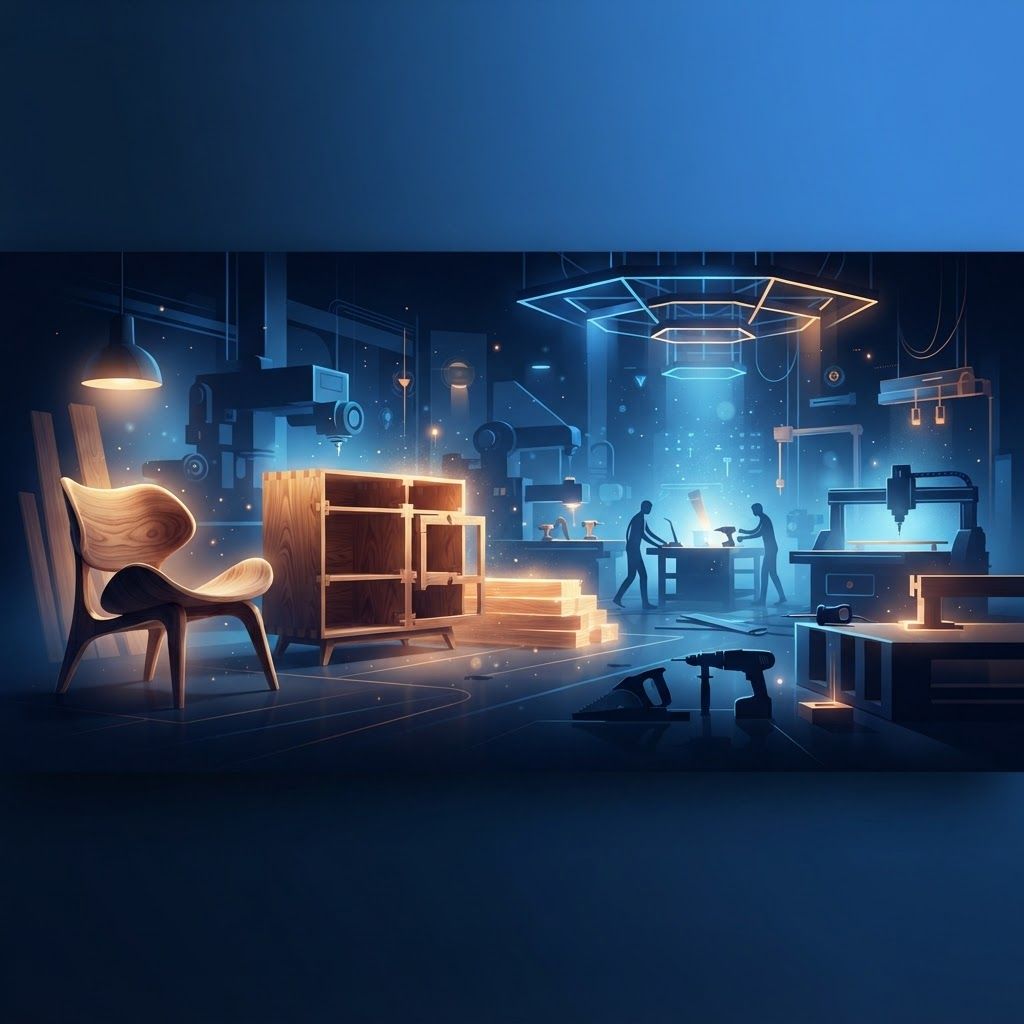
Furniture Making in the Heart of Nottinghamshire
Furniture manufacturing in Newark and Sherwood draws on a long tradition of woodworking in the Trent Valley and the wider Sherwood area. Timber, historically abundant in this part of Nottinghamshire, shaped local craft skills that have survived the shift to industrial production. What exists today is a layered sector: small bespoke workshops producing individually commissioned pieces, mid-sized manufacturers supplying kitchens and fitted furniture, and contract producers making durable seating and tables for hospitality, education and healthcare clients.
This diversity matters to buyers. Whether the requirement is a single handmade sideboard, forty matching restaurant tables, or a full office fit-out, there is almost certainly a local manufacturer configured for that type of work. Buying locally also shortens lead times dramatically and makes site surveys, template fitting and installation far simpler than dealing with a distant factory.
Ten Furniture Manufacturers Worth Knowing
1. Sherwood Oak Furniture Makers. A traditional workshop specialising in solid hardwood dining tables, dressers and bedroom furniture. Pieces are made to order using mortice and tenon joinery, with clients able to select timber boards and specify finishes. The firm's reputation is built on longevity, with furniture designed to be repaired and refinished rather than replaced.
2. Newark Contract Furniture. Producer of commercial-grade seating, banquettes and tables for pubs, restaurants and hotels. Frames are engineered for heavy use, upholstery meets commercial fire performance requirements, and finishes are chosen for cleanability. Volume capability combined with bespoke sizing is its core strength.
3. Trent Valley Kitchens and Joinery. Manufacturer of fitted kitchens, utility rooms and bespoke storage. In-house spray finishing allows precise colour matching, and the company handles design, manufacture and installation, which removes the coordination problems that often arise between separate suppliers.
4. Southwell Upholstery Works. A specialist in sofas, armchairs and reupholstery, working in both contemporary and classic styles. Traditional sprung construction sits alongside modern foam and fibre systems, and the workshop is frequently trusted with the restoration of antique frames.
5. Ollerton Timber Furniture Company. Focused on sustainably sourced softwood and hardwood furniture for garden, leisure and outdoor hospitality use. Products are pressure treated or naturally durable, and the company has grown alongside the trend for outdoor dining at pubs and cafes.
6. Farndon Bespoke Interiors. A high-end maker of library walls, media units, panelling and staircases, working closely with architects and interior designers. Detail resolution and finish quality define its output, with surveys and templating carried out on site before manufacture.
7. Balderton Office Furniture Manufacturing. Producer of desks, benching systems, storage and meeting tables for commercial offices. The business has adapted well to hybrid working demand, offering height-adjustable desking, acoustic panelling and reconfigurable layouts.
8. Edwinstowe Woodcraft Studio. A small artisan studio producing individually designed pieces in native timbers, often incorporating live-edge boards and hand-cut joinery. Clients come for pieces with genuine character rather than catalogue uniformity.
9. Clipstone Furniture Components. A trade manufacturer of doors, drawer boxes, carcasses and edged panels supplied to other furniture makers and fit-out contractors. Precise machining and rapid turnaround make it a valuable link in the local supply chain.
10. Collingham Educational Furniture. Manufacturer of classroom tables, laboratory benching, library shelving and storage designed to withstand heavy institutional use. Robust construction, rounded safety detailing and compliance with relevant furniture standards are central to its work.
Materials, Sustainability and Provenance
Timber sourcing has become a serious purchasing consideration. Buyers increasingly ask whether hardwoods come from responsibly managed forests, whether board materials use low-formaldehyde adhesives, and whether finishes are water-based rather than solvent-heavy. The better manufacturers in the district can answer these questions with certificates rather than assurances.
Repairability is re-emerging as a quality marker. Furniture built with mechanical joints, replaceable components and refinishable surfaces lasts decades, while glued and stapled construction rarely survives a single house move. Several local makers now deliberately market repair services alongside new production, an approach that appeals to customers thinking about lifetime cost and waste.
There is also a visible shift toward using British-grown timber. Ash, oak, sycamore and elm from regional woodlands reduce transport impact and produce furniture with recognisable local provenance, a story that resonates strongly with buyers who want their purchases to mean something.
Understanding Commercial and Domestic Requirements
Domestic and contract furniture are engineered very differently. A domestic dining chair might be tested for occasional household use, while a pub chair must survive thousands of sittings, cleaning chemicals and occasional abuse. Contract furniture also carries stricter fire performance obligations for upholstery and foam. Specifying domestic furniture for commercial premises is a common and expensive mistake, and reputable manufacturers will steer clients away from it.
Lead times deserve equal attention. Bespoke hardwood furniture may take several weeks because timber must be selected, machined, assembled and finished with drying time between coats. Rushing a finishing schedule is the most frequent cause of disappointing results, so buyers should build realistic timescales into project plans, particularly for hospitality openings and office relocations.
How to Choose a Furniture Manufacturer
Visit the workshop and look at work in progress rather than only finished showroom pieces. Examine joint construction, the underside of tables, the inside of drawers and the back of casework, because these hidden areas reveal true build standards. Ask for references from projects similar to yours in scale and use.
Discuss design early. The most successful commissions in Newark and Sherwood happen when the maker is involved before dimensions and materials are fixed, allowing them to suggest construction methods that improve durability or reduce cost without compromising appearance.
Clarify aftercare. Guarantees, touch-up services, replacement components and reupholstery options all extend the useful life of the furniture. Manufacturers confident in their construction are usually generous with these commitments.
A Sector With Real Depth
Furniture manufacturing in Newark and Sherwood succeeds because it combines craft skill with practical commercial understanding. Makers here are accustomed to solving awkward problems, whether that is a kitchen in a listed building, seating for a busy market-town pub, or a boardroom table that must be assembled inside a room it cannot pass through in one piece. For anyone specifying furniture in the East Midlands, that adaptability is worth far more than a catalogue page.
Want your brand featured in front of decision-makers? Publish a guest post or get a link insertion in our guides through AAMAX's guest post and link insertion service.
Helpful Links
 SponsoredAAMAX — Full-Service Digital Agency
Write for Us
Share your expertise with our readers. We welcome guest contributions from industry specialists.
Pitch your idea