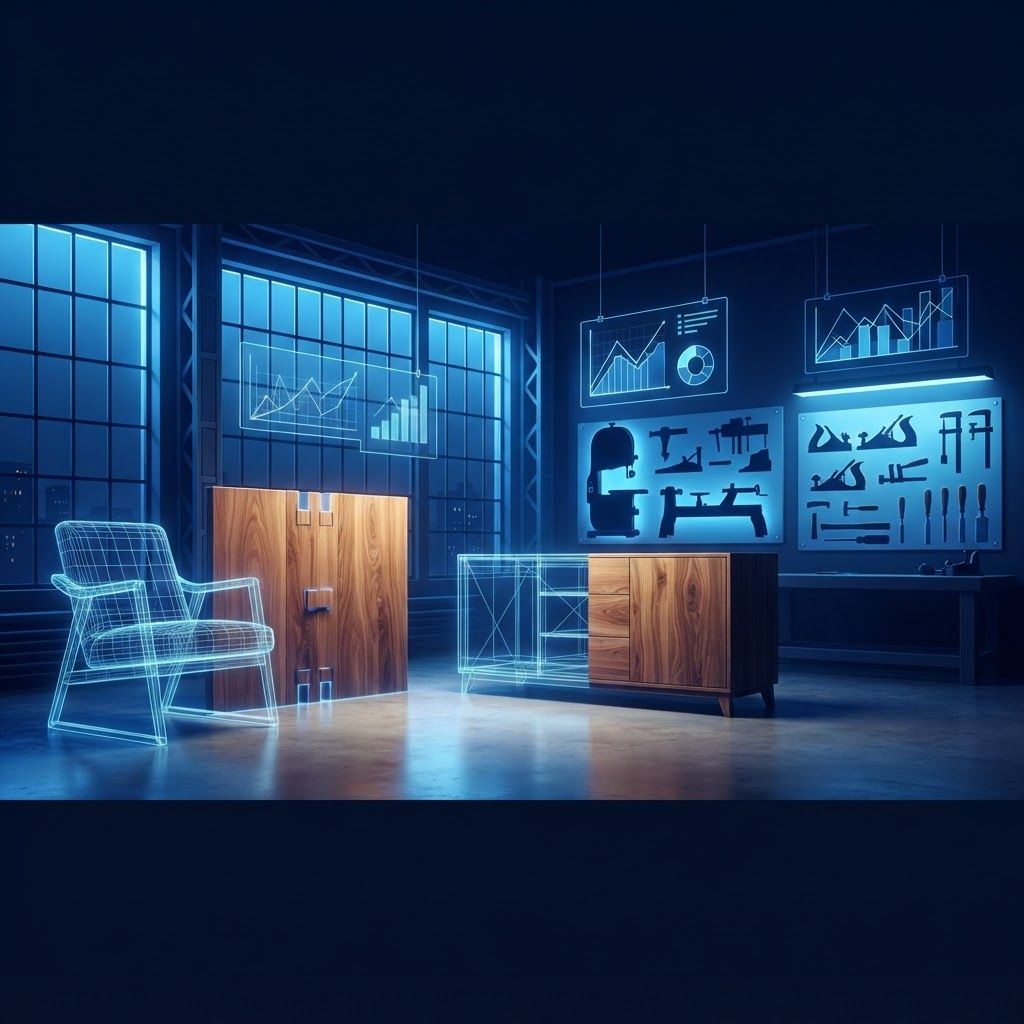
Furniture Making in Ipswich: Craft Meets Contract
Ipswich and the surrounding Suffolk countryside have supported woodworking trades for centuries. Timber arriving through the port, abundant local hardwood and a long tradition of building for farms, churches and merchant houses created a skills base that never entirely disappeared. Today the town's furniture manufacturing sector spans two quite different worlds. At one end sit small workshops producing handmade, individually commissioned pieces. At the other sit contract manufacturers turning out hundreds of identical desks, seating units or fitted kitchens to tight schedules and precise specifications.
What connects them is a shared understanding of material. Wood is not a uniform engineering substance; it moves with humidity, varies in grain and behaves differently depending on how it was dried and cut. Manufacturers who genuinely understand that produce furniture that stays flat, closes properly and lasts for decades. Those who do not produce furniture that warps, splits and disappoints. In a town with this depth of tradition, the difference is easy to find and worth paying for.
Ten Furniture Manufacturers Worth Knowing in Ipswich
1. Orwell Cabinetmakers represents the bespoke end of the market at its strongest. The workshop produces individually designed freestanding and fitted furniture in solid hardwood, using traditional jointing techniques supported by modern machining where it makes sense. Clients typically come for library fittings, dining furniture, staircases and kitchen cabinetry where standard products simply cannot accommodate the space or the brief.
2. Suffolk Contract Furniture operates at the opposite scale, supplying offices, schools, universities and healthcare facilities. Contract furniture must satisfy demanding requirements around fire performance, impact durability, accessibility and warranty, and the company's product testing and certification programme addresses each of those. Its ability to deliver a phased installation across a large building without disrupting occupants is a significant practical advantage.
3. Gipping Valley Joinery specialises in architectural joinery: doors, window frames, panelling, reception desks and staircases. This sits at the intersection of furniture and construction, requiring both cabinetmaking precision and an understanding of building tolerances. The company works closely with architects and main contractors, and its ability to produce detailed shop drawings before manufacture prevents the site-fit problems that plague less organised suppliers.
4. Deben Upholstery Works manufactures upholstered seating for domestic, hospitality and commercial customers. Frames are built in-house from kiln-dried hardwood, then sprung, padded and covered by hand. The company maintains an extensive fabric and leather library and handles full reupholstery of existing furniture, which appeals both to heritage properties and to organisations seeking to extend the life of good-quality frames.
5. Anglia Kitchen Manufacturing produces fitted kitchen and bedroom furniture, from carcass construction through to painted and veneered door fronts. In-house spray finishing gives the company control over one of the most failure-prone stages of kitchen production, and its survey and design service means the finished units account for the genuine irregularities of older Suffolk properties rather than assuming perfect walls.
6. Stour Valley Reclaimed Furniture builds pieces from reclaimed timber salvaged from barns, industrial buildings and old flooring. Beyond the strong aesthetic appeal, this is a genuinely low-carbon approach to furniture making, and the company documents the provenance of its material. Working with reclaimed stock demands real skill, since every board carries its own history of nail holes, moisture and movement.
7. Ransomes Metal and Wood Furniture combines steel fabrication with timber work to produce industrial-style tables, shelving, benches and retail fixtures. This hybrid capability under one roof avoids the coordination problems that arise when a customer must manage separate metalworkers and joiners on the same piece.
8. Felixstowe Road Outdoor Furniture manufactures garden and public realm furniture using durable species and treated timber designed for coastal exposure. Benches, planters, picnic tables and pergolas are supplied to local authorities, schools and landscaping contractors. The company pays close attention to fixing details and drainage, which is where outdoor furniture typically fails first.
9. Ipswich Retail Display Manufacturing produces shopfitting, display units, counters and point-of-sale fixtures. Retail projects run on compressed timescales because every day a unit is not trading costs money, and the company's production planning is structured around meeting fixed opening dates. It also offers refurbishment of existing fixtures, which suits brands refreshing a store estate on a budget.
10. Waveney Children's Furniture makes furniture for nurseries, primary schools and children's bedrooms, where safety standards are considerably more stringent than for adult products. Rounded edges, tested stability, non-toxic finishes and appropriate sizing are all designed in rather than added as afterthoughts, and the company's products are supported by independent test certification.
Trends in Furniture Manufacturing
Sustainability has moved from a marketing message to a purchasing requirement, particularly in contract furniture. Buyers now ask about timber certification, the recycled content of board materials, the chemistry of adhesives and finishes, and end-of-life recyclability. Ipswich manufacturers using locally sourced hardwood and low-emission finishes are well positioned for this scrutiny.
Customisation has also become a mainstream expectation. Digital design tools and CNC machining have reduced the cost penalty of variation, so customers increasingly expect to specify dimensions, materials and finishes rather than accept a standard product. Meanwhile, changing workplace patterns have reshaped commercial demand: fewer fixed individual desks, more collaborative settings, acoustic booths and flexible reconfigurable furniture.
Finally, repair and refurbishment have gained commercial momentum. Reupholstering and refinishing good-quality furniture is cheaper and far less carbon-intensive than replacement, and several local manufacturers have built meaningful revenue streams around it.
How to Choose a Furniture Manufacturer
Inspect actual samples rather than relying on photographs, and look specifically at the parts customers do not usually examine: drawer construction, the back panel, the underside of a table, the edge banding. These reveal a manufacturer's true standards. Ask about timber sourcing and moisture content, since inadequately dried timber will move after installation regardless of how skilled the joinery is. For commercial work, verify that products meet the relevant fire and durability standards and request the certificates. Clarify lead times honestly, as bespoke furniture nearly always takes longer than customers expect. And discuss aftercare, because a manufacturer willing to return and adjust a door or tighten a fixing six months later is demonstrating confidence in its own work.
The Outlook for Ipswich Furniture Manufacturing
The sector faces genuine pressure from low-cost imports, but the Ipswich manufacturers thriving today are not competing on price. They compete on fit, on material quality, on customisation and on the ability to stand behind their work locally. As sustainability requirements harden and as buyers grow more sceptical of disposable furniture, those strengths look increasingly like the right ones to have.
Want your brand featured in front of decision-makers? Publish a guest post or get a link insertion in our guides through AAMAX's guest post and link insertion service.
Helpful Links
 SponsoredAAMAX — Full-Service Digital Agency
Write for Us
Share your expertise with our readers. We welcome guest contributions from industry specialists.
Pitch your idea