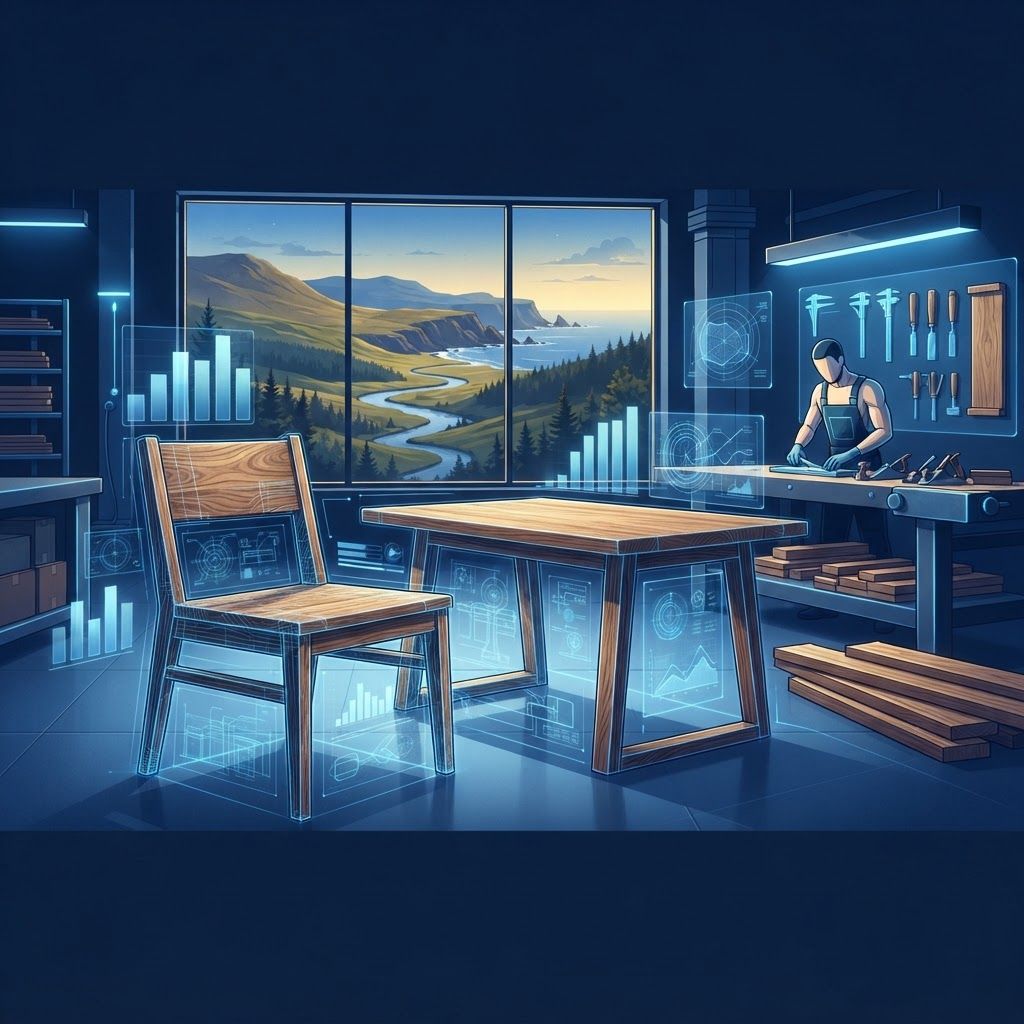
A Tradition of Timber Craft
Furniture making has long been part of the working life of the Causeway Coast and Glens. Rural communities have always included joiners and cabinetmakers producing dressers, tables, church pews, farm gates and fitted interiors from locally available timber. That tradition has not disappeared. It has evolved into a sector combining hand craftsmanship with computer-controlled machining, serving domestic customers, the hospitality industry and commercial clients across Northern Ireland and beyond.
The borough is well suited to the trade. There is plenty of workshop space in rural buildings and small industrial units, a skilled labour pool with joinery and carpentry backgrounds, and a customer base that appreciates quality. The substantial tourism and hospitality sector along the Causeway Coast generates steady demand for contract furniture, while the strong local housing market keeps bespoke kitchen and bedroom makers busy.
What Local Furniture Manufacturers Produce
Bespoke kitchens are the largest single category. A handmade kitchen in painted hardwood or oak is a major household investment, and buyers increasingly prefer a local maker who will survey the room, design around its quirks and install personally rather than delivering a flat-packed compromise.
Solid timber furniture, including dining tables, dressers, beds and occasional pieces, forms a second strand, often produced in small batches or as one-off commissions. Contract and hospitality furniture is a third, covering the tables, chairs, banquette seating, reception desks and bedroom furniture required by hotels, restaurants and guesthouses. Finally, commercial joinery covers shopfitting, office furniture, library and educational fit-outs.
Ten Furniture Manufacturers in the Borough
1. Bann Valley Cabinetmakers produces handmade kitchens and fitted furniture in painted hardwood and solid oak, known for precise fitting into older properties where nothing is square and standard units simply do not work.
2. Glens Timber Furniture specialises in solid wood dining tables, dressers and bedroom pieces, with designs that draw on traditional Irish country furniture while remaining comfortably contemporary.
3. Causeway Contract Interiors serves the hospitality sector with durable commercial furniture, banquette seating and bedroom fit-outs built to withstand the heavy use of a busy hotel on the north coast.
4. Coleraine Joinery Works combines architectural joinery with furniture manufacture, producing staircases, doors, panelling and built-in units for residential and commercial projects.
5. Roe Valley Kitchens offers design, manufacture and installation of bespoke kitchens and utility rooms across Limavady, Dungiven and the western borough, with in-house spray finishing.
6. North Coast Upholstery focuses on sofas, armchairs and reupholstery, offering both new manufacture and the restoration of older frames that are worth saving.
7. Ballymoney Furniture Company produces a mix of domestic and contract furniture, with a reputation for practical, robust construction and sensible pricing.
8. Dalriada Bespoke Woodcraft undertakes one-off commissions and fine cabinetmaking, including inlay and specialist finishes for clients seeking genuinely individual pieces.
9. Antrim Coast Shopfitting manufactures retail counters, display units and commercial interiors, working with independent shops and cafes throughout the region.
10. Basalt Studio Furniture completes the list with contemporary design-led pieces that combine timber with steel, glass and stone, often inspired by the dramatic geology of the coastline.
Materials and Sustainability
Timber sourcing has become a central concern for buyers. Certified sustainable hardwoods and softwoods are now the expectation rather than a premium option, and makers who can document the origin of their material hold an advantage. Some manufacturers in the borough work with locally felled and air-dried timber, including oak, ash, elm and sycamore recovered from estates and storm-damaged trees, producing furniture with a genuinely local provenance.
Finishes have also changed. Water-based lacquers, natural oils and low-emission paints have largely replaced older solvent-heavy products, improving workshop air quality and reducing environmental impact. Buyers should ask about finish durability as well, particularly for kitchen and hospitality pieces that will face constant cleaning.
Repairability is an underrated sustainability factor. Furniture built with traditional joinery, solid timber components and replaceable parts can be restored decades later, whereas particleboard construction with concealed fixings generally cannot.
Craft Meets Technology
Modern furniture workshops are hybrid environments. Computer numerical control routers cut components with exceptional repeatability, saving hours on repetitive work and reducing waste through optimised nesting. Three dimensional design software allows clients to see a photorealistic view of their kitchen before a single board is cut, which dramatically reduces misunderstandings.
Yet the hand skills remain essential. Scribing a worktop to an uneven wall, hanging a door so it closes sweetly, finishing a surface so it feels right under the hand, matching grain across a set of drawer fronts: none of these can be automated. The best manufacturers use machines for what machines do well and reserve human skill for what genuinely requires it.
The Hospitality Contract Market
The concentration of hotels, guesthouses, restaurants and self-catering properties along the Causeway Coast creates significant demand for contract furniture. This market has particular requirements. Furniture must meet commercial fire safety standards, withstand far heavier use than domestic equivalents, and often be produced in matching sets to a tight programme aligned with a refurbishment schedule.
Local manufacturers have a real advantage here. Proximity means site surveys, sample approvals and snagging visits are straightforward. Lead times can be shorter than importing, and replacements for damaged items can be produced to match years later.
Commissioning Bespoke Furniture
Start with a clear brief covering function, dimensions, materials, finish and budget. Visit the workshop if possible: the condition of a workshop tells you a great deal about the work that emerges from it. Ask to see completed projects, ideally in situ and several years old.
Expect a proper design process with drawings and material samples, and expect to pay a deposit. Clarify lead times honestly, because good makers are usually booked months ahead and a suspiciously immediate availability may be a warning sign. Confirm who handles delivery and installation, and what happens if timber moves slightly in its first heating season, which is normal for solid wood.
Skills and the Next Generation
The sector depends on cabinetmakers, machinists, sprayers, upholsterers and installers. These skills take years to develop, and workshops across the borough continue to train apprentices, often informally alongside experienced makers. Furniture making offers a genuinely satisfying career for people who want to produce tangible objects that outlast them, and interest among young people appears to be recovering.
Outlook
Demand for well-made furniture is holding up strongly. Buyers weary of disposable products are willing to invest in pieces that last, and the market for bespoke kitchens and commissioned timber furniture remains healthy. For the manufacturers of the Causeway Coast and Glens, the combination of craft heritage, modern equipment and a discerning local and hospitality customer base provides solid foundations for continued growth.
Want your brand featured in front of decision-makers? Publish a guest post or get a link insertion in our guides through AAMAX's guest post and link insertion service.
Helpful Links
 SponsoredAAMAX — Full-Service Digital Agency
Write for Us
Share your expertise with our readers. We welcome guest contributions from industry specialists.
Pitch your idea