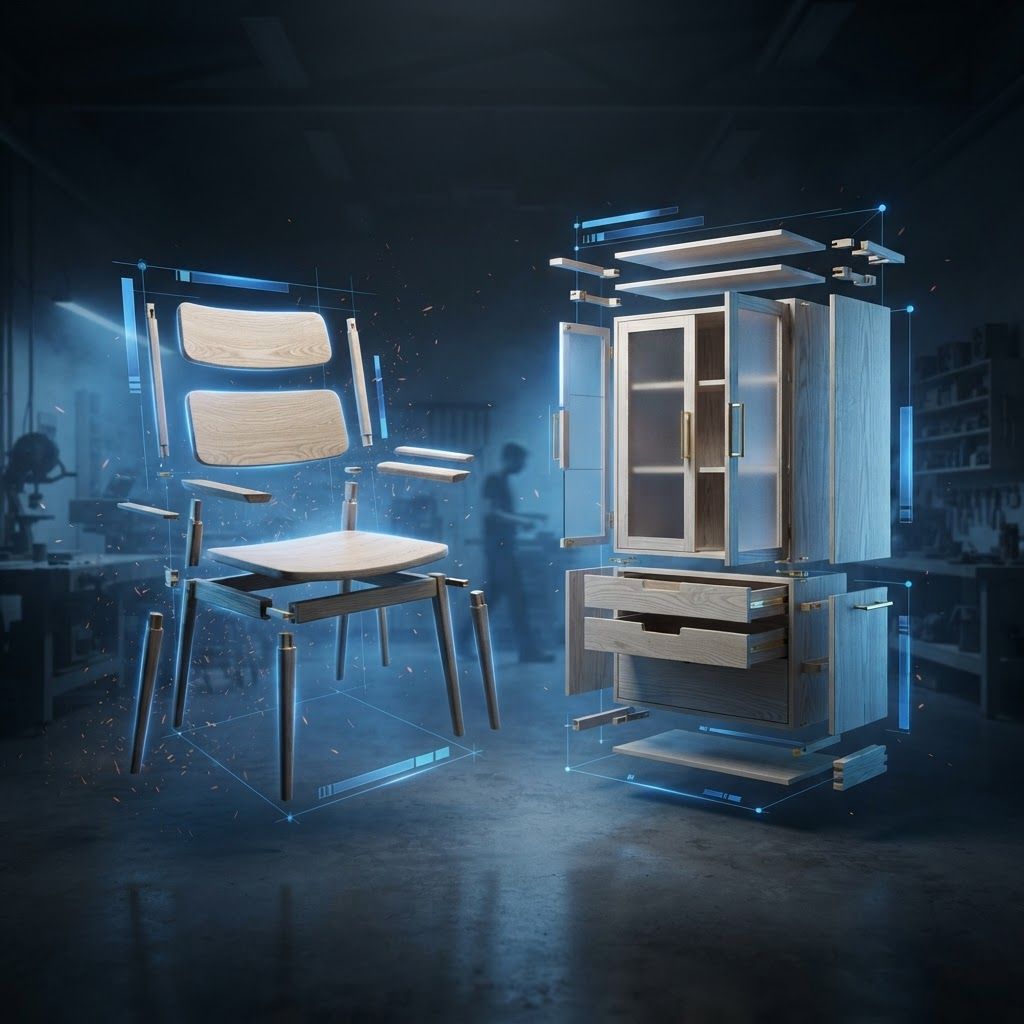
Furniture Making in a Growing Borough
Furniture manufacturing has a natural relationship with Barking and Dagenham. The borough has industrial units suitable for workshops requiring extraction, spray facilities and space for material storage; it has road access adequate for the bulky logistics furniture demands; and it sits within reach of an enormous customer base spanning residential developments, offices, schools, healthcare facilities and hospitality venues across London.
Demand has been reinforced by the borough's own transformation. Thousands of new homes at Barking Riverside and elsewhere require furnishing, and the specification of fitted kitchens, wardrobes and bathroom furniture is decided at development scale rather than household by household. Commercial fit-out work for the offices, studios and community facilities accompanying that development creates parallel demand for contract furniture.
The Leading Furniture Manufacturers
Ercol is among the most respected British furniture manufacturers, known for steam-bent solid wood construction and designs that have remained in production for decades. Its combination of traditional woodworking technique with contemporary manufacturing discipline sets a standard for domestic furniture.
Orangebox specialises in office and workplace furniture, with particular strength in task seating and acoustic pods. Its products address how workplaces are actually used, which has shifted markedly towards collaborative and focus spaces.
Senator Group manufactures contract furniture at scale for commercial, education and healthcare environments, combining design capability with substantial production capacity.
Boss Design produces seating and soft furniture for workplace and hospitality settings, with an emphasis on design-led products manufactured to contract durability standards.
Deadgood takes a design-focused approach to contract furniture, working with independent designers to produce distinctive pieces for hospitality and workplace projects.
Hitch Mylius manufactures upholstered furniture in London, and its proximity to the capital's architects and designers supports the close collaboration that bespoke specification requires.
Benchmark Furniture combines solid timber craftsmanship with rigorous attention to material provenance and indoor air quality, and its focus on healthy materials has influenced wider industry practice.
Vitsoe, Naughtone and Isomi complete the leading group. Vitsoe manufactures modular shelving designed for extension and repair over decades rather than replacement. Naughtone produces contract furniture for workplace and public settings with an emphasis on versatile, hardworking pieces. Isomi specialises in solid surface furniture for reception, washroom and public environments where durability and cleanability govern material choice.
Manufacturing Capabilities
Timber machining forms the core of most furniture production. Computer-controlled routing and drilling has transformed both accuracy and the economics of variation, allowing bespoke dimensions without the cost penalty traditional methods imposed. Solid timber work additionally requires understanding of moisture content, movement and grain orientation — knowledge that cannot be substituted by machinery.
Panel processing dominates volume production for kitchens, wardrobes and office furniture. Beam saws, edge banding and drilling produce components from engineered boards with high precision. Edge banding quality is a reliable indicator of overall manufacturing standard, as poorly bonded edges fail visibly and early.
Upholstery remains a skilled manual process. Frame construction, suspension, foam specification and cover cutting and sewing each affect comfort and durability. Contract upholstery must additionally satisfy fire performance requirements, which constrains material selection considerably.
Finishing determines both appearance and durability. Spray finishing, lacquering, oiling and increasingly UV-cured coatings each suit different applications. Water-based finishes have largely displaced solvent systems for environmental and workplace exposure reasons, and their performance has improved to match.
Metalwork and fabrication supports frames, bases and structural elements. Welding, powder coating and mechanical assembly bring furniture manufacturing into contact with general engineering disciplines.
Trends in Furniture Manufacturing
Sustainable material sourcing has become a procurement requirement rather than a preference. Certified timber, recycled content in boards and textiles, and documented supply chains are routinely specified in commercial projects. Formaldehyde emissions from engineered panels receive particular attention because of indoor air quality implications.
Circular design is advancing beyond material choice towards construction method. Furniture designed for disassembly, with replaceable components and reversible fixings, can be repaired, reupholstered and reconfigured rather than discarded. Some manufacturers now offer take-back and refurbishment services, which changes the commercial relationship substantially.
Workplace change continues to drive contract furniture design. Hybrid working has reduced fixed desk requirements while increasing demand for meeting spaces, acoustic enclosures and settings that support both collaboration and concentration. Furniture that can be reconfigured as needs evolve has clear advantage.
Made-to-measure production has become commercially viable at scale through digital manufacturing. Bespoke dimensions once carried a substantial premium; controlled machining now allows variation with limited cost impact, which suits the irregular spaces common in London residential conversions.
Local manufacturing has gained value as freight costs and lead times have risen. Bulky, low-density products are expensive to ship, and the ability to produce close to the installation site improves both economics and responsiveness.
Selecting a Furniture Manufacturer
Distinguish domestic from contract requirements clearly. Contract furniture must satisfy durability, fire performance and often accessibility standards that domestic products do not address. Specifying domestic furniture for commercial use is a common and costly error.
Examine construction rather than appearance. Joint methods, frame materials, fixing quality, drawer runner specification and hinge grade determine how furniture performs after several years of use. Surface finish tells you little about longevity.
Verify certification relevant to the application. Timber sourcing certification, fire performance test evidence and emissions classification each matter in different contexts, and reputable manufacturers provide documentation readily.
Assess lead time and installation capability realistically. Furniture frequently sits on the critical path of a fit-out programme, and delivery failure has knock-on consequences. Manufacturers who install with their own teams typically resolve problems faster than those relying on third parties.
Discuss repair and spares availability. For furniture intended to last, the availability of replacement components, covers and fittings years after purchase substantially affects lifetime value.
Conclusion
Furniture manufacturing serving Barking and Dagenham spans craft timber production, volume panel processing and design-led contract furniture. The strongest manufacturers combine sound construction with credible material sourcing, and increasingly with repairability that extends product life well beyond a single occupancy. For specifiers and households alike, examining construction detail and documented standards remains the most reliable route to lasting quality.
Want your brand featured in front of decision-makers? Publish a guest post or get a link insertion in our guides through AAMAX's guest post and link insertion service.
Helpful Links
 SponsoredAAMAX — Full-Service Digital Agency
Write for Us
Share your expertise with our readers. We welcome guest contributions from industry specialists.
Pitch your idea