

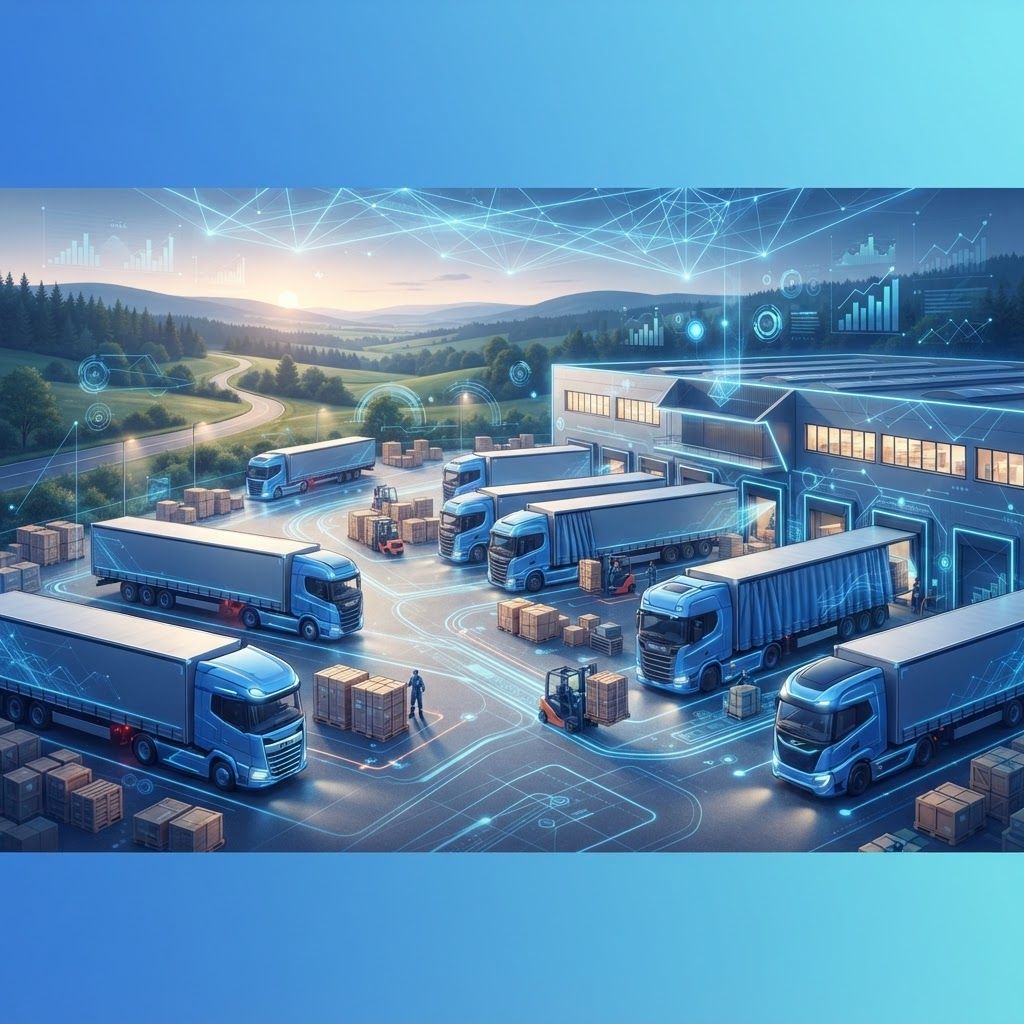
Freight in a County Without a Motorway
Powys presents one of the more demanding freight environments in Britain. There is no motorway within the county, no significant rail freight terminal, no port and no airport. Goods move on trunk roads such as the A470, A483, A458, A44 and A40, and from there onto a network of B roads and single-track lanes leading to farms, quarries, sawmills, factories and villages.
Despite these constraints, the county sustains a substantial freight economy. Agriculture generates enormous tonnage in livestock, feed, fertiliser, silage and machinery. Forestry across the Cambrians, Berwyns and mid Wales plantations produces timber requiring specialist transport. Food and drink manufacturing, engineering and construction materials add further volume. And a rural population dispersed across thousands of square kilometres requires a constant flow of retail and parcel deliveries.
Ten Categories of Freight Operator Serving Powys
1. General haulage and palletised distribution companies. The mainstay of the sector. Operators running curtain-sided and box trailers move manufactured goods, packaged products and mixed pallet loads between Powys businesses and distribution hubs in the Midlands, north west England and south Wales. Most are members of national pallet networks, which allows a small local firm to offer next-day delivery anywhere in Britain.
2. Agricultural and livestock hauliers. A defining Powys specialism. Livestock transport requires purpose-built vehicles, welfare-compliant loading and unloading, journey planning under animal transport regulations and drivers holding certificates of competence. These operators serve markets at Welshpool, Builth Wells and beyond, and the annual rhythm of their work follows the farming calendar.
3. Bulk and tipper haulage firms. Moving aggregates, lime, stone, grain, feed, sand and spoil. Powys has active quarrying and substantial construction activity, and tipper fleets are essential to both. Bulk blowers delivering animal feed to farm silos are a particularly visible part of rural freight.
4. Timber and forestry transport specialists. Timber haulage demands specialist trailers, cranes and drivers experienced in loading on soft forest tracks. Operators in this field work closely with forestry managers and follow agreed timber transport routes designed to protect fragile rural roads.
5. Temperature-controlled and food freight operators. Serving the county's dairy, meat, cheese and drinks producers with refrigerated and frozen transport. These operators maintain cold chain integrity, temperature logging and food safety compliance throughout the journey.
6. Abnormal load and heavy haulage companies. Powys sees an unusual amount of oversized movement: agricultural machinery, construction plant, modular buildings, transformers and, notably, wind turbine components for upland renewable projects. These movements require route surveys, police and highway authority notification and specialist trailers.
7. Parcel and courier networks. National carriers and their local depots and subcontracted drivers handle the enormous volume of consumer and business parcels reaching rural addresses. Delivery to isolated properties is one of the hardest problems in Powys logistics, and operators who solve it well are highly valued.
8. Same-day and urgent freight providers. Serving manufacturers who need a breakdown part, a production component or an urgent document moved immediately. Vehicles range from small vans to seven and a half tonne trucks, and reliability matters far more than price in this segment.
9. Groupage and international freight forwarders. Arranging export and import movements for Powys manufacturers and food producers, consolidating part loads, handling customs documentation and coordinating with ports at Holyhead, Liverpool, Bristol and the south east.
10. Owner-driver and small fleet local hauliers. Independent operators with one to five vehicles, serving farms, builders, quarries and businesses in a defined area. Flexibility and local knowledge are their advantage, and they are often the only realistic option for awkward access sites.
What Makes Powys Freight Distinctive
Access is the recurring challenge. Farm entrances, village streets and mountain lanes were not designed for articulated vehicles. Experienced local hauliers know which delivery points require a rigid vehicle rather than a trailer, where turning is possible, which bridges have weight restrictions and which routes flood after prolonged rain.
Distance without density is the second. A delivery round in Powys might cover two hundred kilometres for a handful of drops, which changes the economics fundamentally compared with urban distribution. Efficient operators build consolidated routes and backload wherever possible.
Weather is the third. Snow and ice on upland roads, flooding along the Severn, Wye and Usk, and high winds affecting high-sided vehicles on exposed routes all disrupt schedules. Reliable operators plan contingency routes rather than treating disruption as an excuse.
Choosing a Freight Partner
Start with compliance. Confirm the operator holds a valid operator licence of the correct type, that vehicles are maintained under a documented system, and that drivers hold current Driver Certificate of Professional Competence qualifications. Check goods in transit insurance and the level of cover per load, and confirm liability terms, since many hauliers contract under standard conditions that limit liability by weight rather than value.
Then assess capability. Ask about vehicle types available, whether tail lifts, moffetts or cranes are offered, what tracking and proof of delivery systems are in place, and how exceptions are communicated. For temperature-controlled or livestock work, ask specifically about certification and audit history.
Finally, test local knowledge. A haulier who asks detailed questions about your site access, turning circle, opening hours and unloading equipment before quoting is demonstrating exactly the diligence that prevents failed deliveries.
Trends Reshaping the Sector
Decarbonisation is the largest long-term factor. Electric vehicles are becoming viable for lighter urban and town distribution but remain challenging for heavy long-distance rural work, and operators are watching alternative fuels closely while improving efficiency through route optimisation and driver training.
Driver recruitment continues to constrain capacity across the industry, and rural operators face particular difficulty attracting and retaining staff. Firms investing in training, apprenticeships and better working conditions are securing an advantage.
Technology adoption has accelerated, with telematics, electronic proof of delivery, real-time tracking and integrated transport management systems now expected even from small fleets. Customers increasingly select hauliers on visibility of information as much as on price.
Conclusion
Freight operators in Powys do difficult work in difficult conditions, and the county's agricultural, forestry and manufacturing economy depends entirely on them. Choosing well means looking past headline rates to compliance, equipment, local knowledge and communication. Get that right and a good haulier becomes one of the most valuable partners a rural business has.
Want your brand featured in front of decision-makers? Publish a guest post or get a link insertion in our guides through AAMAX's guest post and link insertion service.
Helpful Links
 SponsoredAAMAX — Full-Service Digital Agency
Write for Us
Share your expertise with our readers. We welcome guest contributions from industry specialists.
Pitch your idea

