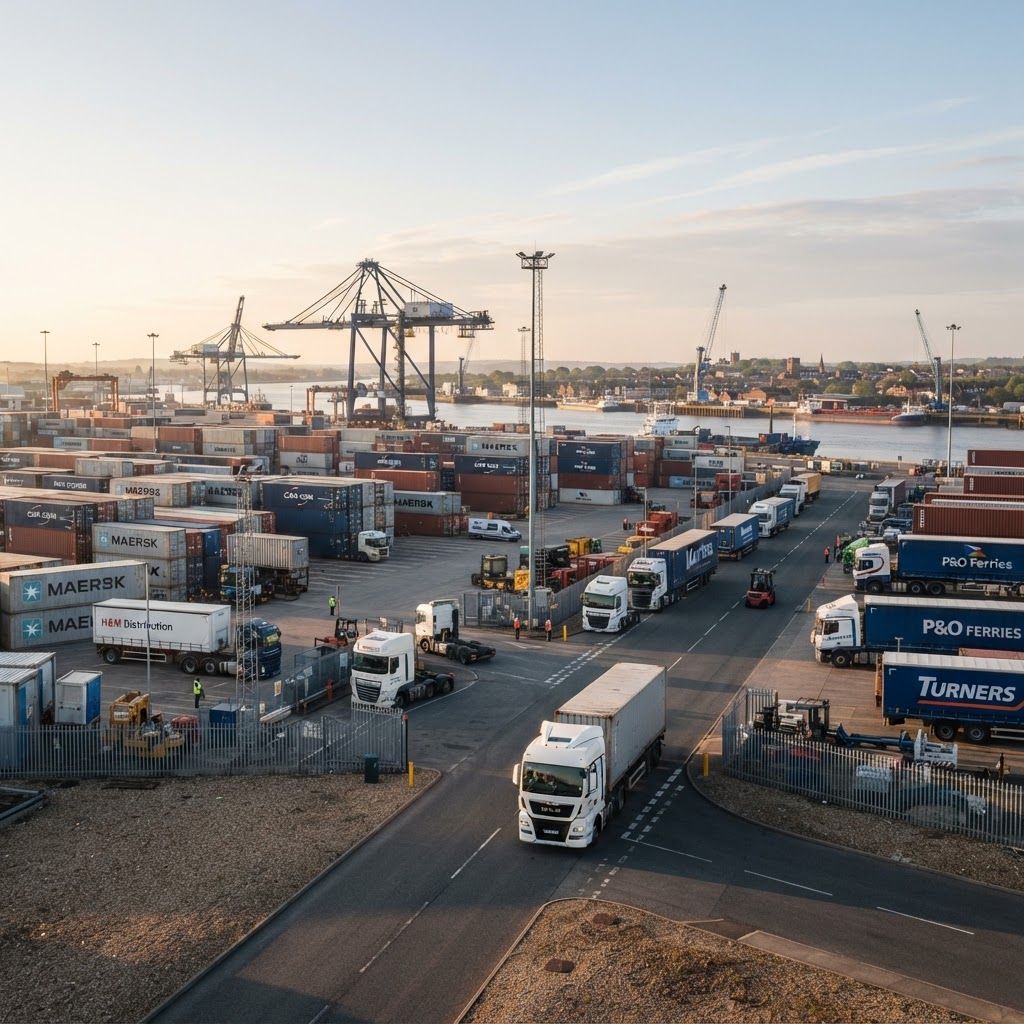
Ipswich and the Freight Economy
Few towns in Britain are as closely bound to freight as Ipswich. The Port of Felixstowe, a short distance to the east, handles a very large share of the country's container traffic, and the Port of Ipswich itself remains an active facility handling bulk cargoes including agricultural products, aggregates and grain. The A14 corridor, which links the ports to the Midlands, passes directly alongside the town.
The consequence is a dense concentration of haulage operators, container hauliers, freight forwarders and warehousing businesses. For companies in Suffolk needing to move goods, the local market offers depth of capacity and expertise that most regions cannot match. The following ten cover the main categories.
1. Container Haulage Operators
Container haulage is the defining freight activity of the area. Operators run skeletal trailers between Felixstowe, inland depots and customer premises across the country, managing quay collection slots, container availability and empty returns. The operational discipline required is considerable, since port booking windows are tight and demurrage charges accrue quickly. Established local hauliers with strong port relationships consistently outperform newcomers on turnaround times.
2. General Road Haulage Firms
Suffolk supports a substantial population of general hauliers operating articulated and rigid vehicles for palletised and loose freight. Services cover full load and part load movements throughout the United Kingdom, with many operators also running European services. Family-owned firms with long histories in the region dominate this sector and compete primarily on reliability and driver quality rather than price alone.
3. Pallet Network Members
Membership of a national pallet network allows a local haulier to offer overnight delivery anywhere in the country without operating a national fleet. Freight is collected locally, trunked to a central hub overnight, sorted and delivered by another member the next day. For Ipswich businesses sending small consignments regularly, this model provides national reach at a cost that would otherwise be impossible.
4. Freight Forwarding Companies
Freight forwarders arrange international movements rather than operating vehicles themselves, coordinating sea, air and road legs, customs clearance, documentation and insurance. Given Ipswich's proximity to Felixstowe and Harwich, the local forwarding community is experienced and well connected. Since changes to customs arrangements with the European Union, forwarders have become substantially more important to exporters and importers of all sizes.
5. Customs Clearance Agents
Customs brokerage has grown into a significant specialism in the region. Agents handle import and export declarations, tariff classification, duty calculations, origin documentation and compliance with controlled goods requirements. Errors in classification can result in overpayment of duty or serious compliance problems, making experienced agents a worthwhile investment rather than an administrative overhead.
6. Bulk and Aggregate Transport Specialists
The Port of Ipswich handles substantial volumes of grain, fertiliser, aggregates and other bulk commodities, supported by operators running tipper trucks, bulk tankers and walking floor trailers. Agriculture across Suffolk generates strong seasonal demand, and harvest periods put intense pressure on capacity. Farmers and merchants typically build long-term relationships with hauliers to secure availability at critical times.
7. Abnormal and Heavy Load Carriers
Specialist operators move oversized and heavy items: construction plant, wind energy components, industrial machinery and pre-fabricated structures. This work requires route surveys, notification to authorities and police, escort vehicles and specialist low-loader trailers. The engineering and planning content is as important as the driving, and only a limited number of operators in the region have the capability.
8. Temperature-Controlled Freight Operators
Suffolk's food production and processing sector requires refrigerated transport meeting strict temperature integrity standards. Operators run vehicles with monitored refrigeration units and maintain documentation demonstrating an unbroken cold chain. Failure in this area results in rejected loads and food safety consequences, so reliability standards in the sector are high.
9. Warehousing and Distribution Providers
Third-party warehousing around Ipswich and along the A14 offers storage, pick and pack, order fulfilment and onward distribution. Proximity to Felixstowe makes the area attractive for importers who want to unload containers close to the port rather than paying to move full containers inland. Bonded warehousing, where duty is deferred until goods leave storage, is available and valuable for importers managing cash flow.
10. Courier and Same-Day Freight Services
At the urgent end of the market, same-day courier operators run vans and small trucks for time-critical consignments: production line parts, legal documents, medical supplies and emergency spares. Ipswich's position on the trunk road network means same-day delivery to London, the Midlands and the South East is achievable, and these operators typically offer direct dedicated vehicles rather than shared routes.
Choosing a Freight Partner
Start with operator licensing, which is a legal requirement for commercial haulage and indicates that the business meets financial standing, maintenance and management competence tests. Check insurance cover levels, since standard haulier liability is limited by weight rather than value and may fall well short of your consignment's worth. Ask about tracking, proof of delivery systems and how the operator communicates when something goes wrong, because the last point distinguishes good suppliers from mediocre ones.
Cost Drivers in Freight
Fuel remains the largest single variable, and most contracts include a fuel surcharge mechanism linked to published prices. Driver availability has been a persistent constraint across the industry, affecting both cost and capacity. Port congestion, container availability and seasonal peaks around harvest and pre-Christmas retail all influence rates. Businesses that provide accurate forecasts to their hauliers generally secure better pricing than those booking reactively.
Sustainability and Compliance
Freight operators in the region are investing in fuel-efficient vehicles, alternative fuels, aerodynamic trailers and route optimisation software. Modal shift towards rail freight from Felixstowe is significant, with substantial container volumes moving by train to inland terminals, which reduces road congestion on the A14. Customers increasingly request carbon reporting for their supply chains, and operators able to supply credible data have a commercial advantage.
The Outlook for Ipswich Freight
The area's freight sector remains structurally strong because of its geography. Continued investment in port capacity, rail connections and warehousing along the A14 corridor points to sustained activity. For local businesses, the practical implication is positive: a competitive market with genuine depth of expertise, where it is possible to find a specialist for almost any type of movement without looking outside the county.
Want your brand featured in front of decision-makers? Publish a guest post or get a link insertion in our guides through AAMAX's guest post and link insertion service.
Helpful Links
 SponsoredAAMAX — Full-Service Digital Agency
Write for Us
Share your expertise with our readers. We welcome guest contributions from industry specialists.
Pitch your idea