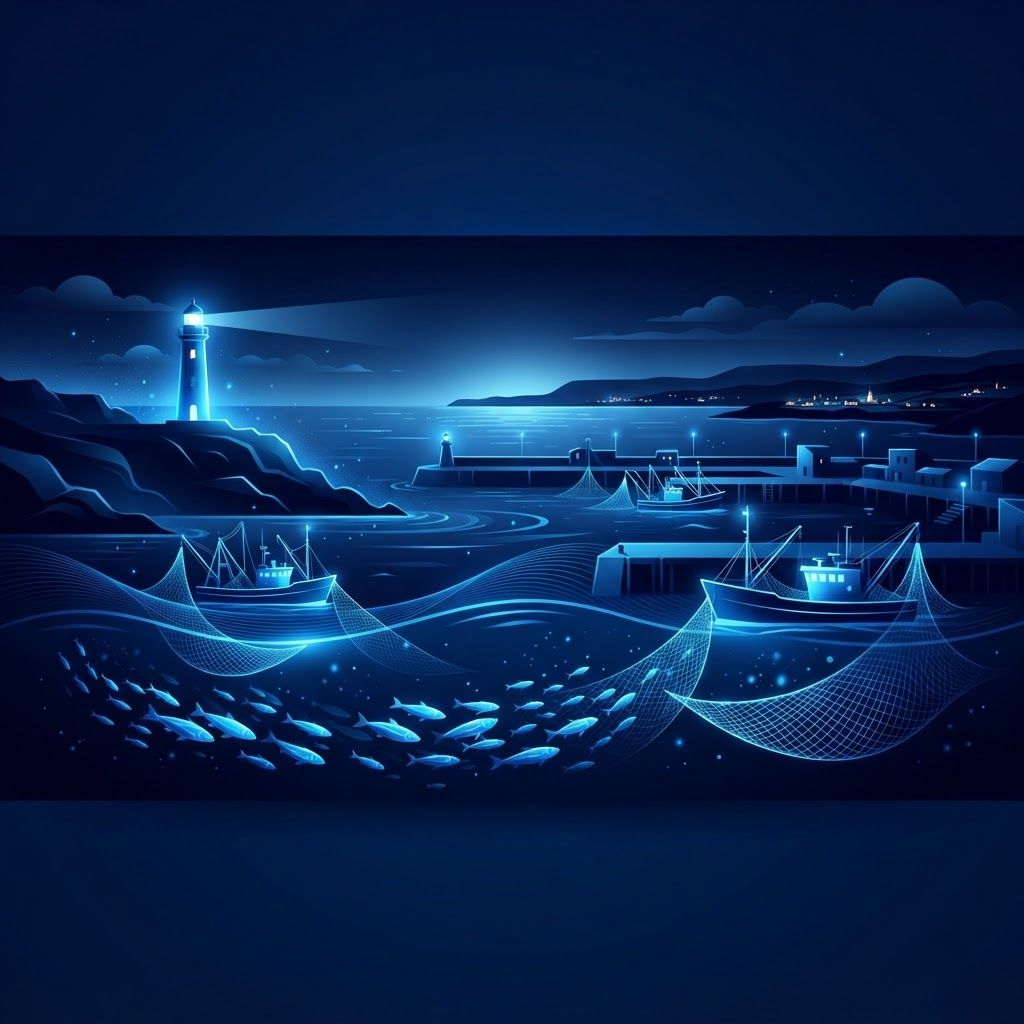
A Coastline With Deep Maritime Roots
Mid and East Antrim's coastline runs for many miles along Belfast Lough and the North Channel, taking in Carrickfergus, Whitehead, Islandmagee, Larne, Ballygally and Glenarm before reaching the southern Glens. These are working waters with a long history. Fishing villages along this coast supplied local markets for centuries, Larne developed as a commercial port, and the harbours at Carrickfergus and Glenarm still support boats today.
The modern sector is smaller than it once was but more varied. It spans inshore commercial fishing, shellfish harvesting, processing and distribution, recreational sea angling, freshwater fisheries, aquaculture and the marine services that support all of them. Understanding it means looking well beyond the image of a trawler leaving harbour.
1. Inshore Commercial Fishing Operations
Small inshore boats working out of harbours along the Antrim coast target species including whitefish, mackerel, herring and flatfish depending on season and quota. These are typically owner operated vessels making short trips, landing fresh catch for local sale and onward distribution. The sector operates within a detailed framework of quota, licensing, gear restrictions and catch recording designed to keep stocks sustainable.
2. Shellfish and Crustacean Harvesters
Potting for lobster, brown crab, velvet crab and prawns is one of the most valuable activities on this coast. Shellfish command strong prices, much of it exported live to markets in Europe and Asia, and the fishery is well suited to small boats working close to shore. Minimum landing sizes, protection of berried females and escape gaps in pots all form part of the conservation approach, and many operators participate in voluntary measures beyond the legal minimum.
3. Seafood Processing Businesses
Processors handle filleting, portioning, freezing, smoking and packing, adding significant value to landed catch. Northern Ireland has a strong reputation in seafood processing, and traditional smoking in particular produces premium products that sell well domestically and for export. Food safety accreditation, cold chain control and full traceability from vessel to pack are fundamental requirements in this segment.
4. Fish Merchants and Wholesale Distributors
Merchants buy from vessels and processors and supply restaurants, hotels, fishmongers and retailers across the borough and beyond. Speed defines this trade, since quality declines quickly, and the strongest operators run early morning deliveries and can source species that are not landed locally. The tourism corridor along the Causeway Coastal Route generates significant restaurant demand for quality local seafood.
5. Aquaculture and Shellfish Farming Enterprises
Cultivation of mussels, oysters and other shellfish, along with finfish farming, forms a growing part of the marine economy in Northern Ireland. Shellfish farming has a notably low environmental footprint since the animals feed on naturally occurring plankton and require no supplementary feed. Water quality classification is central to operating, and producers work closely with regulators on monitoring.
6. Sea Angling Charter and Tourism Operators
Charter boats operating from Carrickfergus, Whitehead, Larne and Glenarm take anglers out for wreck and reef fishing in the North Channel. The waters here have a reputation for quality sport, and charter operators contribute meaningfully to coastal tourism. Passenger vessel certification, safety equipment and skipper qualification are strictly regulated, and reputable operators are transparent about their credentials.
7. Freshwater Fisheries and Game Angling
Inland, the rivers and loughs of the borough support game angling for salmon, sea trout and brown trout, along with coarse fishing and stocked still water fisheries. Angling clubs manage many of these waters, undertaking habitat improvement, bank maintenance and stock management. Salmon conservation measures have tightened considerably, with catch and release now widespread practice.
8. Harbour, Port and Marine Services
Fishing depends on shoreside infrastructure. Harbour facilities, slipways, moorings, ice supply, fuel, chandlery, net repair and boat maintenance services keep vessels working. Larne's port and the smaller harbours along the coast each play a role, and investment in harbour facilities directly affects the viability of the fleet that uses them.
9. Marine Conservation and Fisheries Science Organisations
Scientific monitoring, stock assessment, habitat mapping and marine protected area management are carried out by agencies and research bodies working along this coastline. Their data underpins quota decisions and conservation measures. Increasingly, fishers themselves participate in data collection, and this collaborative approach tends to produce both better science and better compliance.
10. Seafood Retail, Restaurants and Direct Sales
Fishmongers, farm shops, seafood restaurants and direct from boat sales connect the catch to the consumer. Interest in local provenance has grown strongly, and visitors travelling the Causeway Coastal Route actively seek out local seafood. Shortening the chain between boat and plate improves both freshness and the margin retained by fishers.
Sustainability and Regulation
Fisheries management is complex, combining quota allocation, effort limits, gear regulations, minimum conservation reference sizes, closed areas and seasons, and detailed catch reporting. Certification schemes provide market recognition for well managed fisheries, and buyers increasingly ask for evidence of sustainable sourcing. Beyond stock management, the sector is addressing gear loss and marine plastic, bycatch reduction and vessel fuel efficiency.
Challenges Facing the Sector
Local fisheries face real pressures: quota constraints, fuel costs, an ageing workforce, difficulty attracting new entrants, market access arrangements and the administrative burden of compliance. Climate driven changes in species distribution add further uncertainty. At the same time, strong consumer demand for high quality seafood, growing interest in provenance and the potential of low impact aquaculture provide genuine grounds for optimism.
Buying Seafood Locally
For restaurants and consumers, buying locally landed seafood means better freshness, verifiable provenance and support for coastal communities. Ask where and when fish was landed, be willing to buy less familiar species when they are abundant, and work with suppliers who can explain their sourcing. Seasonal flexibility on a menu is one of the most practical contributions a kitchen can make to a sustainable fishery.
Final Thoughts
The fishery sector in Mid and East Antrim is modest in scale but rich in heritage and increasingly focused on quality and sustainability. From lobster pots off Islandmagee to smoked seafood and charter boats out of Glenarm, the borough's maritime economy remains a living part of its identity.
Want your brand featured in front of decision-makers? Publish a guest post or get a link insertion in our guides through AAMAX's guest post and link insertion service.
Helpful Links
 SponsoredAAMAX — Full-Service Digital Agency
Write for Us
Share your expertise with our readers. We welcome guest contributions from industry specialists.
Pitch your idea