

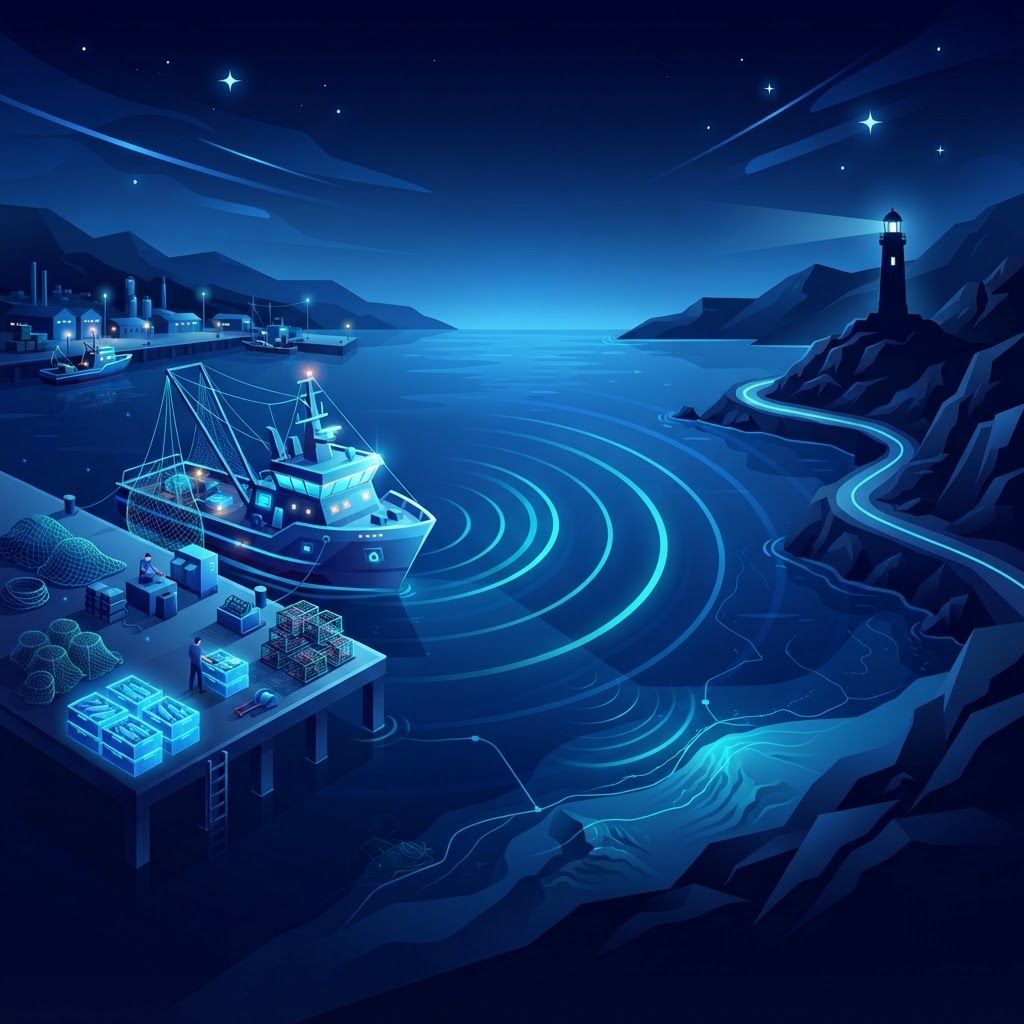
A Coastline Defined by the Sea
The northern coast of County Antrim and County Londonderry has looked seaward for centuries. Harbours at Portrush, Portballintrae, Ballycastle, Rathlin Island and along the Foyle estuary have supported fishing communities through generations, and while the industry has contracted from its historic peak, it remains economically and culturally significant to Causeway Coast and Glens.
The waters here are productive but demanding. The North Channel and the approaches to the Atlantic bring strong tides, exposed conditions and a diverse species mix. Local vessels target crab, lobster, langoustine, scallops, whitefish and pelagic species depending on season, quota and vessel capability. It is a sector where seamanship, local knowledge and weather judgement remain as important as any technology.
Ten Fishery Companies and Operators in the Region
1. Ballycastle Fishermen's Cooperative represents the collective strength of small-boat operators working out of the north Antrim coast. Cooperatives improve bargaining power on price, share the cost of ice and handling facilities, and provide a unified voice in quota and policy discussions.
2. Rathlin Island Shellfish works some of the most productive and challenging grounds in the region. Island-based operations face particular logistical hurdles around transport and landing, but the quality of crab and lobster from these waters is highly regarded.
3. Portrush Harbour Fisheries combines commercial landings with a visible presence in a town where tourism and fishing coexist. Fresh fish sold directly at the harbour connects visitors to the working maritime economy and supports a premium price for the catch.
4. Foyle Seafood Company operates in the estuary and inshore waters, where the mix of freshwater and marine environments supports distinctive fisheries. The Foyle system has a long association with salmon and eel fishing, both now carefully managed under conservation regimes.
5. North Atlantic Shellfish Processors handles the crucial post-landing stage: grading, holding, processing and preparing product for domestic and export markets. Live shellfish export demands precise water quality management and rapid, temperature-controlled logistics.
6. Causeway Coast Lobster and Crab focuses on the potting sector, which is well suited to the rocky ground along the basalt coastline. Potting is comparatively low-impact fishing with limited seabed disturbance and high selectivity, and the product commands strong prices in continental markets.
7. Glens Aquaculture represents the farmed side of the industry, an area of growing importance as wild stocks face pressure. Shellfish aquaculture in particular has a favourable environmental profile, requiring no feed inputs and providing water filtration benefits.
8. Bann Estuary Fisheries works the mouth of the River Bann, historically significant for salmon and eel. Today the emphasis is heavily on conservation and regulated, sustainable harvest, with scientific monitoring guiding what can be taken.
9. Antrim Coast Fish Merchants connects vessels to buyers, supplying restaurants, hotels, fishmongers and wholesalers across Northern Ireland. Merchants add value through grading, reliable supply and the ability to match a chef's specification to what the boats actually land on a given day.
10. Atlantic Marine Services supports the fleet rather than fishing itself, providing gear, engineering, safety equipment and vessel maintenance. A fishing industry cannot function without this supporting infrastructure, and its availability locally is a genuine competitive factor.
Sustainability at the Centre
No industry has a more direct interest in the health of its resource than fishing. Quota management, minimum landing sizes, closed areas and gear restrictions all aim to keep stocks viable. Local operators have increasingly engaged with these measures rather than resisting them, recognising that the alternative is collapse.
Gear innovation has made a real difference. Escape panels in pots allow undersized crustaceans to leave, selective trawl designs reduce unwanted bycatch, and improved handling practice means that returned fish have far higher survival rates. V-notching of egg-bearing female lobsters, a practice widely adopted along the north coast, protects breeding stock and is a good example of the industry regulating itself.
Marine protected areas along the Causeway coast and around Rathlin have created some tension but also opportunity. Well-designed protected zones can act as nurseries that replenish surrounding grounds, and fishermen involved in their design are far more likely to support them.
Processing, Provenance and Market Access
The greatest commercial opportunity for the sector lies in capturing more value locally. Shipping live shellfish to distant processors means the profit accrues elsewhere. Investment in local processing, packing and branded product keeps that value in the borough and creates shore-based employment that is less weather-dependent than fishing itself.
Provenance branding works particularly well for seafood. Consumers respond to knowing the harbour, the vessel and the method. The Causeway Coast name carries international recognition thanks to tourism, and seafood marketed under that banner benefits from an association with clean, wild Atlantic waters.
Tourism and hospitality provide a strong domestic outlet. Restaurants along the coastal route increasingly feature locally landed shellfish, and seafood festivals draw visitors while showcasing the industry. This direct connection between fishery and visitor economy is mutually reinforcing.
Challenges Ahead
Crew recruitment is difficult across the industry. Fishing is physically demanding, often dangerous and increasingly regulated, and attracting young entrants requires better conditions and clearer career progression. Safety improvements, including personal flotation devices and vessel monitoring, have reduced risk considerably but the work remains hard.
Changing sea temperatures are altering species distribution, bringing some species north while others retreat. Adaptable operators who can switch target species and hold diverse licences are best placed to cope.
For all these pressures, fishing in Causeway Coast and Glens retains real strengths: productive grounds, high-quality product, strong provenance and communities with deep maritime skill. Managed carefully, it has a durable future.
Want your brand featured in front of decision-makers? Publish a guest post or get a link insertion in our guides through AAMAX's guest post and link insertion service.
Helpful Links
 SponsoredAAMAX — Full-Service Digital Agency
Write for Us
Share your expertise with our readers. We welcome guest contributions from industry specialists.
Pitch your idea

