

Bridgend and the Sea
Bridgend County Borough meets the Bristol Channel along a stretch of coastline that includes Porthcawl, Rest Bay, Newton and the dramatic limestone cliffs and dunes running toward Ogmore-by-Sea. That coast has supported fishing communities for centuries, and while the industry has changed profoundly, marine and freshwater fisheries remain part of the local economy and culture.
The Bristol Channel is a distinctive marine environment. It has the second largest tidal range in the world, with tides at Porthcawl exceeding twelve metres on spring tides. Those enormous tidal flows create powerful currents, high turbidity and a nutrient-rich system that supports productive fisheries, while simultaneously making fishing physically demanding and sometimes hazardous.
Commercial Fishing in the Bristol Channel
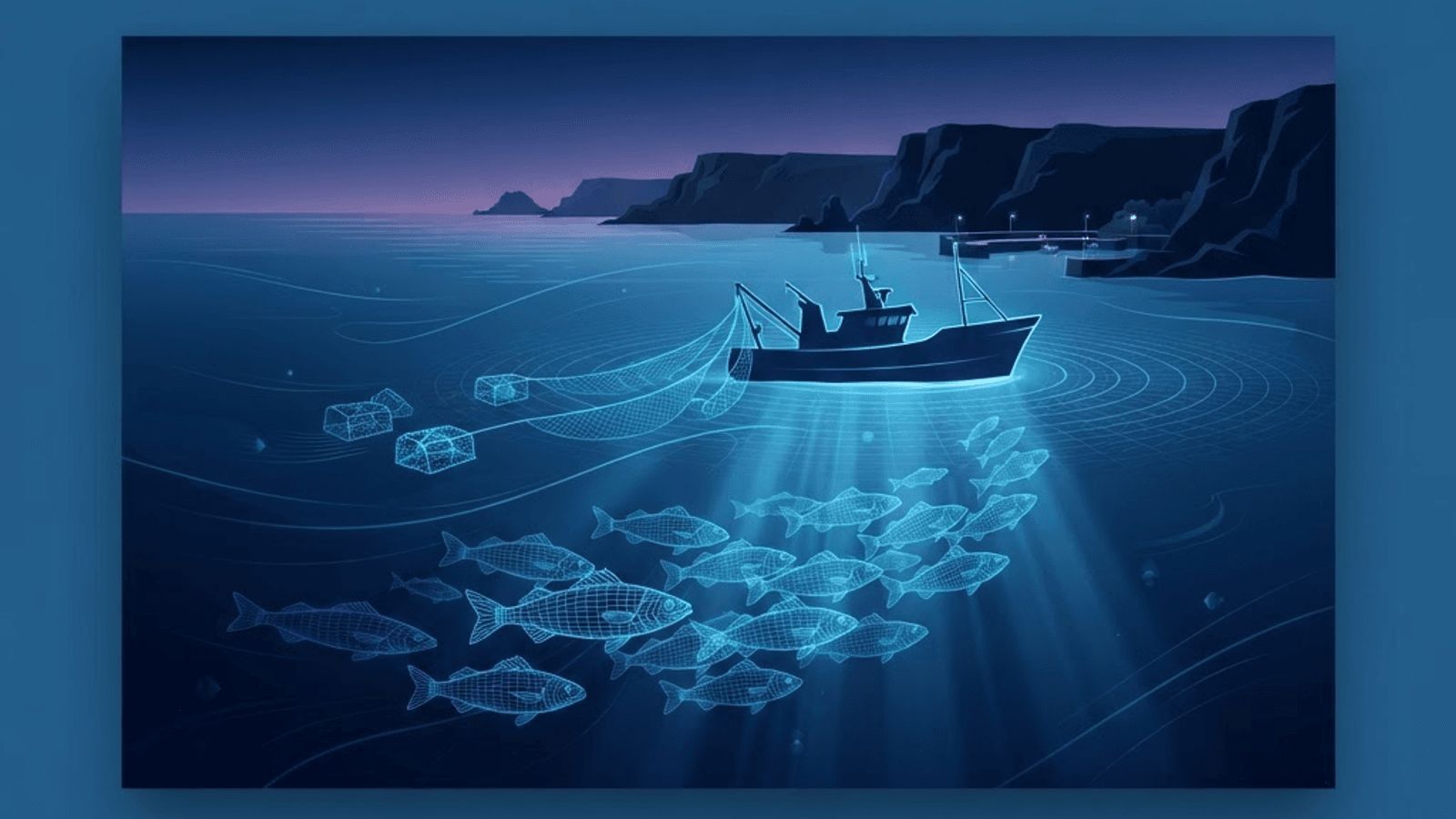
Commercial fishing from South Wales ports today is largely a small-boat, inshore affair. Vessels typically work day trips within relatively short distances, using pots, nets and lines rather than large-scale trawling.
Key species include brown crab, lobster and velvet crab taken in pots; sole, plaice and other flatfish; bass, which is subject to strict management measures; whelks, which support a substantial fishery with much of the catch exported to Asian markets; and seasonal fisheries for species such as skate and ray.
Potting is the dominant method for shellfish and is comparatively low impact, with minimal seabed disturbance and the ability to return undersized or berried animals alive. Fishers work strings of pots on defined grounds, hauling and rebaiting on a regular cycle, and knowledge of ground and tide accumulated over years is what separates successful boats from struggling ones.
Shellfish Gathering and the Intertidal Zone
The vast intertidal areas exposed by the Bristol Channel's tidal range support gathering of cockles, mussels and periwinkles. The cockle fisheries of the Burry Inlet and surrounding estuaries have historic importance in Welsh coastal culture, sustaining communities for generations.
Shellfish gathering is tightly regulated for public health reasons. Filter-feeding bivalves concentrate bacteria, viruses and biotoxins from the water, so harvesting areas are classified according to contamination levels, with corresponding purification or treatment requirements before shellfish can enter the food chain. Monitoring for algal biotoxins is continuous, and closures follow when levels rise.
Water quality is therefore not an abstract environmental issue for this sector but a direct commercial determinant. Sewage discharge, agricultural runoff and urban drainage all affect classification, and improvements in catchment management translate directly into fishery viability.
Seafood Processing and Distribution
Processing adds substantial value to landed catch. Businesses in South Wales handle filleting, portioning, shellfish cooking and picking, smoking, freezing, packing and distribution to wholesalers, restaurants, retailers and export markets.
Standards in seafood processing are exacting. Cold chain management from landing through processing to delivery determines both safety and quality. Traceability requirements mean product must be trackable to vessel and fishing trip. Approved premises must operate documented food safety management systems, and many hold third-party certification demanded by larger customers.
Export is significant. A considerable proportion of UK shellfish, particularly crab, lobster and whelks, is destined for European and Asian markets where prices exceed domestic levels. That export orientation makes the sector sensitive to trade arrangements, customs procedures and the speed with which perishable product can move.
Angling Fisheries and Recreational Waters
Away from commercial marine fishing, the Bridgend area supports a substantial recreational fishing economy. Coarse fisheries with stocked lakes holding carp, tench, bream, roach and perch attract anglers throughout the year. Trout fisheries offer fly fishing on stocked stillwaters. And the rivers Ogmore, Garw and Llynfi support wild brown trout, sea trout and salmon runs.
Commercial angling fisheries are genuine small businesses, managing water quality, fish health, stocking, bank maintenance, facilities and increasingly on-site accommodation and catering. Well-run fisheries in the region draw anglers from across South Wales and beyond, contributing meaningfully to rural tourism.
River fisheries face different challenges. Migratory salmon and sea trout stocks have declined significantly across Wales, prompting strict catch and release requirements and byelaws restricting methods. Habitat restoration, barrier removal to improve fish passage, and catchment water quality improvement are the long-term interventions that matter, and angling clubs frequently lead volunteer effort on these.
Aquaculture and Emerging Opportunities
Aquaculture in Wales remains modest compared with Scotland but is developing. Shellfish cultivation, particularly mussels grown on ropes or bottom-laid, is well established in suitable sheltered waters. Seaweed cultivation has attracted considerable interest, offering a low-input crop with applications in food, animal feed, cosmetics, fertiliser and biomaterials, alongside potential ecosystem benefits through nutrient absorption.
Land-based recirculating aquaculture systems, which raise fish in controlled tanks with water treatment and reuse, offer another route. Capital intensive but with precise environmental control and minimal discharge, these systems could produce high-value species close to market.
Sustainability and Fisheries Management
Sustainability is existential for fisheries, since a depleted stock supports no industry at all. Management measures include minimum landing sizes allowing fish and shellfish to reproduce before capture, prohibition on landing berried female crabs and lobsters, gear restrictions, closed seasons, catch limits and marine protected areas.
Post-Brexit fisheries management in Wales operates under devolved arrangements with Welsh Government responsible for policy within Welsh waters. Fisheries management plans are being developed for key stocks, and the inshore sector has generally welcomed a management approach more attuned to small-boat realities than previous frameworks.
Marine Stewardship Council certification provides market recognition for well-managed fisheries, though the cost and data requirements can be prohibitive for small-scale operations. Alternative assurance schemes and direct provenance marketing offer other routes for fishers to differentiate their product.
Challenges and Resilience
The sector faces real difficulties. Fuel costs weigh heavily on vessel economics. Crew recruitment is difficult, as fishing is physically demanding, weather dependent and offers uncertain income. Climate change is altering species distribution, with warmer water species appearing more frequently while traditional species shift northward. Marine spatial competition with offshore renewables, shipping and conservation designation constrains fishing grounds.
Resilience strategies include diversifying species and methods across the season, direct selling to capture better margins, adding value through processing rather than selling raw commodity, and engaging constructively in management processes to secure workable arrangements.
Conclusion
Fishery businesses connected to Bridgend represent a small but culturally and economically meaningful part of the local economy. From small commercial boats working Bristol Channel grounds through processors adding value to inland angling fisheries supporting rural tourism, the sector combines tradition with genuine commercial adaptation. Its future depends on maintaining healthy stocks and clean water, which makes fishers among the most direct stakeholders in the environmental health of the Welsh coast.
Want your brand featured in front of decision-makers? Publish a guest post or get a link insertion in our guides through AAMAX's guest post and link insertion service.
Helpful Links
 SponsoredAAMAX — Full-Service Digital Agency
Write for Us
Share your expertise with our readers. We welcome guest contributions from industry specialists.
Pitch your idea

