

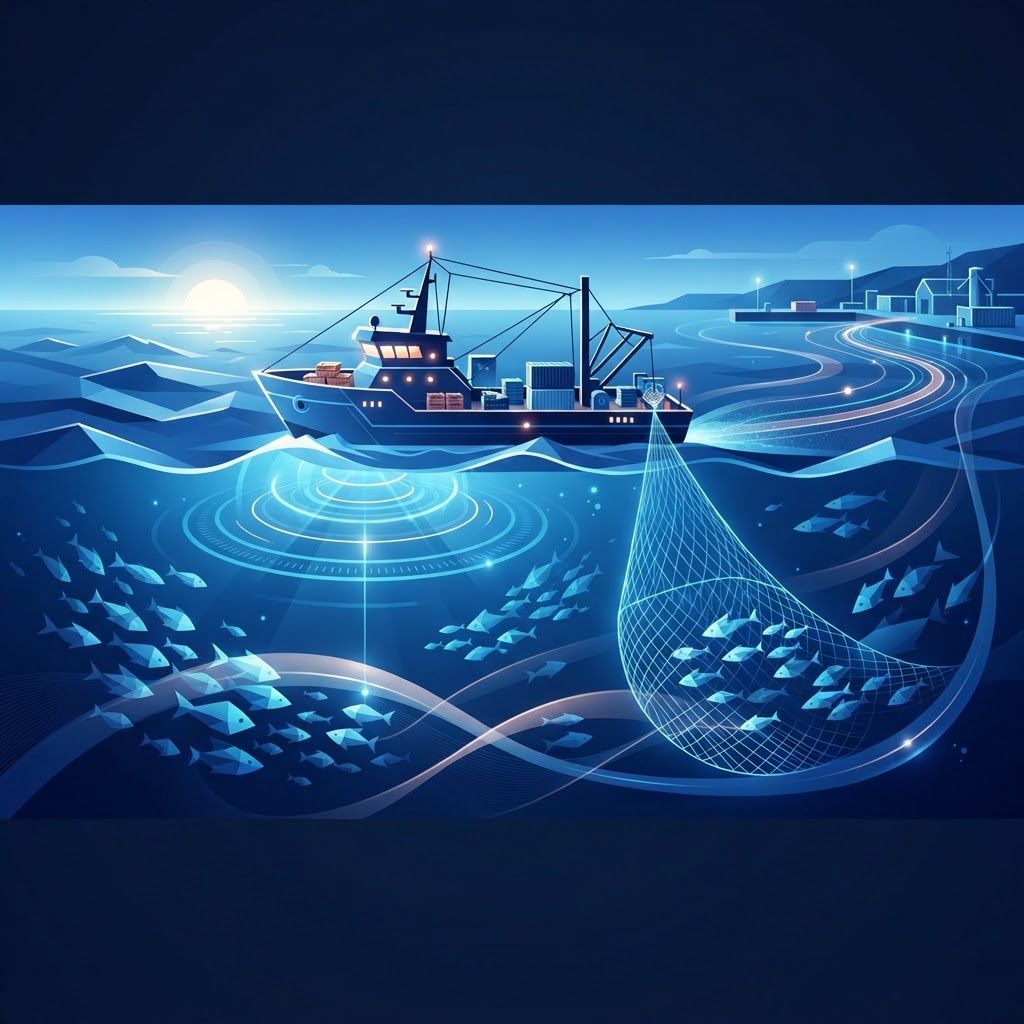
Fisheries and the Ashford Area
Ashford is an inland town, yet its relationship with fisheries is stronger than that fact suggests. The Kent coast at Folkestone, Hythe and Dungeness lies within a short drive, placing the borough squarely within the distribution radius of the county's landing ports. The Great Stour flows through the town itself, and the surrounding countryside contains a substantial network of lakes, reservoirs and managed waters supporting both commercial angling and conservation fisheries.
The result is a fishery sector with three quite distinct components: seafood processing and wholesale distribution, freshwater aquaculture and fish farming, and recreational fishery management. Each operates on different commercial logic, but all contribute to the local economy and to the food and leisure offer available across the borough.
The Seafood Supply Chain
Kent's inshore fleet lands a valuable mix of species including sole, plaice, bass, cod, whelks, cuttlefish and shellfish. Much of this catch moves inland for processing, packing and onward distribution, and Ashford's transport links make it a logical staging point. Seafood is unforgiving of delay, so the businesses handling it operate to tight temperature-controlled schedules with full traceability from landing to delivery.
Restaurants, fishmongers, farm shops and food service operators across Kent depend on this chain. Increasingly, so do direct consumers, as online ordering and home delivery have opened routes to market that were previously the preserve of wholesale buyers.
1. Kent Coast Seafood Supply
A wholesale distributor sourcing directly from Kent landing ports and supplying restaurants, hotels and retailers across the county. Daily availability reflects what the boats have actually landed rather than a fixed catalogue, and chefs value the honesty of that approach alongside the freshness it guarantees.
2. Ashford Fish Processing
Filleting, portioning, packing and cold storage services form the core of this operation. Working to strict hygiene and cold chain standards, the business enables smaller catchers and merchants to access retail-ready presentation without investing in their own processing facilities.
3. Stour Valley Trout Fishery
Freshwater aquaculture on the chalk-influenced waters of the Stour catchment supports trout production for both the table and for stocking purposes. Careful water quality management and low-density rearing are emphasised, producing fish of consistent condition.
4. Romney Marsh Shellfish
Specialising in shellfish including whelks, cockles and mussels, this business works closely with the coastal fleet and applies rigorous purification and grading processes. Shellfish require particularly careful handling and documented water classification, making expertise here non-negotiable.
5. Weald Coarse Fisheries
Managing a network of coarse angling lakes around Ashford, this operator maintains stocked waters for carp, tench, bream and roach. Fishery management involves water quality monitoring, habitat maintenance, stock health management and angler facilities, blending ecology with hospitality.
6. Ashford Fishmongers Wholesale
Serving independent fishmongers, farm shops and delicatessens, this wholesaler consolidates catch from multiple sources to provide the range that smaller retailers need without requiring them to buy at volume from each supplier individually.
7. Channel Seafood Exporters
Given Ashford's proximity to the Channel crossings, export-oriented seafood trading has a natural home here. This business handles shellfish and finfish destined for continental markets, managing the substantial documentation and health certification requirements involved.
8. Kent Aquaculture Systems
Focused on recirculating aquaculture technology, this company supplies and operates land-based fish farming systems. Controlled environment production offers biosecurity advantages and predictable output, and interest in the approach has grown as wild stocks face increasing pressure.
9. Great Stour Fishery Management
Conservation-focused river fishery work includes habitat restoration, fish passage improvement, invasive species control and stock assessment along the Stour. Work of this kind underpins the long-term health of the catchment and the recreational fishing it supports.
10. Ashford Angling Supplies and Fishery Services
Combining tackle retail with fishery consultancy, this business supports both anglers and water owners. Services include stocking advice, water testing, aeration equipment and habitat improvement planning for private and syndicate fisheries.
Sustainability and Regulation
Few sectors face sustainability scrutiny as directly as fisheries. Quota management, minimum landing sizes, gear restrictions and seasonal closures all shape what can be caught and when. Kent's inshore fleet operates predominantly with smaller vessels and relatively selective methods, which supports a reasonable sustainability profile, but pressure on certain stocks remains a live concern.
Buyers increasingly expect certification or at least clear sourcing information. Restaurants in particular now frequently name the port or vessel on their menus, and wholesalers who can supply that level of detail have a commercial advantage as well as an ethical one.
Freshwater fisheries face their own challenges. Water quality, abstraction pressure, invasive species and disease risk all require active management. Biosecurity protocols around fish movements have tightened considerably, and fishery managers must now document stocking carefully.
Trends Worth Watching
Direct-to-consumer seafood sales have grown substantially, with box schemes and online ordering giving coastal suppliers access to inland customers in towns like Ashford. This shortens the chain and improves returns for catchers.
Land-based aquaculture is attracting serious investment as technology improves and its environmental case strengthens. Recirculating systems allow production close to markets with controlled inputs and minimal escape risk.
Recreational angling continues to provide significant rural economic value, supporting fisheries, tackle retail, accommodation and hospitality across the Ashford countryside.
Final Thoughts
The fishery sector around Ashford is more substantial and more varied than its inland location might suggest. From coastal catch moving through local processors to managed lakes drawing anglers from across the south east, these businesses combine food production, environmental stewardship and leisure provision. Those that thrive are the ones treating sustainability not as a constraint but as the foundation of a durable operation.
Want your brand featured in front of decision-makers? Publish a guest post or get a link insertion in our guides through AAMAX's guest post and link insertion service.
Helpful Links
 SponsoredAAMAX — Full-Service Digital Agency
Write for Us
Share your expertise with our readers. We welcome guest contributions from industry specialists.
Pitch your idea

