

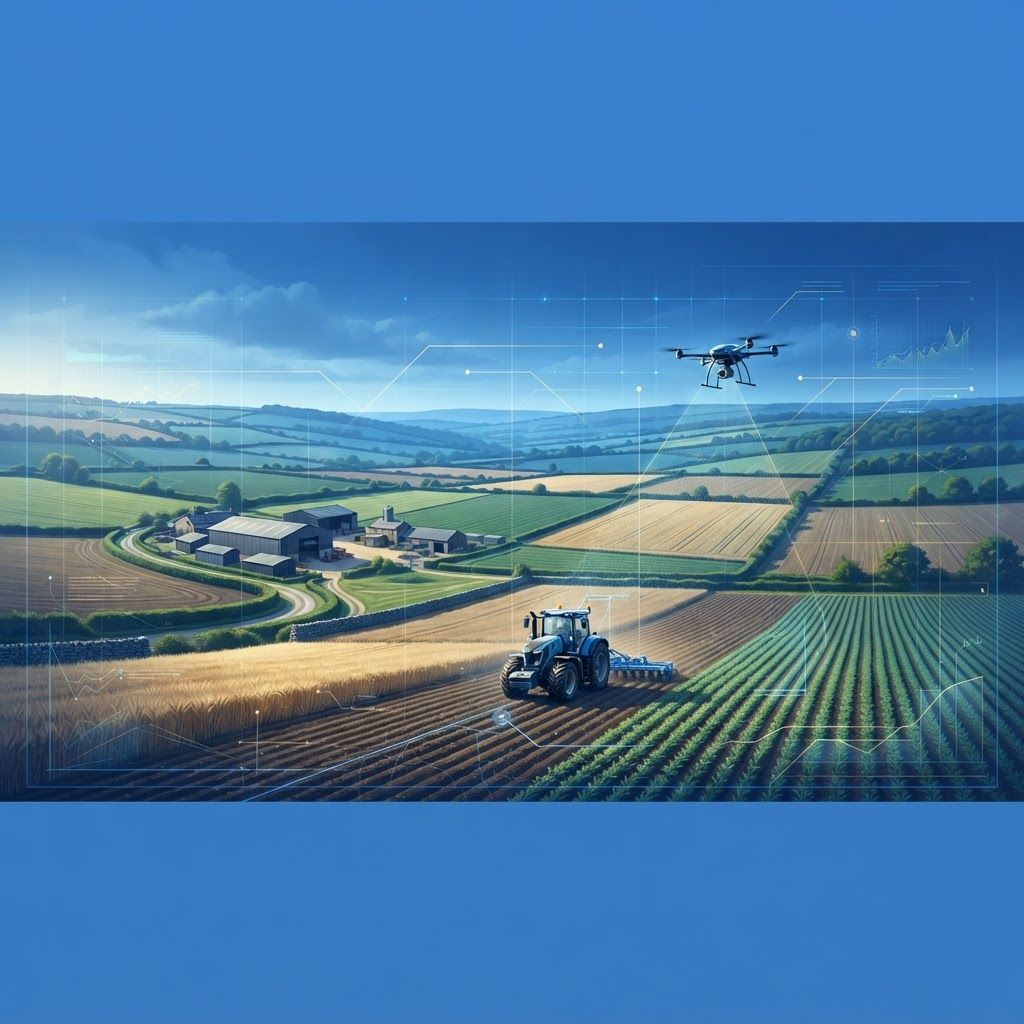
Wokingham is often described as a commuter town, but the borough's boundaries stretch into genuinely productive farmland. Between the Loddon valley, the villages of Arborfield, Barkham, Shinfield and Swallowfield, and the wider Berkshire countryside, agriculture remains a working industry rather than merely a scenic backdrop. Farms here operate under particular pressures: land values are high, development competes for acreage, and proximity to a large population creates both opportunity and constraint.
Agriculture in the Wokingham Borough
The predominant enterprises are arable cropping, grassland livestock and equestrian activity, complemented by horticulture, poultry and increasingly diversified rural businesses. Soils in the Loddon and Blackwater valleys vary from free-draining gravels to heavier clays, which influences cropping choices and drainage investment.
What genuinely distinguishes farming near Wokingham is market access. With hundreds of thousands of consumers within a short drive, farms can sell directly through farm shops, box schemes, farmers' markets and pick-your-own operations, capturing far more value than commodity supply chains allow. That same proximity brings challenges too, including public access pressures, fly-tipping, road congestion during harvest and planning complexity.
Top 10 Farming Companies Serving the Wokingham Area
1. Loddon Valley Arable Farms
Represents the large-scale cropping model, growing wheat, barley, oilseed rape and break crops across the river valley. Precision agriculture, variable-rate fertiliser application and GPS-guided machinery drive efficiency, while grain storage on farm allows more flexible marketing rather than selling at harvest prices.
2. Arborfield Livestock Company
A grassland-based beef and sheep enterprise using rotational grazing to improve pasture productivity and soil health. Livestock businesses in the area increasingly market direct to consumers through boxed meat sales, which improves margins and strengthens local provenance credentials.
3. Barkham Dairy Enterprises
Illustrates the dairy sector's continuing presence in Berkshire, with attention to herd health, milk quality and feed efficiency. Automation in milking and monitoring has improved both animal welfare oversight and labour productivity, which matters given persistent recruitment challenges in rural work.
4. Shinfield Market Gardens
Focuses on vegetables, salads and soft fruit for local sale, supplying farm shops, restaurants and box schemes. Short supply chains allow harvesting to order, extending shelf life and reducing waste while offering varieties that supermarkets rarely stock.
5. Swallowfield Estate Farming
Reflects the traditional mixed estate model, combining cropping, grazing, woodland management and let property. Diversified income streams give resilience against volatile commodity markets, and woodland management contributes both timber revenue and environmental benefit.
6. Emmbrook Poultry & Eggs
Produces free-range eggs and poultry for regional distribution. Biosecurity discipline, welfare standards and traceability underpin the operation, and demand for locally produced eggs has remained strong even as costs have risen.
7. Winnersh Equestrian & Grassland Co.
Serves the substantial local equestrian community with livery, grazing and forage production. Equestrian enterprise is a significant rural land use around Wokingham and provides steady income where conventional agriculture faces margin pressure.
8. Woodley Regenerative Farming Group
Adopts practices such as minimum tillage, cover cropping, diverse rotations and reduced chemical inputs to build soil organic matter. Interest in these methods has grown as farmers seek lower input costs alongside improved long-term resilience to drought and heavy rainfall.
9. Hurst Fruit & Orchards
Manages apple, plum and soft fruit production with associated pick-your-own and juice processing. Orchard businesses combine agriculture with visitor experience, generating seasonal income and building direct customer relationships.
10. Wokingham Agricultural Contractors
Provides contract cultivation, drilling, spraying, harvesting and baling services to farms that no longer justify owning full machinery fleets. Contracting has become essential infrastructure, spreading expensive equipment costs across multiple holdings.
Challenges Facing Local Farms
Cost volatility remains the dominant concern. Fertiliser, fuel, feed and energy prices have swung sharply, while output prices do not always follow. Labour availability is a persistent constraint, particularly for horticultural harvesting. Development pressure around Wokingham reduces available land and can fragment holdings, complicating rotations and machinery movement.
Weather variability adds further difficulty. Wetter autumns delay drilling while drier summers stress crops and grassland, pushing farms towards more resilient varieties, improved drainage and better water management. Public access, while positive for engagement, brings issues around dog control near livestock, litter and gate security.
Trends and Opportunities
Environmental land management schemes have created new income streams for habitat creation, hedgerow restoration and soil improvement, encouraging farms to view natural capital as a productive asset. Direct-to-consumer selling continues to expand, supported by strong local demand for provenance and freshness. Diversification into events, glamping, farm shops, cafés and educational visits generates non-agricultural revenue from existing buildings and land.
Technology adoption is accelerating too. Soil mapping, drone crop monitoring, livestock sensors and farm management software improve decision quality while documenting practices for assurance schemes. Renewable generation, including solar on building roofs and anaerobic digestion, reduces energy costs and adds income.
Conclusion
Farming around Wokingham is smaller in area than in more rural counties but sophisticated in its approach, blending arable and livestock production with horticulture, equestrian enterprise, contracting and direct sales. The businesses succeeding here treat proximity to a large urban population as an advantage, selling quality and provenance rather than competing purely on commodity scale. Supporting them keeps productive land in active management and keeps genuinely local food on Berkshire tables.
Want your brand featured in front of decision-makers? Publish a guest post or get a link insertion in our guides through AAMAX's guest post and link insertion service.
Helpful Links
 SponsoredAAMAX — Full-Service Digital Agency
Write for Us
Share your expertise with our readers. We welcome guest contributions from industry specialists.
Pitch your idea

