

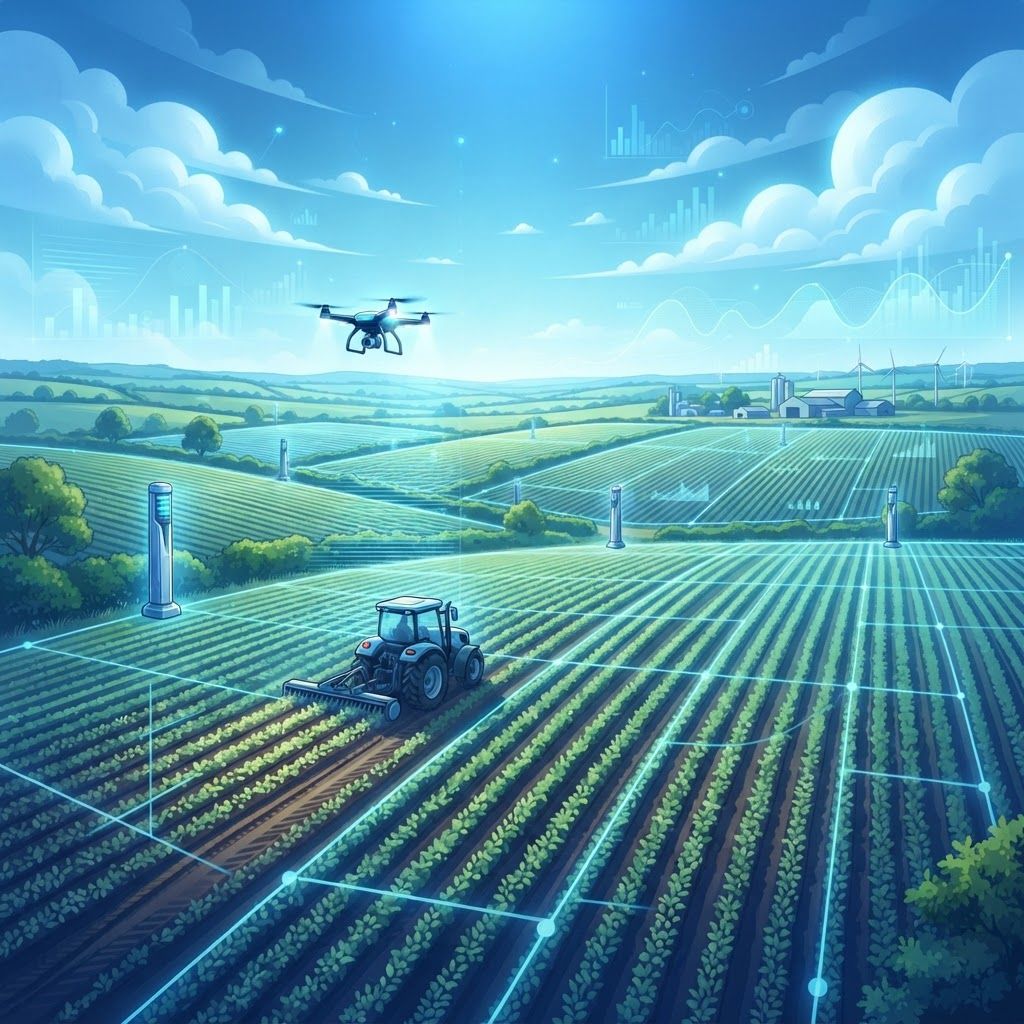
The Farming Landscape Around Warrington
Warrington is often characterised purely as a logistics and manufacturing town, which understates a genuine agricultural heritage that persists in the borough today. Move a short distance beyond the urban core and the landscape opens into the Cheshire Plain, some of the most productive dairy country in England. The combination of reliable rainfall, deep loam and clay soils and gently undulating grassland created the conditions for a dairy industry that has shaped the county's rural economy for centuries.
The borough's agricultural land sits in an unusual position. It is close enough to Manchester and Liverpool to access enormous consumer markets directly, which has encouraged farm diversification into retail, box schemes and hospitality. At the same time, urban proximity brings development pressure, higher land values and the practical challenges of farming alongside a growing population. Farms that have prospered here have generally done so by treating that proximity as an opportunity rather than a constraint.
Sectors That Define Local Agriculture
Dairy remains the dominant enterprise across the Cheshire Plain surrounding Warrington. Herd sizes have grown substantially over recent decades as smaller units consolidated, and the remaining businesses tend to be technically sophisticated operations managing grassland, forage quality and herd health with considerable precision. Arable cropping occupies the lighter and better-drained land, primarily wheat, barley, oilseed rape and forage maize, much of it feeding back into livestock rations.
Horticulture has a long history in the area, with market gardens historically supplying the industrial towns of the North West. That tradition survives in salad, brassica and soft fruit production, increasingly under protection to extend growing seasons. Livestock enterprises including beef finishing, sheep and a growing number of poultry units complete the picture, alongside equine businesses that benefit from proximity to a large population of horse owners.
Cheshire Plain Dairy Holdings
Among the more substantial dairy operations in the area, this business manages a large herd across several units with a strong emphasis on grassland productivity and forage self-sufficiency. Investment in robotic milking and herd monitoring technology has improved both animal welfare outcomes and labour efficiency. The business is known locally for its detailed approach to soil health and rotational grazing, which has reduced bought-in feed dependency.
Warrington Arable Farming Company
Operating combinable crops across a significant acreage of the borough's better land, this company grows wheat, barley and oilseed rape alongside forage crops contracted to neighbouring livestock farms. It has adopted variable rate application and controlled traffic farming to reduce input use and compaction, and it participates in environmental stewardship schemes that support field margins and overwintered stubbles for farmland birds.
Mersey Valley Livestock Farms
This beef and sheep enterprise finishes cattle on grass and home-grown forage across land in the Mersey valley, including areas of floodplain grazing that are unsuitable for cropping. The business supplies regional butchers and food service customers directly, and its emphasis on traceability and grass-fed provenance has allowed it to secure premium pricing outside commodity markets.
Bridgewater Market Gardens
Continuing the area's horticultural tradition, Bridgewater produces salad crops, brassicas, root vegetables and soft fruit for regional wholesale markets and its own farm retail operation. Protected cropping under polytunnels and glass extends the season considerably, and the business has invested in rainwater harvesting and precision irrigation to reduce mains water use during increasingly dry summers.
Latchford Family Farms
A mixed farming business spanning several generations, Latchford combines dairy, arable and diversified income from farm buildings let to local enterprises. This diversification has provided resilience through volatile commodity cycles. The farm is well regarded locally for hedgerow restoration and tree planting undertaken alongside commercial production.
Sankey Poultry and Egg Producers
Supplying free range eggs to regional retailers and food manufacturers, this producer operates housing designed around bird welfare with substantial ranging area and tree cover. On-farm grading and packing shortens the supply chain, and solar generation on shed roofs offsets a meaningful proportion of the operation's electricity demand.
Padgate Organic Farming Cooperative
Bringing together several smaller certified organic holdings, this cooperative markets vegetables, dairy and meat collectively, achieving scale that individual members could not reach alone. Shared machinery and joint marketing reduce costs, and the model has attracted attention as a route for smaller farms to remain viable in a consolidating industry.
Birchwood Agri Contracting and Farming
Combining its own farming operations with contracting services for neighbouring businesses, Birchwood provides silage harvesting, cultivation, drilling, slurry application and hedge management. Access to modern machinery through contracting allows smaller farms in the borough to benefit from equipment they could never justify purchasing, which improves timeliness and crop outcomes across the area.
Warrington Equine and Grassland Enterprises
Serving the substantial equine population around the borough, this business produces hay, haylage and straw alongside livery and grazing provision. Careful management of forage quality and consistency has built a loyal customer base among competition yards and private owners who cannot risk variable feed.
Grappenhall Heritage Farming
Rounding out the list, this business combines traditional mixed farming with agri-tourism, education visits and a farm shop. School visits and open days connect an urban population with food production, and the retail operation captures full value from farm output. It represents one of the clearest examples of how Warrington's farms have turned urban proximity into commercial advantage.
The Pressures Reshaping Local Agriculture
Farming around Warrington faces a demanding set of simultaneous changes. The transition away from area-based subsidy towards payment for environmental outcomes has fundamentally altered farm income structures, rewarding businesses that can deliver measurable environmental benefit alongside food production. Input cost volatility, particularly in fertiliser and energy, has squeezed margins and accelerated interest in nutrient efficiency, manure management and legume-based nitrogen.
Climate variability is increasingly practical rather than theoretical. Wetter autumns compress drilling windows and increase soil damage risk, while drier summers stress grassland and increase irrigation demand in horticulture. Farms are responding with improved drainage, greater forage reserves, more resilient crop rotations and increased water storage. Labour availability remains a persistent constraint, particularly in horticulture, pushing investment towards mechanisation and automation.
Opportunity in Proximity
What sets Warrington's farming businesses apart is the market on their doorstep. A farm here can sell directly to hundreds of thousands of consumers within a short distance, supply restaurants and independent retailers across two major cities, and host visitors who would travel much further for the same experience. Businesses that have built retail, hospitality, education or subscription box operations alongside primary production have generally proved the most resilient.
Renewable energy and natural capital markets add further potential. Anaerobic digestion, solar generation, tree planting and habitat creation all offer income streams that complement rather than replace farming. As biodiversity net gain requirements bite on development in and around a growing town, land managers with capacity to host habitat creation may find themselves in an unusually strong negotiating position.
Looking Forward
The likely direction for agriculture around Warrington is fewer, larger and more technically capable farming businesses, complemented by a resilient tier of smaller diversified enterprises serving local markets directly. Both models can work. What will not work is standing still, and the farms profiled here are notable precisely because they have adapted their businesses to the borough's particular combination of good land, real pressure and an enormous nearby market.
Want your brand featured in front of decision-makers? Publish a guest post or get a link insertion in our guides through AAMAX's guest post and link insertion service.
Helpful Links
 SponsoredAAMAX — Full-Service Digital Agency
Write for Us
Share your expertise with our readers. We welcome guest contributions from industry specialists.
Pitch your idea

