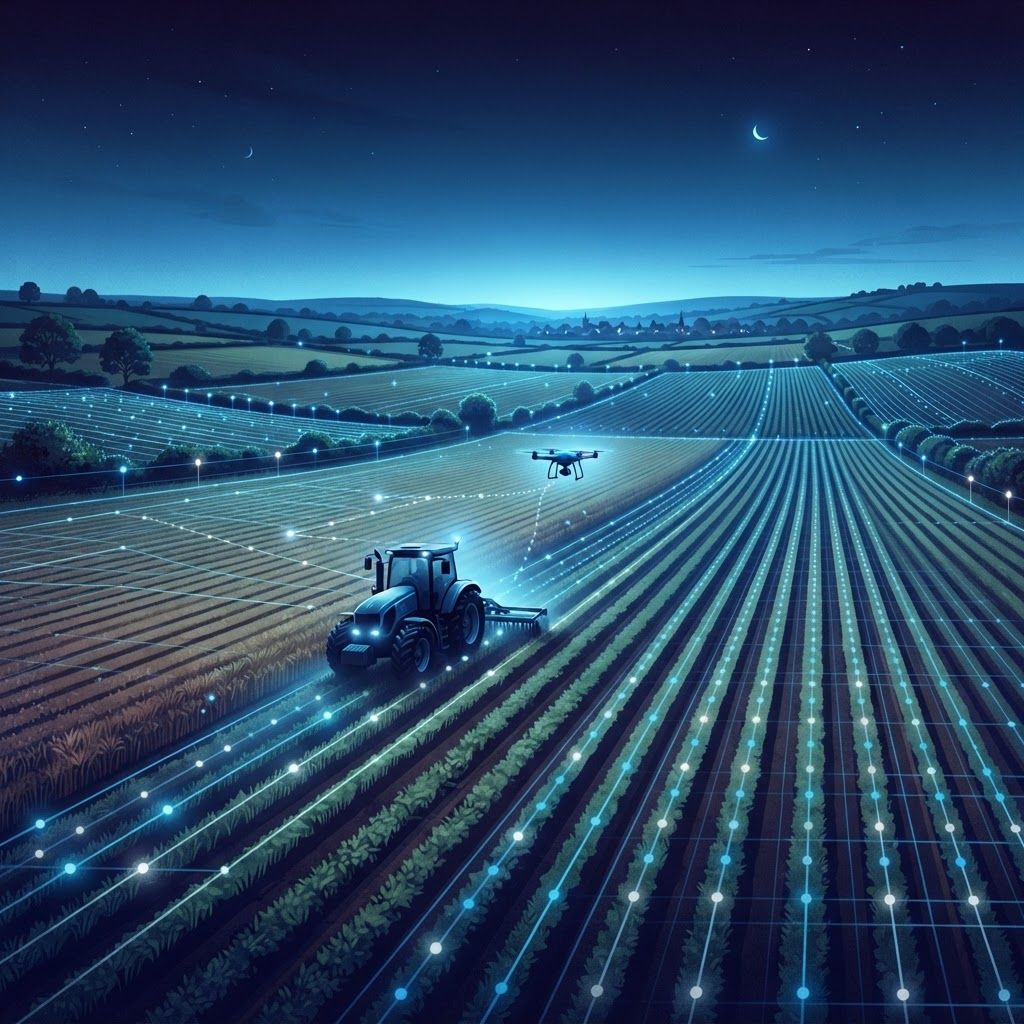
Farming on Swindon's Doorstep
Swindon is often described in terms of railways, offices and distribution parks, but drive fifteen minutes in almost any direction and the picture changes entirely. The town is ringed by productive farmland: the chalk downland of the Marlborough Downs to the south, the clay vales towards Cricklade and the Cotswold Water Park to the north, and mixed farming country stretching west towards the Cotswold escarpment. Agriculture remains a defining industry of the wider Wiltshire economy and an important part of Swindon's identity as a market town that grew into a manufacturing centre.
The farming businesses operating around Swindon are diverse. Arable enterprises grow wheat, barley, oilseed rape and increasingly pulses and cover crops on the lighter downland soils. Dairy and beef units make use of heavier grassland to the north. Sheep farming persists across the downs, often integrated with arable rotations. Alongside these sit horticulture, egg production, contract farming operations and a growing number of diversified businesses combining food production with tourism, renewable energy, equestrian facilities and farm retail.
What Defines a Well-Run Farming Business Today
Modern farm management is a technical, data-heavy discipline. Soil health monitoring, variable-rate application, GPS-guided machinery, integrated pest management and detailed gross-margin analysis per field are standard practice on well-run units. The gap between the top and bottom performers in UK agriculture is driven far more by management quality than by land quality.
Resilience is the other defining characteristic. Farm incomes are exposed to weather, commodity markets, input costs and policy change simultaneously. The businesses that thrive around Swindon tend to spread that risk: multiple enterprises, forward contracting on some output, diversified income streams and careful control of fixed costs, particularly machinery.
Environmental performance is no longer separable from commercial performance. With public support increasingly tied to environmental outcomes, and with buyers and lenders asking for carbon and biodiversity data, farms that measure and improve their natural capital are positioning themselves for the next decade rather than defending the last one.
Ten Leading Farming Companies and Agricultural Businesses
1. Velcourt. One of the UK's largest farm management companies, Velcourt manages substantial arable and mixed acreages on behalf of landowners, including holdings across the wider Wiltshire and Thames Valley area. Its reputation rests on professional agronomy, rigorous benchmarking and research-led decision making, making it a reference point for large-scale arable management.
2. Wiltshire Wildlife Trust farming partnerships. Working with landowners across the county, the Trust has become an influential force in nature-friendly farming, advising on habitat creation, water quality and regenerative practice. For farms near Swindon dealing with river catchment sensitivities, this expertise carries real practical weight.
3. Arla Foods (farmer-owned cooperative). Many dairy farms in the countryside around Swindon supply milk through cooperative structures, and Arla is one of the most significant. As a farmer-owned business it gives producers a route to market, contractual stability and access to sustainability incentive schemes that reward reduced emissions and improved animal welfare.
4. Frontier Agriculture. The UK's largest crop production and grain marketing business, Frontier is central to how arable output from the Swindon area reaches millers, maltsters and feed compounders. Its agronomy service, seed supply and grain pooling arrangements make it a key commercial partner for local growers.
5. Openfield. As a farmer-owned grain marketing cooperative, Openfield gives arable businesses collective bargaining strength and access to storage and logistics infrastructure. For growers on the downs, pooled marketing can smooth the extreme price volatility of recent harvests.
6. Wynnstay Group. A major agricultural supplies and feed business, Wynnstay serves livestock and arable farms with animal nutrition, fertiliser, seed and on-farm advice. Its technical field teams are valued for practical, farm-specific guidance rather than generic recommendations.
7. ForFarmers UK. Specialising in animal nutrition, ForFarmers supports dairy, beef and sheep enterprises with ration formulation and feed efficiency programmes. With feed representing the largest variable cost on most livestock units, this expertise translates directly into margin.
8. Agrii. Agrii combines agronomy advice with input supply and an extensive trials network, helping growers select varieties and manage crop protection under real local conditions. Its regional trial data is particularly useful given how much soil type varies within a short distance of Swindon.
9. Cotswold Seeds. Based nearby and highly regarded for grass, herbal ley, cover crop and green manure mixtures, Cotswold Seeds has become closely associated with the regenerative and mixed-farming movement. Farms integrating livestock back into arable rotations rely heavily on this kind of specialist knowledge.
10. Yeo Valley (organic farming and supply partnerships). As one of the best-known organic dairy businesses in the South West, Yeo Valley has helped build a viable market for organic milk. Its farming standards and grower relationships have influenced organic and low-input practice well beyond its own holdings.
Trends Reshaping Agriculture Around Swindon
Policy transition is the largest single change. The move away from area-based subsidy towards payments for environmental outcomes has fundamentally altered farm business planning. Schemes rewarding soil management, habitat creation, nutrient management and public access are now a meaningful revenue line, and farms that engaged early have adapted more comfortably than those that delayed.
Regenerative practice has moved from the margins to the mainstream. Reduced cultivation, cover cropping, longer rotations, herbal leys and reintegrated grazing are increasingly common on Swindon-area farms, driven by rising fertiliser and fuel costs as much as by environmental conviction. The commercial logic of building soil organic matter is now widely accepted.
Diversification continues apace. Farm shops, glamping, equestrian livery, solar arrays, anaerobic digestion, event venues and direct-to-consumer meat and vegetable boxes all appear across the district. Swindon's population of around a quarter of a million people provides a substantial local customer base within easy reach, which makes direct selling far more viable here than in remoter rural areas.
Technology adoption is accelerating. Satellite imagery, soil scanning, autonomous machinery trials, precision livestock monitoring and farm management software are all in active use. The constraint is rarely the technology itself but the time and skill needed to turn data into decisions.
Looking Ahead
Farming around Swindon faces genuine pressures: climate volatility, labour availability, development on the urban fringe and thin margins in several sectors. Yet the fundamentals are strong. The land is productive, the location gives excellent access to markets and processing, and the local farming community has shown a real willingness to adopt new practice.
For anyone buying, supplying or partnering with agricultural businesses in the area, the advice is consistent: look for operators who measure their performance, spread their risk, invest in soil, and treat environmental improvement as a business strategy rather than an obligation. Those are the farms that will still be producing food on Swindon's doorstep a generation from now.
Want your brand featured in front of decision-makers? Publish a guest post or get a link insertion in our guides through AAMAX's guest post and link insertion service.
Helpful Links
 SponsoredAAMAX — Full-Service Digital Agency
Write for Us
Share your expertise with our readers. We welcome guest contributions from industry specialists.
Pitch your idea