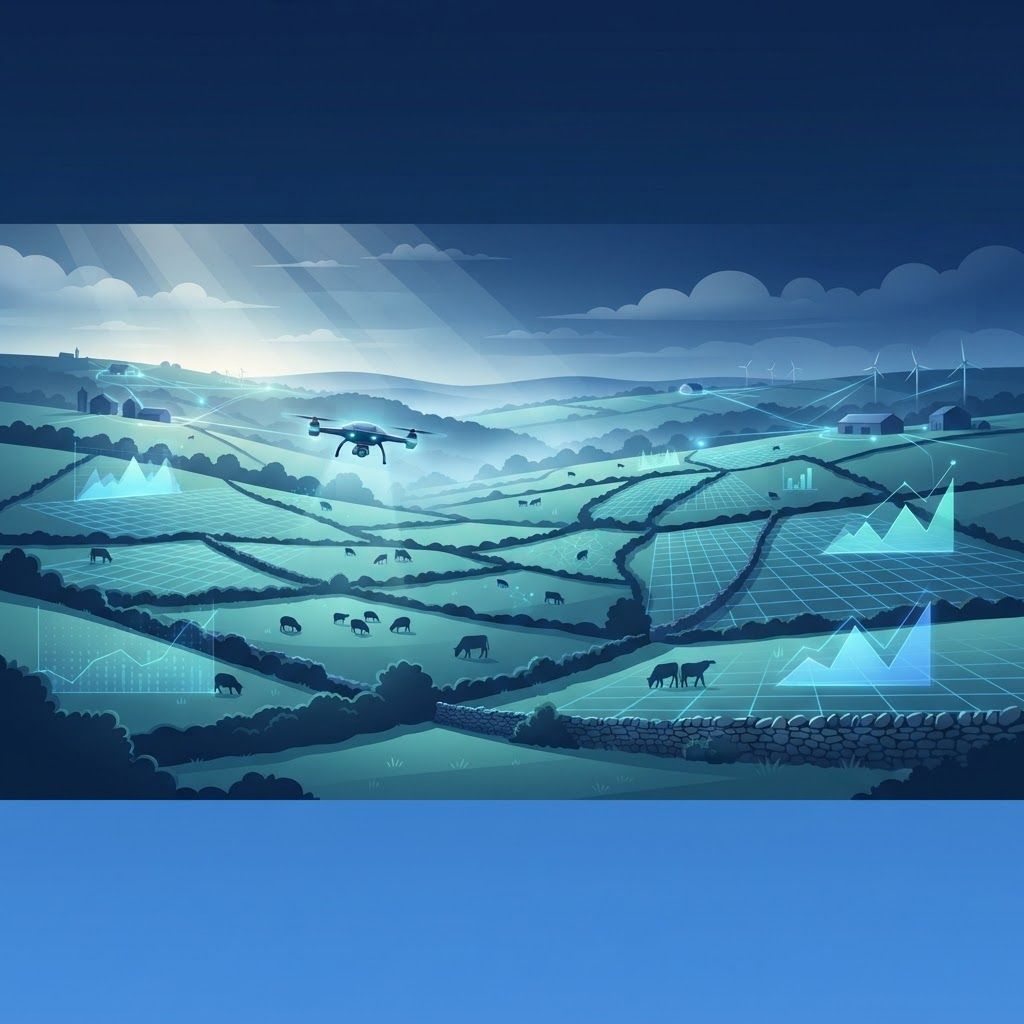
Agriculture Around Swansea: A Distinctive Landscape
Swansea is often described purely as a coastal city, but step a few miles beyond its centre and agriculture dominates. The Gower Peninsula, the UK's first designated Area of Outstanding Natural Beauty, is a patchwork of livestock farms, commons grazing, hay meadows and coastal pasture. To the north, the Swansea Valley and the fringes of the Brecon Beacons support upland sheep and beef systems. Closer to the city, smaller holdings and market gardens supply restaurants, farm shops and weekly markets.
This proximity between farm and city creates unusual opportunities. Producers can sell directly to Swansea's restaurants, delis and residents without long supply chains, capturing more value and building genuine local reputation. It also creates responsibilities: farms on the Gower operate within protected landscapes and near sensitive coastal habitats, which shapes how land, livestock and nutrients are managed.
The Structure of Local Farming
Welsh agriculture is dominated by grassland, and the Swansea area is no exception. Sheep and beef production suit the climate, rainfall and topography, with grass-based systems making efficient use of land that would be unsuitable for arable cropping. Dairy is present, particularly on lower, more sheltered ground. Horticulture is a smaller but growing segment, driven by demand for local vegetables, salads and soft fruit.
Farm businesses here are typically family-run, often across several generations, and increasingly diversified. Holiday cottages, campsites, farm shops, cafés, livery, contracting and renewable energy generation frequently sit alongside food production, spreading risk across multiple income streams. This diversification has become a defining feature of resilient farms in the region.
Top 10 Best Farming Companies in Swansea
1. Gower Salt Marsh Lamb Farms — A group of Gower producers whose lambs graze the tidal salt marshes of the north Gower coast, producing meat with a distinctive flavour recognised for its regional character. Their approach combines traditional common grazing with careful habitat management.
2. Llanrhidian Livestock Company — A long-established beef and sheep enterprise focused on grass-fed production and pasture management. Known for consistent stock quality and participation in local livestock markets and breed improvement programmes.
3. Fairwood Valley Dairy — A dairy operation producing milk from grazing herds on lower Gower pasture, supplying processors and local outlets. Emphasis on herd health, low-input grazing rotations and efficient milk-from-forage performance.
4. Clyne Farm Enterprises — A diversified farm business combining livestock with visitor activities and hospitality on the western edge of Swansea. A strong example of how agricultural land and tourism can be integrated without compromising farming operations.
5. Penclawdd Coastal Farms — Operating close to the Loughor estuary, this business blends livestock rearing with cockle-gathering heritage and estuary land management, reflecting the unusual mix of farming and shellfish traditions in the area.
6. Swansea Valley Upland Graziers — Focused on hill sheep production north of the city, with hardy breeds suited to exposed upland conditions. Their work includes managing common grazing rights and habitat schemes on higher ground.
7. Mawr Community Farming Co-operative — A collaborative venture among smaller holdings in the Mawr area, sharing machinery, contracting and marketing. Co-operative models like this help small farms access equipment and buyers that would otherwise be out of reach.
8. Bishopston Market Garden — A horticultural producer growing vegetables, salads and soft fruit for Swansea restaurants, box schemes and markets. Their focus on soil health, succession planting and short supply chains suits the city's growing appetite for local produce.
9. Llangyfelach Arable & Forage — Concentrated on forage crops, silage and cereals to support livestock systems across the region, alongside contracting services for harvesting and slurry management. A key link in the local feed supply chain.
10. Gower Organic Growers — A certified organic producer combining vegetables, poultry and mixed livestock with agroecological practices such as rotation, composting and hedgerow restoration. Popular with farm shops and consumers seeking certified organic Welsh produce.
Trends and Pressures in Welsh Farming
Agricultural policy in Wales has shifted decisively towards paying for environmental outcomes alongside food production. Farms are increasingly rewarded for habitat creation, tree planting, water quality improvements and carbon storage, which changes business planning significantly and requires new record-keeping and advisory support.
Regenerative practices are gaining ground for both environmental and economic reasons. Rotational and mob grazing, multi-species swards, reduced fertiliser dependence and improved soil organic matter can lower input costs while improving drought resilience — an increasingly relevant consideration as weather patterns become less predictable.
Technology adoption continues steadily. Electronic identification for livestock, GPS-guided machinery, soil and nutrient mapping, remote water monitoring and farm management software are now common even on modest holdings, improving both compliance and decision-making.
Direct selling remains one of the strongest opportunities near a city. Farm shops, box schemes, restaurant supply and farmers' markets allow producers around Swansea to capture retail margins and build direct relationships with customers who value provenance.
Working With Local Farming Businesses
For chefs, retailers and food producers in Swansea, sourcing locally requires understanding agricultural rhythms. Lamb, beef, vegetables and soft fruit all have seasons, and menus or ranges built around availability work better than fixed specifications that force imports. Talking to farmers months ahead about planting or stocking plans often unlocks better supply than placing last-minute orders.
Fair terms matter. Agriculture operates on thin margins and long production cycles, so prompt payment, realistic volume commitments and honest forecasting are genuinely valuable to producers. Buyers who provide that reliability tend to receive priority when supply is tight.
For those entering farming or expanding a holding, the region offers strong support networks: agricultural societies, young farmers' organisations, co-operatives and advisory services all operate actively across South and West Wales. Engaging with them accelerates learning and opens routes to shared machinery, contracting and market access.
Ultimately, farming around Swansea succeeds by combining tradition with adaptation. The salt marshes, commons and valley pastures have supported food production for centuries, and the businesses thriving today are those pairing that inherited knowledge with modern environmental and commercial thinking.
Want your brand featured in front of decision-makers? Publish a guest post or get a link insertion in our guides through AAMAX's guest post and link insertion service.
Helpful Links
 SponsoredAAMAX — Full-Service Digital Agency
Write for Us
Share your expertise with our readers. We welcome guest contributions from industry specialists.
Pitch your idea